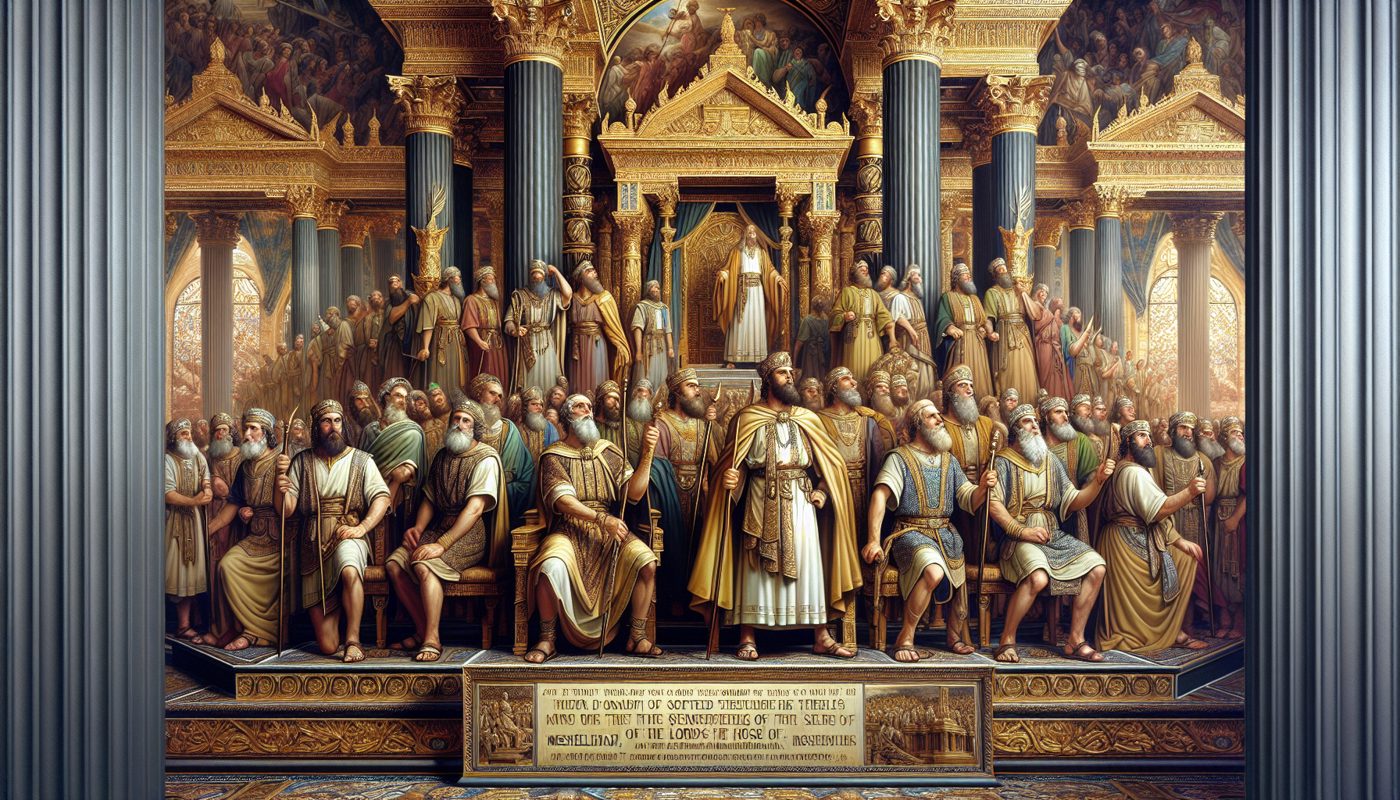
This chapter does not pause to tell stories. It is a registry of names, assignments, and numbers, and it expects the reader to see the weight of order in the house of the Lord. David and the leaders are finishing the work of organizing the Levites, and here the focus narrows to the doorkeepers, the treasurers, and the officers who handled the outward business of Israel. Nothing in this chapter is accidental, and nothing is left to personal ambition.
The doorkeepers came from the Korahites and the Merarites. Meshelemiah, son of Kore, of the sons of Asaph, heads one list. His seven sons are named in order: Zechariah, Jediael, Zebadiah, Jathniel, Elam, Jehohanan, and Eliehoenai. There is no description of their character beyond their place in the lineage. They are simply the men who will stand at the gates.
Obed-edom had eight sons, and the text adds a brief note: God blessed him. That blessing appears in the number of sons and in the fact that Shemaiah, his firstborn, had sons who ruled over the house of their father because they were mighty men of valor. The list of Shemaiah’s sons follows: Othni, Rephael, Obed, Elzabad, Elihu, and Semachiah. All told, the sons of Obed-edom numbered sixty-two able men in strength for the service. Meshelemiah’s house supplied eighteen valiant men. Hosah, of the children of Merari, had thirteen sons and brethren, with Shimri made chief though he was not the firstborn.
These men were not assigned by personal preference or family size alone. They cast lots, small and great alike, for every gate. The lot eastward fell to Shelemiah. For Zechariah, described as a discreet counsellor, the lot came out northward. Obed-edom received the southward gate, and his sons were given the store-house. Shuppim and Hosah took the westward gate, by the gate of Shallecheth at the causeway that goes up, watch against watch. The numbers for each post were precise: six Levites eastward, four northward each day, four southward, and two and two for the store-house. At Parbar westward, four at the causeway and two at Parbar. The doorkeepers served by course, and their offices mirrored the ministry of their brethren in the house of the Lord.
The chapter then shifts to the treasures. Ahijah was over the treasures of the house of God and over the treasures of the dedicated things. The sons of Ladan the Gershonite, particularly Jehieli and his sons Zetham and Joel, had charge of the treasures of the house of the Lord. From the Amramites, Izharites, Hebronites, and Uzzielites came Shebuel, the son of Gershom and grandson of Moses, who ruled over the treasures. The line of Eliezer produced Rehabiah, Jeshaiah, Joram, Zichri, and Shelomoth, and this Shelomoth and his brethren were over all the treasures of the dedicated things.
What had been dedicated? The spoil won in battles, dedicated by David, the heads of fathers’ houses, the captains over thousands and hundreds, and the captains of the host. The purpose was clear: to repair the house of the Lord. Even Samuel the seer, Saul the son of Kish, Abner the son of Ner, and Joab the son of Zeruiah had dedicated things, and all of it came under the hand of Shelomoth and his brethren. The treasury was not a private store; it was a record of what Israel had consecrated from war and from devotion.
Finally, the chapter records the officers and judges for the outward business of Israel. Of the Izharites, Chenaniah and his sons were appointed for this work. Of the Hebronites, Hashabiah and his brethren, men of valor numbering a thousand seven hundred, had the oversight of Israel beyond the Jordan westward, for all the business of the Lord and for the service of the king. In the fortieth year of David’s reign, the Hebronites were sought out, and at Jazer of Gilead they found mighty men of valor. Jerijah was chief among them. With his brethren, two thousand seven hundred heads of fathers’ houses, David made them overseers over the Reubenites, the Gadites, and the half-tribe of Manasseh, for every matter pertaining to God and for the affairs of the king.
What emerges from this chapter is a kingdom where worship and administration are woven together. The doorkeepers stood at their posts by lot, not by favor. The treasurers kept what the nation had dedicated, from the spoils of battle to the gifts of seers and kings. The officers judged and managed the tribes across the Jordan. Every man had his place, and every place had its task. The house of the Lord required not only priests and singers but gatekeepers and accountants and regional overseers. The chapter offers no drama, only the quiet assertion that the work of God includes the work of order.
Comments
Comments 0
Read the discussion and add your voice.
Members only
Sign in to join the conversation
We keep comments tied to real accounts so the discussion stays clean and trustworthy.
No comments yet. Be the first to add one.