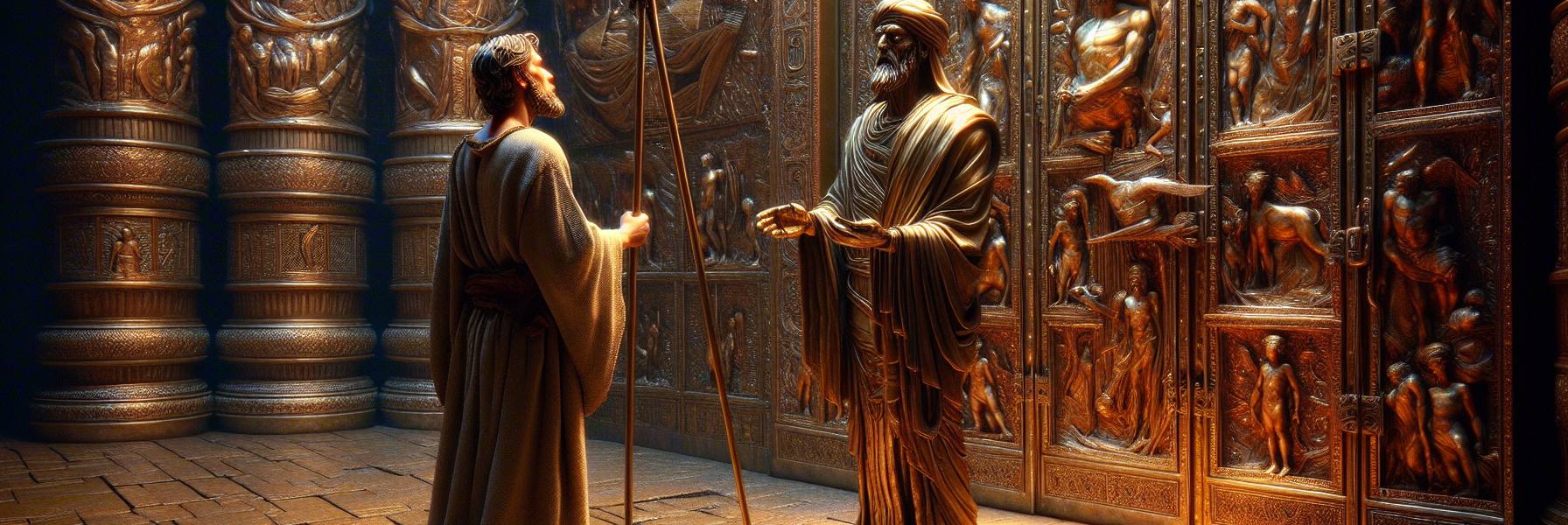

The hand was on my shoulder again, this time not to lift me, but to turn me. I felt the solid warmth of it through the worn linen of my robe. The man—the one whose appearance was like bronze, who had been measuring with a line of flax and a rod—stood beside me, and without a word, he pivoted me away from the inner courts, from the altars and the gates, and faced me toward the east.
“Come,” he said, his voice low like stones grinding deep in the earth. And I went.
We walked back through the outer court, past the silent, gleaming walls, until we stood once more at the eastern gate. But the gate was shut. I remembered it from before, a massive, sealed thing. Yet as we approached, I heard not a creak of hinge, but a sound like a sigh, and the doors, of their own accord, parted just enough for us to pass. We stepped through, and they closed behind us with a final, soft thud.
Outside, the morning sun was harsh, bleaching the rocky ground. The Kidron valley lay before us, a dry, gasping scar in the land. I squinted, expecting dust, thorns, the bones of dead shrubs. But the man led me forward, a dozen paces, maybe twenty, and then he stopped. He pointed with his measuring rod.
“Look,” he said.
At first, I saw nothing. Just the same pale, cracked earth. Then, a glint. A trembling in the air at the threshold of the gate, right where the great doors met the foundation. Not a trickle, not a seep. It was as if the stone itself was weeping, but weeping a clear, living silver. Water was issuing from under the threshold of the temple, from the south side of the altar, a silent, purposeful birth. It didn’t gush; it flowed, steady and insistent, a stream the width of a man’s hand, moving eastward. The sight was so utterly foreign—water, here, from the house of God—that I simply stared, my mouth dry.
He took me then, measuring rod in hand, and we began to walk alongside this newborn stream. It carved a shy path in the dust. After a thousand cubits, he halted, waded into the water—it was only ankle-deep—and looked at me.
“Son of man, have you seen this?”
I nodded, unable to speak. A thousand cubits further, he measured again, and made me pass through. Now the water was up to my knees, cool and shocking against my skin. It made a gentle, chuckling sound around my legs. Another thousand, and it was a river, rising to my waist. I could feel its current now, a firm, silent pull eastward, toward the dead plains and the salt sea.
But he did not stop. Another thousand. And here, he stepped in ahead of me, and the water took him. He turned, and his expression was unreadable. “It is time to cross,” he said.
I stepped forward. The riverbed fell away. The clear water surged to my chest, then my throat. I am not a young man, and the journey had been long. For a moment, panic, cold and sharp, seized me. I was a priest, not a swimmer. My feet sought purchase and found none. The current had me. I flailed, went under, came up sputtering. The water was in my eyes, my ears. I was no longer walking; I was being carried. I could see the bronze man ahead, moving with the current, waiting. I fought for a breath, and in that struggle, I understood. This was not a thing to be measured by a rod anymore. This was a thing to be surrendered to.
I stopped fighting. I let the water take my weight. And I swam.
He led me back to the bank, further down, where the ground rose. I crawled out, dripping and heaving, the taste of the water on my lips—clean, with a faint, sweet hint of minerals, like rain on mountain stone. My clothes clung to me, heavy. He stood on the bank, looking back the way we had come.
“Return now,” he said, “to the bank of the river.”
We walked back along the lush line that was already appearing beside the stream. Green was unfurling on the dead ground, a narrow ribbon of life. When we stood again on the bank, he swept his arm out, encompassing the widening flow.
“Everything that lives, wherever the river goes, will live.”
And as he spoke, I saw it. Not in a flash, but in a slow, dawning realization as my eyes followed the water’s path. Trees were springing up on both banks. Not the scrub oaks of the hills, but trees I did not know, trees of great stature and broad leaf. Their leaves did not wither. Even as I watched, their boughs seemed to swell with the promise of fruit. Not one season of fruit, but a new crop every month. The fruit was for food, he said, and the leaves were for healing. The very leaves.
He turned me toward the east, toward the grim, white rim of the Arabah, toward that place of utter death: the Salt Sea.
“This water flows down toward the eastern region,” he said, “and goes down into the Arabah, and enters the sea. When it enters the salt waters, the waters become fresh.”
I knew that sea. I had seen its white, bitter shores from the heights of Moab in another life. Nothing lived in it. It was a jar of God’s wrath, a basin of sterility. The thought of this sweet, temple-born river pouring into that stagnant bitterness was too vast, too glorious to hold in my mind.
“And so,” he continued, his voice painting the vision upon the barren air, “wherever the river goes, every living creature that swarms will live. Fishermen will stand beside it. From En-gedi to En-eglaim, it will be a place for spreading nets. Its fish will be of very many kinds, like the fish of the Great Sea.”
I closed my eyes and saw it: not a vision from above, but from within. I smelled the damp wood of fishing boats, heard the slap of wet nets on water, the calls of men at work. I saw the silver flicker of life in the sun-dappled current. I saw the trees, heavy with perpetual fruit, their shade deep and cool. All of it, a great, swelling chord of life emanating from a single, silent source under a temple threshold.
“But the swamps and marshes,” he said, and his tone did not change, “they will not become fresh. They will be left for salt.”
Even in this deluge of life, a place for salt. A reminder. A preservative. The judgment was not undone, but it was bounded. Life was the new dominion.
He turned to face me fully then, and in his eyes was a final, staggering weight of promise.
“The land along the river, on both banks, will belong to the Lord who brought you back. It is for food, and for inheritance. And the borders you have known will shift. The tribes will have their portions, from the north sea to the east sea. I, the Lord, have spoken.”
The hand left my shoulder. The sound of water filled my ears, a sound that would not leave me. I stood alone on the bank of the impossible river, the hem of my robe dark with its moisture, the taste of its sweetness still on my tongue. The temple behind me was silent, a geometry of holiness. But from its very heart, from under its door, life was pouring out, unconquerable, deepening, until it could only be swam in, not walked through, on its way to make the dead sea live.
And I, Ezekiel, priest in exile, covered in the dust of Babylon and the water of God, knew then that the curse was not the final word. The final word was a sound like many waters, and it was flowing east, toward everything we had ever lost.