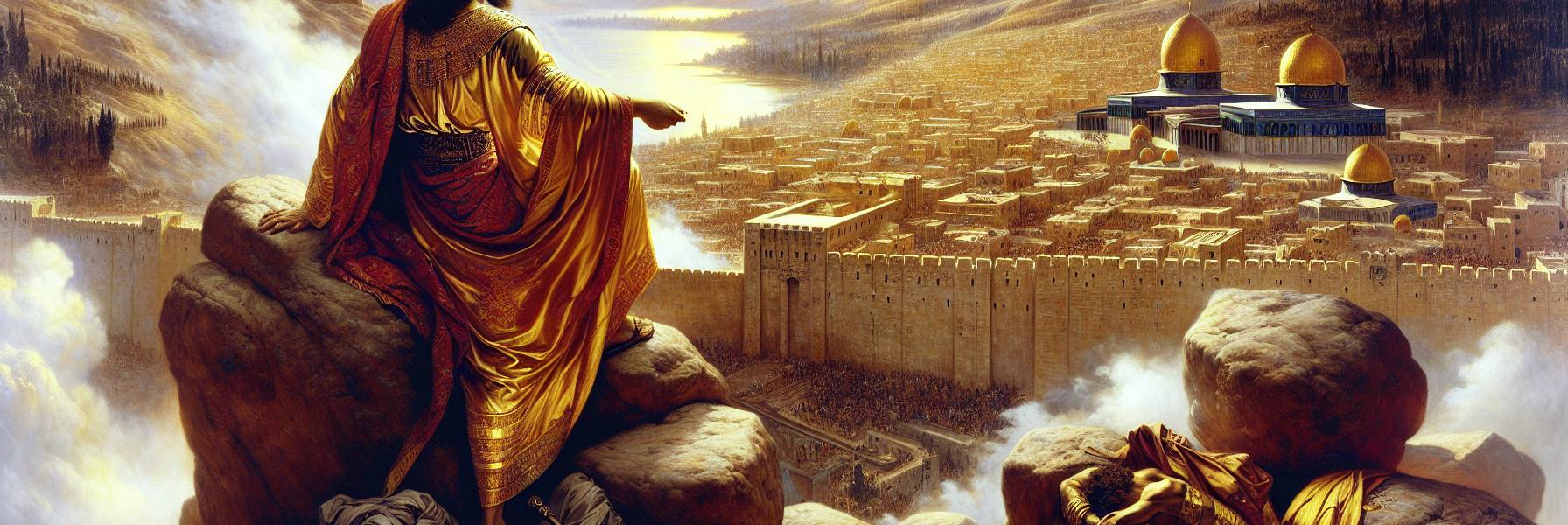

The heat in Jerusalem that summer was a thick, woolen blanket. It lay over the city from the hard, white dawn until the stars emerged, cool and distant. Solomon, feeling the weight of it on his royal robes, would often climb to the high place at Gibeon, not to sacrifice now, but to think. The silence there was different from the palace clamor; it was a silence where a man could hear the echo of a promise.
His father’s dying words were etched into him, not as a gentle memory, but as a charge that vibrated in his bones. *He shall build a house for my name.* David’s passion for it, the plans drawn with a trembling hand, the stockpiles of gold and bronze and cedar—all of it was a legacy that felt, at times, like a mountain on Solomon’s shoulders. He was a king of peace, yes, but this peace was not passive. It was for this.
He returned to the palace, to the room where his father’s scrolls and sketches were kept. The air was close, smelling of papyrus and ink. He unrolled a great sheet, the corners held down by polished stones. Lines for foundations, ratios for pillars, chambers for priests. It was magnificent, precise, and utterly insufficient. It was a structure of stone and timber. What he had to build was a dwelling.
The word turned in his mind. A dwelling. Not for God, who the heavens could not contain, but for His Name. A place where the covenant would be centered, where the smoke of atonement would rise, where Israel would remember and be remembered. The theology of it was a fire in his belly. The logistics were a knot in his gut.
He called for his scribes. “A letter,” he said, and the men dipped their pens. He did not speak in the florid, diplomatic language of Pharaohs or eastern kings. His words, dictated slowly, were those of a man stating a solemn fact.
“To Huram, king of Tyre. As you dealt with David my father, sending him cedars to build his house to dwell in, so deal with me.”
He paused, looking out the window at the sun-baked hills. This was not mere trade. It had to be more. “Behold, I am about to build a house for the name of the LORD my God, to dedicate it to Him, for the burning of incense of sweet spices before Him, for the regular arrangement of the showbread, and for burnt offerings morning and evening, on the Sabbaths and the new moons and the appointed feasts of the LORD our God. This is ordained for Israel forever.”
The scribes scratched diligently. Solomon leaned forward. “The house I will build must be great, for our God is greater than all gods. But who is able to build Him a house, since heaven, even highest heaven, cannot contain Him? Who am I to build Him a house, except as a place to burn incense before Him?”
There it was. The core of it. A humble confession wrapped around an unshakable commission. He was not confining God; he was fulfilling a command. The tension was holy.
Then, the practicalities. He needed a master craftsman. Not just any artisan. “Send me now a man skilled to work in gold, silver, bronze, iron, and in purple, crimson, and blue fabrics, and who can engrave. He will work with my skilled men, and with those of my lord David.” *My lord David.* He still called him that. The respect was a thread tying the generations.
And the materials. The list poured out, a king’s ransom in natural wealth. “Cedar, cypress, algum timber from Lebanon. I know your servants are skilled at cutting timber. My servants will work alongside them, to prepare timber in abundance, for the house I will build will be great and wonderful.”
He knew the commercial mind of Tyre. So he stated the terms plainly. “I will give your servants, the woodsmen who cut the timber, twenty thousand cors of crushed wheat, twenty thousand cors of barley, twenty thousand baths of wine, and twenty thousand baths of oil.”
The scribes’ eyes widened slightly at the quantities. Solomon’s voice was steady. It was not a payment; it was provisioning for a sacred, collaborative work. A nation of farmers would feed a nation of woodsmen, so that together they might raise a house for the God of both.
The letter was sealed and sent with a royal envoy, winding its way down to the coastal plain and north along the Great Sea. Days passed, then weeks. The heat did not break. Solomon oversaw the marshaling of his own labor force – not slaves, but a levy of resident aliens, a vast, organized multitude. The clatter of preparation began: quarries being scouted, roads cleared, storehouses built. Jerusalem hummed with a new kind of energy, the anxious, hopeful buzz before a storm.
Then, the reply came.
Huram’s messenger stood in the throne room, reading from a scroll in a clear, Phoenician-accented Hebrew. “Because the LORD loves His people, He has made you king over them.”
Solomon felt a chill, despite the heat. The pagan king of Tyre was speaking theology.
Huram praised the wisdom and discernment of David’s son. He agreed to all the terms. “I am sending a skilled man, endowed with understanding: Huram-Abi.” The description was of a master of all mediums, a man whose skill was born of divine wisdom—*the son of a Danite woman and a Tyrian father*. A hybrid. A man of two worlds, perfect for a task that bridged heaven and earth.
“The wheat, the barley, the oil, and the wine which you have spoken of, my lord, let that be sent to your servants. We will cut whatever timber you need from Lebanon and bring it to you in rafts by sea to Joppa. You will only have to take it up to Jerusalem.”
The deal was struck. Solomon dismissed the messenger and walked again to the high place at dusk. Below, the city was a bowl of shadows and torchlight. To the north, in the distant, darkening Lebanon ranges, axes would soon be biting into ancient bark. To the west, on the sea, rafts of mighty logs would bob on the swells.
He felt the immensity of it all. The gears of kingdoms were turning, the labor of thousands was being summoned, the wealth of nations tapped, all for a single, silent, empty space where the Ark would one day rest. It was foolishness. It was the only thing that made sense.
The stars appeared again, cold and clear. The promise was moving from parchment to stone. The dwelling for the Name was no longer just a dream in a dusty room. It was a cut in a mountainside, a scent of fresh cedar on a sea breeze, the ringing of a craftsman’s hammer yet unheard. It had begun.