The chapter opens with a name that will dominate the rest of Judah's story: Nebuchadnezzar king of Babylon. He comes up against Jehoiakim, and for three years Jehoiakim serves him. Then he rebels. The text does not explain the rebellion—no provocation, no foreign alliance, no rationale. It simply records the turn, and then the response.
The Lord sends bands. Not one army, but a coordinated dispersal of raiders: Chaldeans, Syrians, Moabites, Ammonites. They are sent against Judah to destroy it, according to the word the Lord spoke by his prophets. This is not a spontaneous military escalation. It is a judgment executed through multiple instruments, each one a fulfillment of what had already been announced.
The chronicler states the cause plainly: the Lord commanded this to remove Judah from his sight, for the sins of Manasseh. The chapter does not re-litigate Manasseh's reign; it simply states that the debt was incurred then and is now being collected. The specific sin named is the innocent blood Manasseh shed, filling Jerusalem with it. The Lord would not pardon. That refusal is not a failure of mercy—it is a judicial boundary.
Jehoiakim dies, and the chronicler dismisses him with a formula: the rest of his acts are written in the book of the chronicles of the kings of Judah. No eulogy. No military summary. He sleeps with his fathers, and his son Jehoiachin reigns in his place. Meanwhile, the king of Egypt never comes out of his land again, because the king of Babylon had taken everything from the brook of Egypt to the Euphrates. The regional power shift is absolute, and Judah is now inside Babylonian territory.
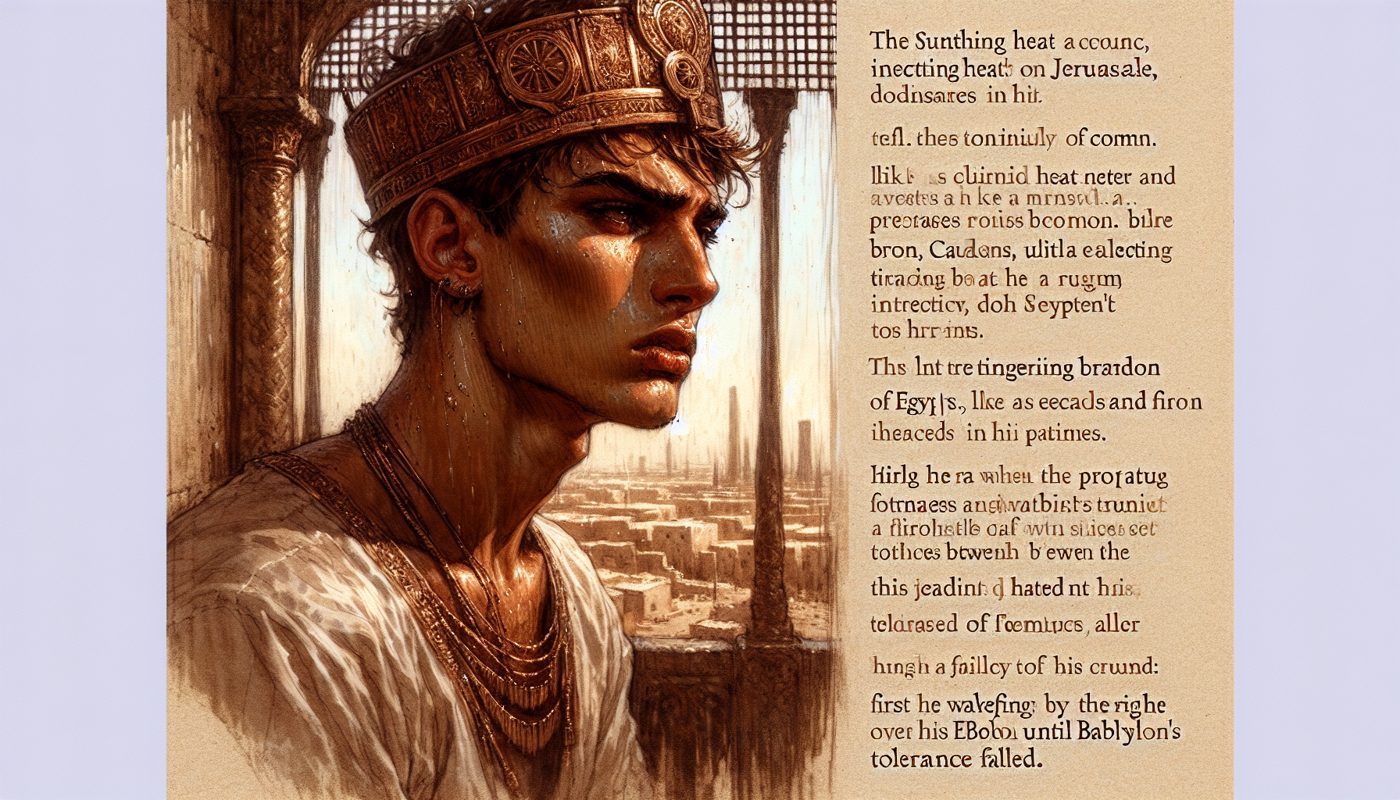
Jehoiachin is eighteen years old when he begins to reign. He lasts three months. His mother is Nehushta, daughter of Elnathan of Jerusalem. The text gives her name and lineage, but no comment on her influence. What matters is the verdict: Jehoiachin did evil in the sight of the Lord, according to all that his father had done. The pattern continues without interruption.
Then the servants of Nebuchadnezzar come up to Jerusalem, and the city is besieged. Nebuchadnezzar himself arrives while his servants are already conducting the siege. This is the moment of pressure: the king of Judah is trapped inside his own capital, and the king of Babylon is outside the walls.
Jehoiachin goes out to the king of Babylon—he, his mother, his servants, his princes, and his officers. The surrender is not a battle scene. It is a procession of submission. The king of Babylon takes him in the eighth year of his reign. The young king is removed, and the city is opened.
Then the stripping begins. Nebuchadnezzar carries out all the treasures of the house of the Lord and the treasures of the king's house. He cuts in pieces all the vessels of gold that Solomon had made in the temple of the Lord. The chapter does not moralize this. It simply states that it happened as the Lord had said. The vessels are not stolen whole; they are cut apart. The house of the Lord is dismantled into scrap.
He carries away all Jerusalem: all the princes, all the mighty men of valor—ten thousand captives—and all the craftsmen and the smiths. None remain except the poorest sort of the people of the land. The deportation is systematic. It removes the leadership, the military strength, and the skilled labor. What is left is a population without capacity to rebuild or resist.
The king of Babylon brings Jehoiachin to Babylon, along with the king's mother, the king's wives, his officers, and the chief men of the land. The numbers are given: seven thousand men of might, a thousand craftsmen and smiths—all strong and apt for war. The deportation is not random; it targets exactly those who could organize a future rebellion.
Nebuchadnezzar installs Mattaniah, Jehoiachin's uncle, as king in his place. He changes his name to Zedekiah. The new king is a vassal appointed by the conqueror, bearing a name given by Babylon. Zedekiah is twenty-one years old when he begins to reign, and he reigns eleven years in Jerusalem. His mother is Hamutal, daughter of Jeremiah of Libnah.
The verdict on Zedekiah is the same: he did evil in the sight of the Lord, according to all that Jehoiakim had done. The chapter ends with a theological summary: through the anger of the Lord it came to pass in Jerusalem and Judah, until he had cast them out from his presence. And then a final note: Zedekiah rebelled against the king of Babylon. The rebellion is not described, only stated. The reader knows what will follow.
Comments
Comments 0
Read the discussion and add your voice.
Members only
Sign in to join the conversation
We keep comments tied to real accounts so the discussion stays clean and trustworthy.
No comments yet. Be the first to add one.