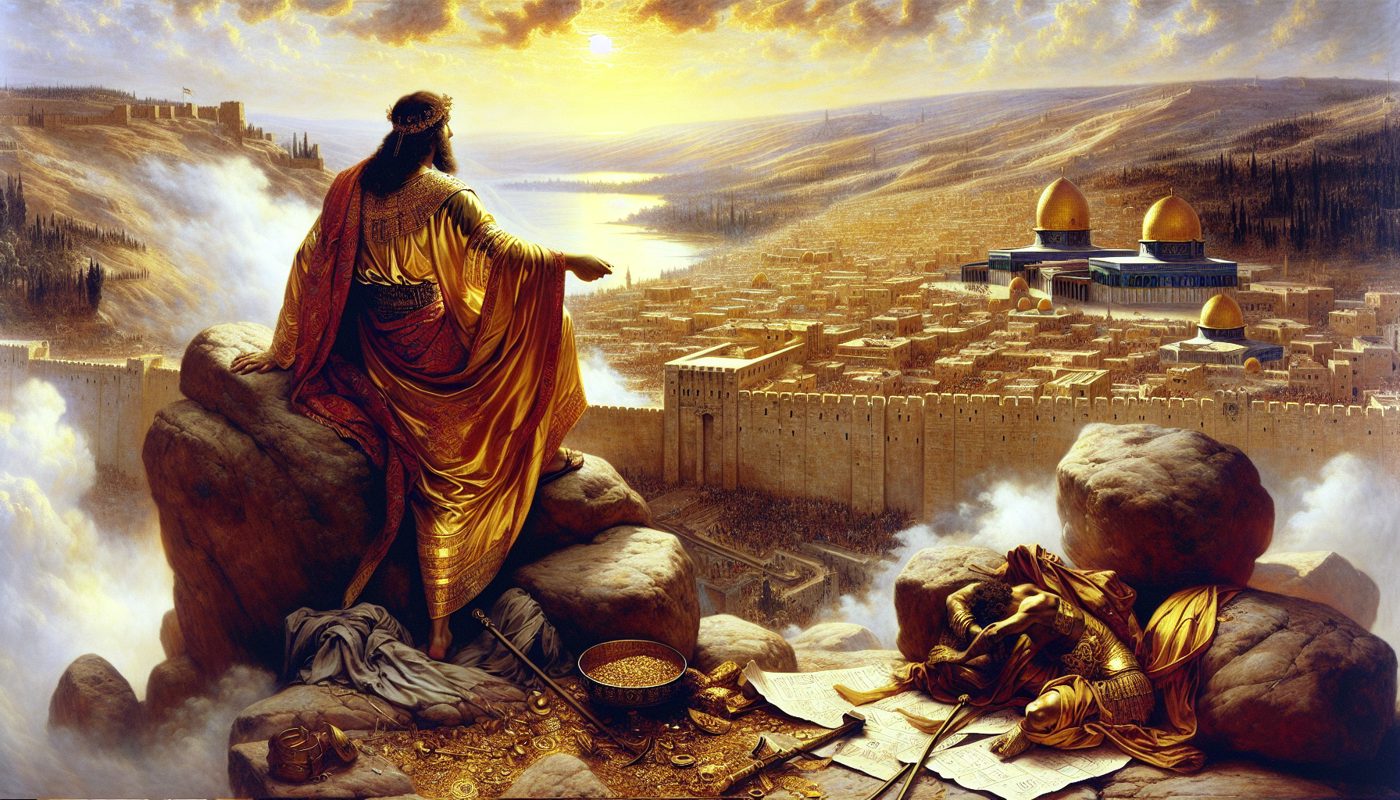
Solomon’s purpose was not a vague ambition. The chapter opens with a hard statement: he purposed to build a house for the name of the Lord, and a house for his kingdom. Two houses. One for the covenant presence, one for the throne. The second could not stand without the first, and the first could not be built by wish alone. Solomon counted out seventy thousand burden-bearers, eighty thousand stonecutters in the mountains, and thirty-six hundred overseers. The numbers are precise, not poetic. This was a levy, not a vision.
The letter to Huram king of Tyre is the core of the chapter, and it is a letter of theological precision. Solomon does not ask for cedar because he needs lumber. He asks because he is building a house for the name of the Lord his God. The purpose clause is repeated: to dedicate it to him, to burn incense of sweet spices, for the continual showbread, for the burnt offerings morning and evening, on sabbaths, new moons, and the set feasts of the Lord. This is not a temple for God’s comfort. It is a place for the rhythm of atonement and remembrance, an ordinance forever for Israel.
Then Solomon says something that sounds like a contradiction but is the whole point. The house he builds is great, because the Lord is great above all gods. But who can build him a house, when heaven and the heaven of heavens cannot contain him? The question is not rhetorical modesty. It is the theological anchor. Solomon is not trying to enclose the Lord. He is building a house for the name—a place where the covenant can be centered, where sacrifice can be offered, where Israel can meet the God who cannot be contained. The only thing a human king can do is burn incense before him.
The practical request follows from that theology. Solomon needs a skilled craftsman, a man who can work gold, silver, bronze, iron, purple, crimson, blue, and engraving. He needs timber from Lebanon—cedar, fir, and algum trees. He knows the servants of Tyre know how to cut timber in Lebanon, and his own servants will work alongside them. The scale is explicit: the house will be great and wonderful. The word is not flattery. It is the only appropriate response to a God who is great above all gods.
Solomon also states the payment: twenty thousand measures of beaten wheat, twenty thousand of barley, twenty thousand baths of wine, twenty thousand baths of oil. This is not a bargain. It is a king’s provision for the workmen. The chapter does not say whether this was a fair price or a generous one. It simply records the transaction. The house for the name required resources from outside Israel, and Solomon was willing to pay for them.
Huram’s reply is not a business letter. He answers in writing, and the first thing he says is that the Lord loves his people, therefore he made Solomon king over them. A pagan king, ruling a city of sea traders and cedar merchants, speaks the theology of Israel’s election. He blesses the Lord, the God of Israel, who made heaven and earth, and who gave David a wise son with discretion and understanding to build a house for the Lord and a house for his kingdom. The chapter does not explain how Huram knew this. It only records that he did.
Huram sends a craftsman: a man skilled and endued with understanding, of Huram his father’s. The man’s mother was a woman of the daughters of Dan; his father was a man of Tyre. He can work in gold, silver, bronze, iron, stone, timber, purple, blue, fine linen, and crimson, and he can engrave any design. The chapter names no personal name for this craftsman, only his lineage and his skill. He is to be appointed with the skilled men of David and Solomon. The house will be built by a mixed workforce: Israelite, Tyrian, and a half-Danite who knows both worlds.
Huram confirms the timber shipment. They will cut wood from Lebanon, bring it in floats by sea to Joppa, and Solomon will carry it up to Jerusalem. The logistics are concrete: sea transport, then a land route uphill to the city. The chapter does not describe the journey or the labor. It simply records the plan.
Then Solomon numbers all the sojourners in the land of Israel, following the numbering his father David had done. They total one hundred fifty-three thousand six hundred. From them he sets seventy thousand to bear burdens, eighty thousand to hew stone in the mountains, and thirty-six hundred overseers to set the people at work. The numbers match the opening. The chapter ends where it began, with the workforce counted and assigned. The house for the name will be built by the labor of sojourners, directed by the king of peace, supplied by the king of Tyre, and blessed by the God who cannot be contained.
Comments
Comments 0
Read the discussion and add your voice.
Members only
Sign in to join the conversation
We keep comments tied to real accounts so the discussion stays clean and trustworthy.
No comments yet. Be the first to add one.