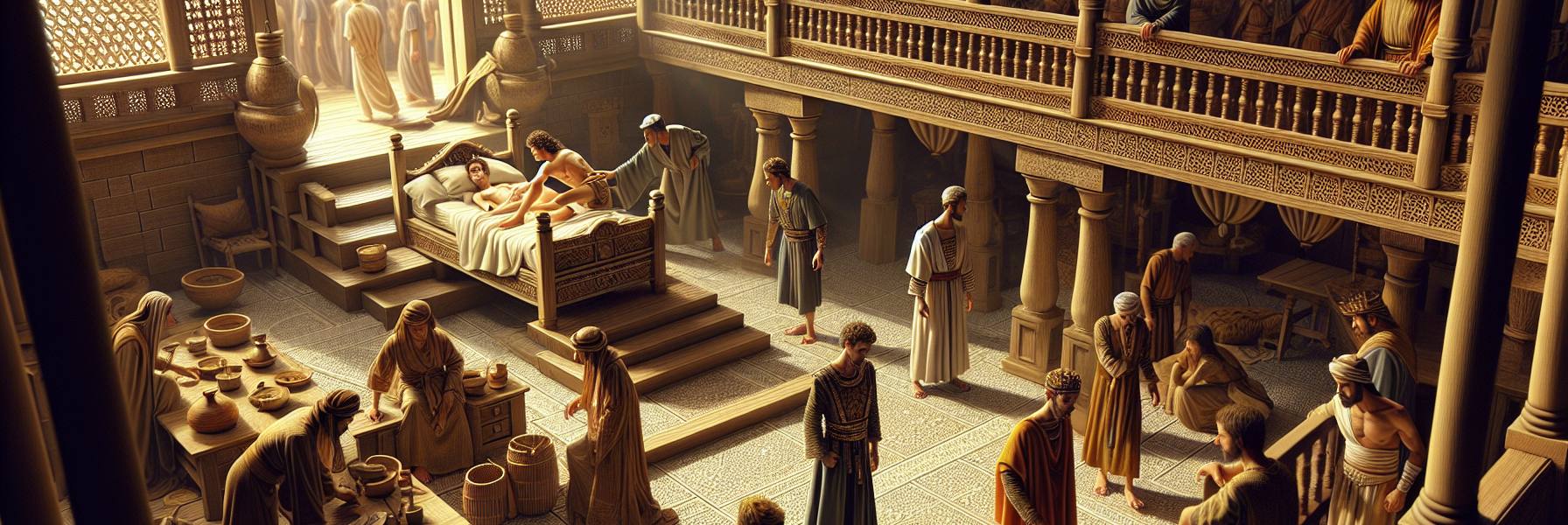

The sun was a hammer on the baked earth of Tirzah, but a deeper chill had settled in the house of Jeroboam. It began with a cough, a dry, rattling thing that seemed too large for the boy’s slight frame. Abijah, the son of the king, lay on his bed, his skin waxy and taut over young bones. The physicians came and went, their murmurs a low, useless hum. They spoke of fevers and humours, but the queen mother, whose name history would not trouble to remember, heard a different silence beneath their words—a silence that smelled of dust and old prophecy.
She stood at the lattice window, her fingers gripping the wood until the knuckles shone white. She watched her husband, the king, pace the courtyard below, a man who had carved a kingdom with his own ambition, now powerless against this invisible siege. Jeroboam, who had set up the golden calves in Bethel and Dan, who had made priests from the common ranks, who had severed the people from the ancient rhythms of Jerusalem. He had built a throne on the foundation of division, and now the foundation was cracking beneath his own roof.
“He will not see the boy,” she said, not turning from the window. Her voice was flat. “He looks at him and sees only an heir dying. He does not see a son.”
A servant girl, barely more than a child herself, flinched at the bitterness.
The queen turned. The resolution in her eyes was desperate, born of a love that was perhaps the only pure thing left in that palace. “Prepare a journey. Simple bread, a skin of wine. No marks of royalty. I will go to Shiloh.”
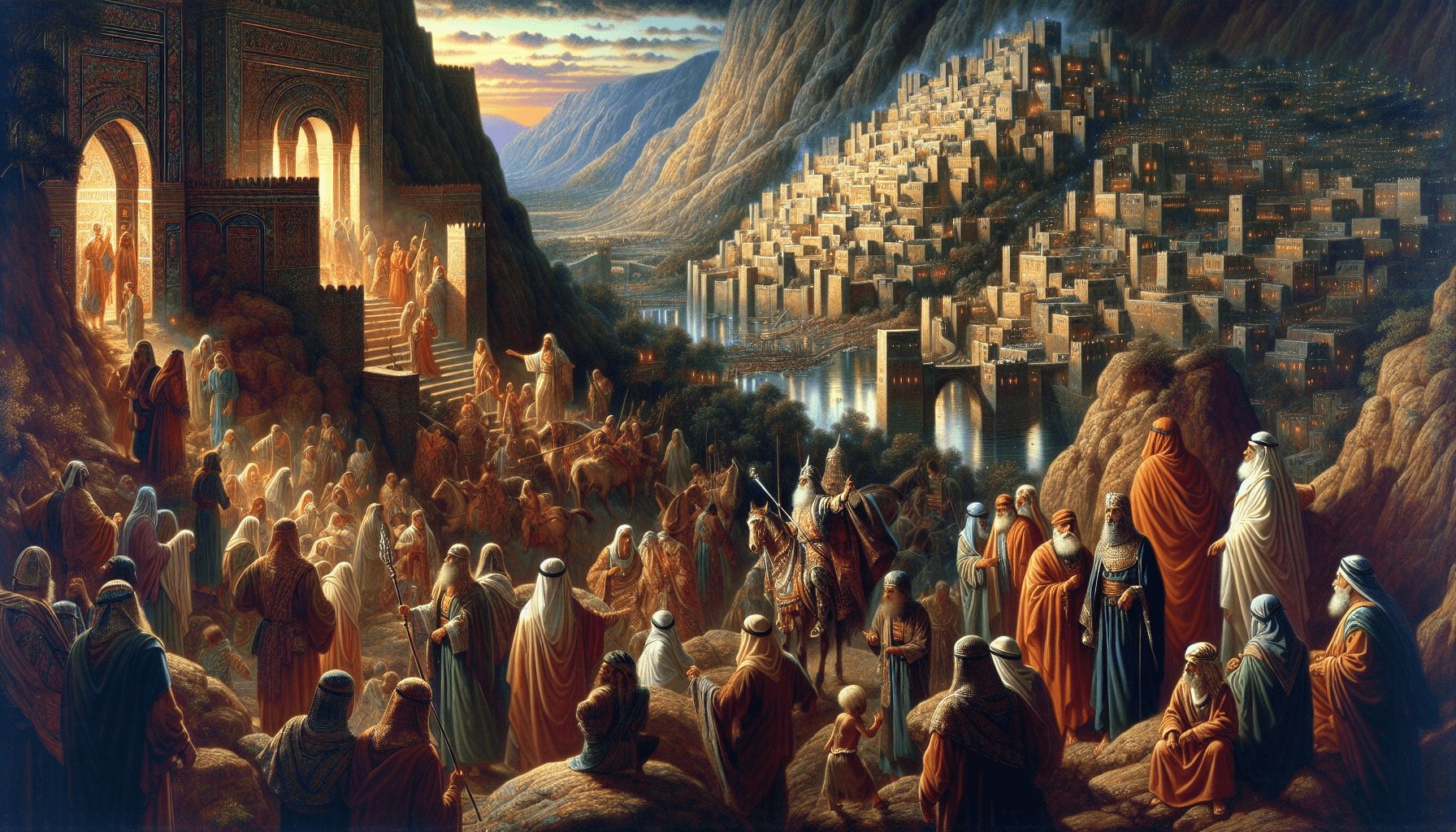
Shiloh. The very name was a whisper of a older, discarded world. It was where the tabernacle had once rested, before David, before Solomon, before the grand Temple in Jerusalem that her husband so reviled. And in Shiloh lived Ahijah the prophet, the same old man who, years before, had torn his own new cloak into twelve pieces and given ten to Jeroboam, sealing the prophecy of a torn kingdom. That same man, now blind and frail, was her only hope.
The journey was a torment. Disguised as a peasant woman, the grit of the road ground into her skin. The simple linen chafed against shoulders accustomed to the finest wool. Every jolt of the donkey carried her further from her dying son and towards a past her family had betrayed. She rehearsed lies, simple ones about a sick child and a mother’s plea. But the words tasted like ash. Ahijah had been the architect of their rise; could he not see through the plaster of their fall?
Shiloh was not a city of kings. It was a quiet, sloping place, a memory in stone. She found Ahijah’s dwelling—a humble house, its door open to the cool interior gloom. The scent of old scrolls and olive oil hung in the air. Before she could form a greeting, a voice, cracked yet disconcertingly sharp, came from the shadows.
“Come in, wife of Jeroboam. Why this pretense? I am sent to you with heavy news.”
Her heart seized. The bread and wine, the plain garments—it was all for nothing. The God who saw her husband’s altars on the high places saw her trudging up a dusty road.
The old man’s sightless eyes seemed to look through her, towards a horizon only he could perceive. He did not offer comfort. His words were not the balm of Gilead, but the inexorable flow of a river cutting stone.
“Go, tell Jeroboam. Thus says the Lord, the God of Israel: I exalted you from among the people and made you leader over my people Israel. I tore the kingdom away from the house of David and gave it to you. But you have not been like my servant David… you have done more evil than all who were before you. You have made for yourself other gods and metal images, provoking me to anger. Therefore, behold, I will bring disaster upon the house of Jeroboam. I will cut off from Jeroboam every male, bond and free, in Israel. I will burn up the house of Jeroboam, as one burns dung until it is all gone. The dogs shall eat those who die in the city, and the birds of the air shall feed on those who die in the field.”
The words fell like stones, each one burying her hope deeper. The kingdom, the dynasty, the future—all reduced to carrion. Then his voice changed, softened by a terrible, specific sorrow.
“But as for you, arise, go to your house. When your feet enter the city, the child shall die. And all Israel shall mourn for him and bury him, for he alone of Jeroboam’s house shall come to the grave, because in him there is found something pleasing to the Lord, the God of Israel.”
The walk back to the door was a walk out of one world and into a condemned one. The sun was lower now, casting long, accusing shadows. She did not weep. The prophecy had dried up all tears. The most dreadful mercy had been granted: her son would die, spared the coming slaughter. He was the only good thing that would be buried whole.
The return journey was a blur of heat and dread. Each step brought her closer to the moment she would cross the threshold of Tirzah. As the walls of the city rose before her in the dusk, a strange, heavy quiet seemed to emanate from within. She passed through the gate, her dusty feet on the familiar stones.
A wail pierced the evening air. Then another. It swelled from the direction of the palace, a chorus of grief. She did not need to be told. She stood still in the street, a peasant woman surrounded by the mourning of a kingdom, holding in her heart the weight of a doomed house and the fragile, beautiful soul of the only one God had seen fit to spare from the dogs and the birds.