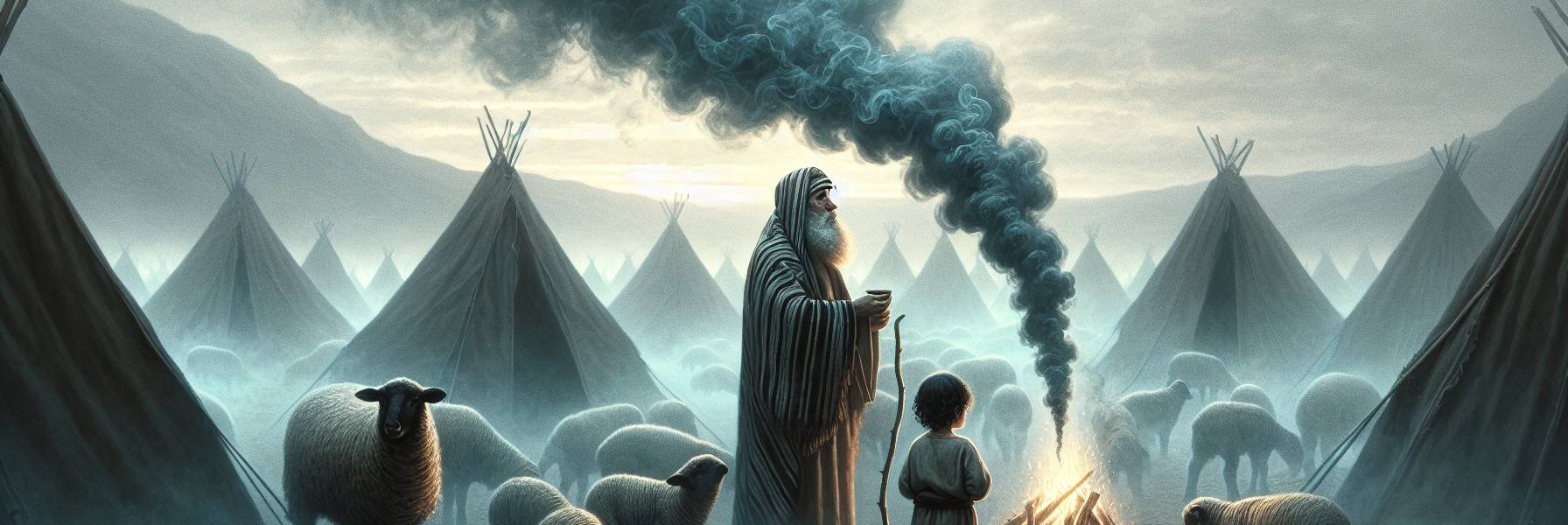

The smoke was the first thing you noticed. It wasn’t the harsh, black plume of a house fire, but a steady, bluish-grey column that rose from the heart of the camp as constant as the sunrise. It carried a scent that permeated everything—woodsmoke, yes, but underneath it, the rich, almost sweet smell of roasting grain, and something deeper, heavier: the scent of animal fat and blood consecrated by fire.
Eliab ben Pedahzur stood before the altar in the grey light before dawn, his breath making faint ghosts in the chill. His bones ached, a familiar complaint from years of rising while the stars still pricked the velvet dark. To his left, his young nephew, Ittai, struggled to keep his eyes open, the lamb he held against his chest bleating softly, its breath a white puff in the cold.
This was the *tamid*. The continual offering. The rhythm that held the world together.
“Remember,” Eliab said, his voice a low rasp. “Not because the Lord is hungry. Not because He sleeps and needs waking.” He placed a hand on the nervous animal’s flank, feeling the quick drumbeat of its heart. “It is a rhythm. Like a heartbeat. Our heartbeat, offered to Him. A reminder that every breath, every sunrise, belongs to Him.”
He took the knife. The action was not brutal, but precise, a somber, practiced motion. Ittai looked away, but Eliab’s gaze was steady. There was a gravity here that had nothing to do with slaughter and everything to do with covenant. The blood was caught, splashed against the great bronze altar. The lamb was quartered, washed. The pieces, laid on the fire, began to crackle and hiss. The smoke joined the perpetual column.
As the fat melted and dripped, hissing on the coals, Eliab thought not of sin, but of presence. This smell, this smoke, was the scent of “I am here.” And by it, Israel said, “We are here, too.”
The dawn proper broke, gilding the tops of the tabernacle’s linen curtains. The *tamid* was complete. But the day, a Sabbath, demanded more. The rhythm intensified.
“Fetch the two lambs,” Eliab instructed Ittai. “Without blemish. And the fine flour, two-tenths of an ephah, mingled with oil.”
This was the Musaf, the “additional offering” for the Sabbath. The daily heartbeat gained a stronger pulse, a deliberate emphasis. While other men rested from their labours, the priesthood laboured all the more. The rest of the camp was a quiet hum of peace; here, at the Tent, it was a controlled bustle. The second set of lambs was brought, their offering a duplicate of the morning’s, yet entirely separate. A double portion of holiness for the holy day.
The grain offering was different today. Ittai brought the fine flour, not coarse. Eliab took a handful—a memorial portion—and flung it onto the fire where the lambs smoldered. The rest was for Aaron and his sons; a dense, oil-rich cake that would be their sustenance. The work of the sanctuary fed its workers.
Later, as the sun climbed toward its zenith, Eliab sat on a rough stool outside his tent, wiping his hands with a piece of sackcloth. Ittai sat in the dust, chewing on a piece of flatbread.
“Uncle,” the boy began, his mouth half-full. “The new moon is coming. Is it… the same?”
Eliab shook his head, a faint smile touching his weathered face. “Similar, but more. The new moon is a new beginning. A fresh cycle. So the offering speaks of more.” He closed his eyes, reciting from the sacred charge. “Two young bulls, one ram, seven lambs. Their grain offerings and drink offerings according to the rule. And a goat for a sin offering.”
Ittai’s eyes widened. “Two bulls? That is a mountain of meat.”
“It is a mountain of acknowledgement,” Eliab corrected gently. “We mark His gift of time. The moon is His clock in the sky. We say, ‘We see it. We thank you for another month of life, another season of your mercy.’ The sin offering reminds us that even our time needs purifying. We often waste it, or fill it with pride.”
The boy was quiet, thinking. Eliab appreciated the questions. He remembered being overwhelmed himself, decades ago, by the sheer volume of it all—the bloody, smoky, unending liturgy. It had taken years to see past the mechanics to the music. The bull for strength, the ram for consecration, the seven lambs for the perfect, complete cycle of days. The fine flour, the oil, the wine—the fruits of the land God had promised but not yet given. They were offering the future in faith.
A few days later, the festival of Unleavened Bread began. For seven days, the rhythm became a symphony. The daily *tamid* continued, its steady beat underlying everything. But upon it was layered the unique sacrifices of the feast: two bulls, a ram, seven lambs each day, with a goat for atonement. The air grew thick with smoke, a constant, swirling pillar visible for miles. The labour was exhausting. Priests moved in sweat-soaked linen, their arms streaked with ash and blood. The altar fire was never allowed to go out; it roared, a hungry, holy beast fed constantly with the fat and the choice pieces.
On the seventh day, as Eliab stood before the roaring heat, his senses were overwhelmed. The smell was no longer separate components, but a single, profound aroma: holiness itself. It was costly, it was relentless, it was beautiful. He understood then, in a way words could not capture, that this was the cost of drawing near. God was a consuming fire. To approach Him was to bring something to be consumed. Not to appease an anger, but to acknowledge a reality. Their life for His life. Their best for His presence.
That evening, utterly spent, he shared a simple meal of unleavened bread and bitter herbs with his brother priests. No one spoke much. There was no need. The message of the offerings was etched into their tired muscles, into their smoke-scented robes. It was a message of relentless grace, a daily, monthly, yearly reminder that life with God was not casual. It was structured, it was costly, and it was drenched in blood that pointed to a deeper, final mercy yet unseen.
The stars came out, sharp and cold over the desert. The fire on the altar had died back to a bed of glowing coals, a sullen red heart in the centre of the camp. Tomorrow, before the first light, Eliab would be there again. The lamb would be brought. The knife would be raised. The smoke would rise.
And the heartbeat of the world, by God’s patient instruction, would go on.