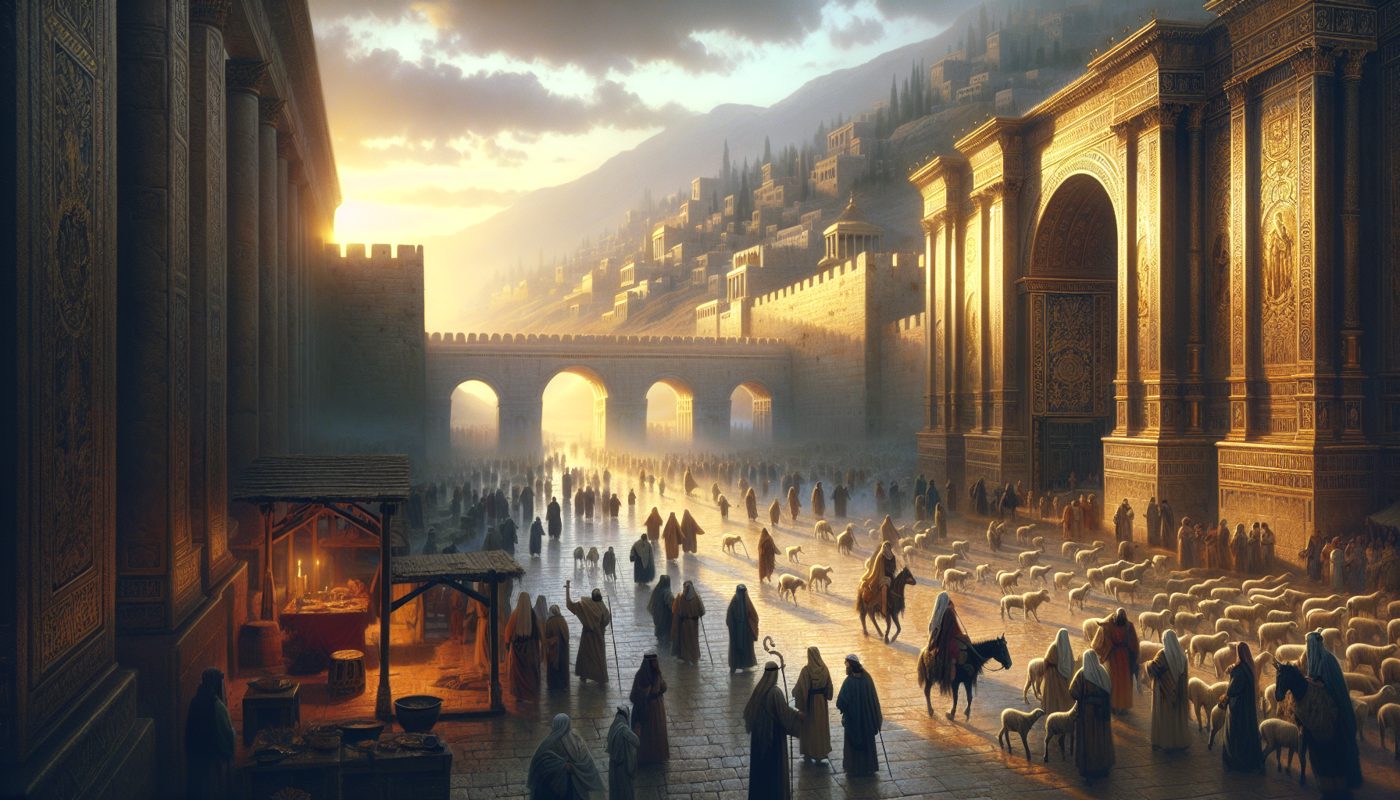
The psalm opens with a claim that leaves no room for negotiation. The earth belongs to the Lord, and so does everything in it—the world itself and every person who lives in it. This is not a general sentiment about divine ownership. It is a specific assertion about creation: the Lord founded the world on the seas and established it on the floods. The ground beneath every city and every nation rests on his work alone. No king, no army, no temple builder can claim that foundation.
Then the psalm turns. If the whole earth is the Lord’s, what kind of person can actually approach him? The question is stark: Who shall ascend the hill of the Lord? Who shall stand in his holy place? The hill is not a geographical feature anyone can climb. The holy place is not a building open to all. The psalm forces the reader to stop and face the gap between the Creator and the creature.
The answer is equally stark. The one who may ascend has clean hands and a pure heart. He has not lifted up his soul to what is false. He has not sworn deceitfully. There is no ritual loophole here, no sacrifice that substitutes for personal integrity. The condition reaches into the inner life—what a person reaches for with his soul—and into the outer life—what his hands actually do. The psalm does not soften this requirement or explain how anyone meets it.
But the psalm does not stop with the requirement. It says that such a person will receive a blessing from the Lord and righteousness from the God of his salvation. The righteousness is not self-generated. It comes from the God who saves. The one who seeks the Lord’s face—the psalm calls this generation the people of Jacob—will find that the Lord himself supplies what the seeker lacks.
Then the scene shifts. The gates of the ancient city are addressed directly: Lift up your heads, you gates. Be lifted up, you everlasting doors, so that the King of glory may come in. The gates are not merely architectural. They are the boundary between the world outside and the presence inside. The command to lift them suggests that something is approaching that is too great for ordinary entry. The King of glory intends to enter.
The psalm asks the obvious question: Who is this King of glory? The answer comes back: The Lord strong and mighty, the Lord mighty in battle. This is not a ceremonial title. It is a warrior’s name. The King of glory is the one who has fought and prevailed. The gates are not being asked to admit a procession of priests carrying an ark. They are being commanded to open for the Lord who has won the field.
The command repeats. Lift up your heads, you gates. Lift them up, you everlasting doors. The repetition is not poetic filler. It insists that the gates respond. The King of glory is coming, and the doors must recognize who he is. The question is asked again: Who is this King of glory? The answer this time is fuller: The Lord of hosts—he is the King of glory. The Lord commands the armies of heaven. There is no power that outranks him.
The psalm ends with the word Selah, a pause that forces the reader to sit with what has been said. The earth is the Lord’s. The requirement for entering his presence is absolute integrity. And the one who meets that requirement is the Lord himself, the King of glory, who comes to his own gates. The psalm does not describe a human procession. It describes the arrival of the one who owns everything and who alone is worthy to enter.
Comments
Comments 0
Read the discussion and add your voice.
Members only
Sign in to join the conversation
We keep comments tied to real accounts so the discussion stays clean and trustworthy.
No comments yet. Be the first to add one.