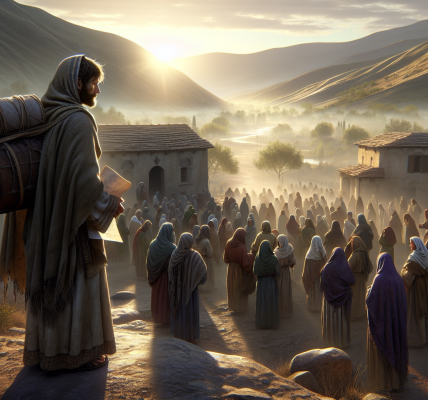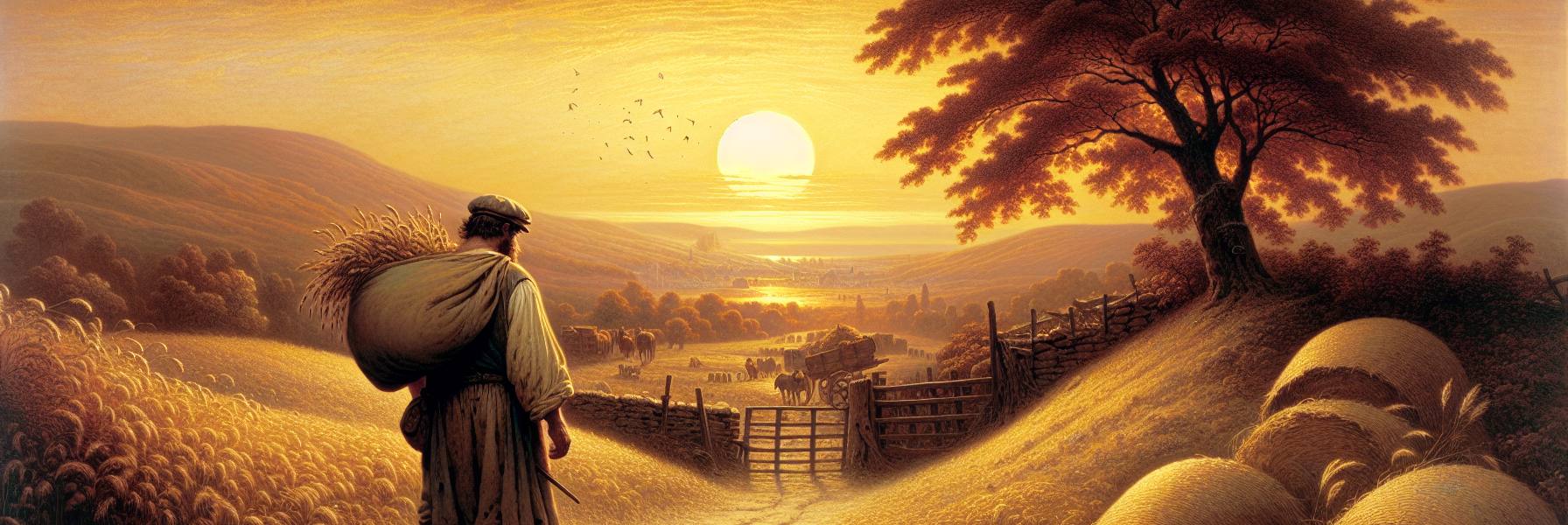

The sun hung low over the hills of Ephraim, a bruised peach in a dusty sky, as Elior made his way back from the threshing floor. The smell of chaff and warm earth clung to his tunic, a familiar scent of exhaustion and small triumph. His forearms ached from the day’s work, but the weight of the barley in his satchel was a good weight.
His sandals scuffed the pale dirt of the path, and his mind drifted, not to the evening meal, but to the morning’s scene at the town gate. It was there, in the patchy shade of the old terebinth, that the matter of Reuben and his debt had been settled. Elior had watched, leaning against the rough stone of the wall, as the elders listened. Reuben, his face etched with a shame deeper than poverty, had stood before his creditor, a man from Bethel named Jamin. The pledge had been a millstone—not the upper stone, but the smaller, nether stone. Jamin, within his rights, had sent a servant to fetch it as collateral for the loan of seed-grain.
But he had followed him. Elior had seen it. Jamin, his own robes swishing with purpose, had walked to Reuben’s dwelling, a low house of fieldstone. He did not enter. He waited at the threshold while the servant emerged, straining under the weight. And then Jamin had gestured for the stone to be set down. He’d spoken, his voice carrying on the still air. “You will bring it to me before sundown.” The law was clear: you did not take a man’s means of grinding his daily bread from his own house. You waited at the threshold, preserving the last shred of his dignity, letting him perform the act of handing it over. It was a small thing, a procedural thing, but as Elior watched Reuben’s shoulders lose some of their terrible tension, it seemed the very hinge of mercy.
Elior’s own vineyard was just ahead, the young vines staked and tender. He thought of the law concerning it. *Do not go over your vineyard a second time. Leave the missed clusters for the stranger, the fatherless, the widow.* It was not merely charity; it was a divine restraint on his own hunger, a check against the instinct to wring every last drop of profit from the land. The land was the Lord’s. He was but a tenant. The forgotten sheaf in the field behind him, left on purpose though it looked like carelessness, was a silent testament to that truth.
As he rounded the bend, the settlement came into view, a scattering of homes like stones cradled in the valley’s palm. Smoke began to curl from a few roofs. His thoughts, unbidden, turned to Leah, the daughter of Malchiel. Two springs past, there had been a divorce. A bitter, quiet affair. Malchiel’s son-in-law had found some indecency in her—the word was vague, a cloud of disapproval—and written her a certificate of cutting-off, sending her back to her father’s house. Elior remembered her face, pale and closed as a shuttered window, walking back up this very path. The law was stern: if that first husband married another, Leah could never return to him. That door, once slammed, was sealed shut forever. It was a brutal law, some whispered, preventing women from being traded like goods between men on a whim. It forced a terrible finality. Elior wondered if that finality was itself a kind of protection, a wall against capriciousness, giving the divorced woman at least the certainty that her former life was truly over, for good or ill.
He reached his own door, the leather curtain drawn back for the evening air. Inside, the scent of lentil stew met him. His wife, Miriam, smiled her tired smile, and his two sons tumbled over each other to greet him. After the meal, as the stars pricked through the deepening blue, he sat on the bench outside, a child curled against each side. The younger one, Obed, had a rash on his arm, a patch of itchy, inflamed skin. Miriam had dressed it with olive oil and rue.
Elior’s mind drifted to the words of the Law, read at the last gathering. *When a man is newly married, he shall not go out with the army or be charged with any business; he shall be free at home one year to be happy with his wife whom he has taken.* He looked at his boys, at the light from the hearth glowing on Miriam’s face as she mended a tunic. He was not a soldier, but he felt the truth of it. The foundation of a house, of a people, was built here, in this fragile, joyful first year, shielded from the demands of the outside world. It was a law that prized happiness as a civic duty.
And then there was the other law, the one that had always seemed strange to him until this moment, with his son’s head warm against his ribs. *Fathers shall not be put to death because of their children, nor children because of their fathers. Each to his own sin.* He looked down at Obed’s innocent face, slack with approaching sleep. The justice of God was not a chain, linking generations in an inevitable curse. Each soul stood before the threshold of its own choices. It was a terrifying responsibility, but also a breathtaking mercy. The past did not have to be a prison.
The night settled around him, cool and quiet. The laws of the chapter were not a list of dry ordinances; they were the fabric of the life around him. They were in the returned millstone, the left-behind sheaf, the finality of a divorce document, the sanctity of a newlywed’s year, the isolation of a skin disease, the binding of a pledge, the terrifying individuality of guilt. They were not about control, he saw now, but about boundaries. Boundaries that guarded dignity, that made room for mercy, that protected the weakest threads in the social weave, and that ultimately pointed to a God who cared about the millstone, the sheaf, the rash, and the human heart all at once.
He lifted Obed, then his older boy, carrying them inside to their pallets. The law was a yoke, yes, but as he lay down beside Miriam, listening to the steady breath of his family in the dark, he understood it was a yoke that fit the neck of a man, designed not to break him, but to guide him—step by step, sheaf by sheaf, stone by heavy stone—toward a life that was human, and just, and somehow, holy.