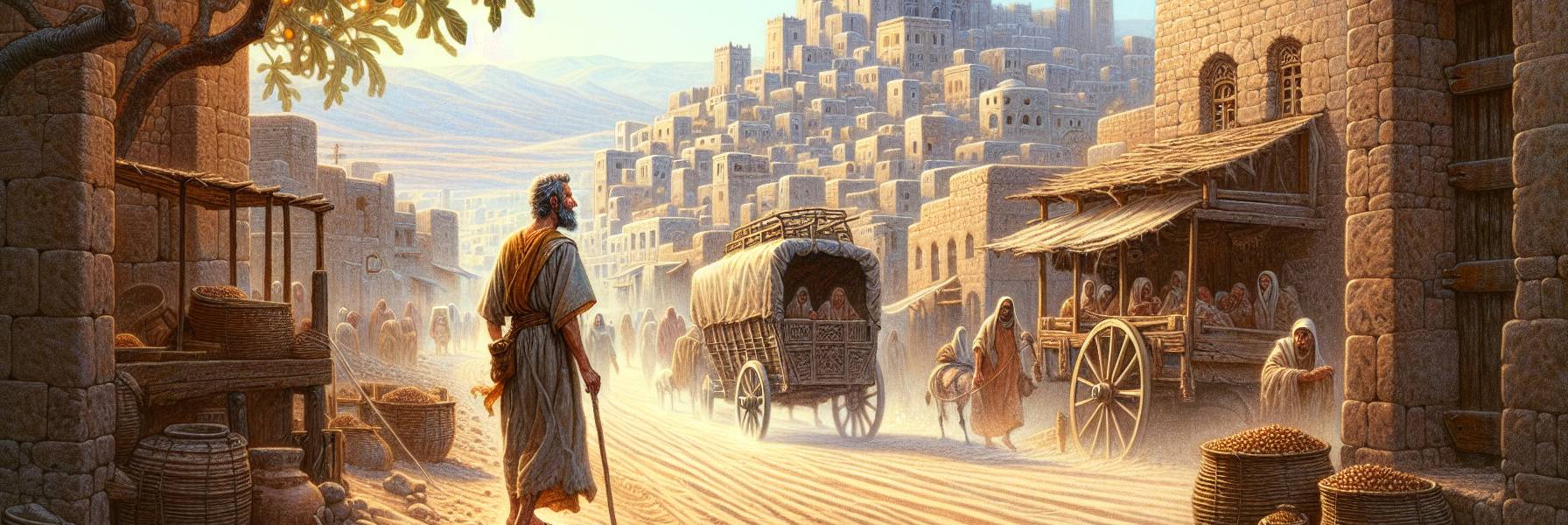

The road to Galatia was dust and ache. A fine, pale powder, kicked up by cart wheels and sandaled feet, hung in the air like a memory of the land’s thirst. It coated Saul’s throat, a gritty reminder that the Spirit’s fire often traveled through very dry places. He walked, not with the hurried pace of his earlier years, but with a determined, weighty stride. The letter in his mind was already writing itself, the words churning like a storm over the Great Sea.
He entered the city not as a conqueror, but as a physician returning to a patient in relapse. The greetings were warm, but strained. In the eyes of some, he saw a flicker of something new: not doubt, but a complicated, uneasy certainty. It was in the house of Jason, by the courtyard where a fig tree offered meager shade, that he saw it plainly.
“But Rabbi,” a man named Levi was saying, his hands illustrating a tight, measured argument, “the blessing is assured through the *keeping*. The law is our fence. Without it, what separates us from the pagans? We must begin with the sign of the covenant, the ancient mark. Then, *then* we receive the Spirit’s promise.”
A younger man, a Greek named Nikios with intelligent, troubled eyes, listened intently. His posture was that of a man trying to fit into a garment that did not sit right on his shoulders.
That evening, the community gathered. The oil lamps smoked, painting shifting shadows on the walls. Saul sat among them, the weariness of the road in his bones, but a hotter fire in his spirit. He began not with argument, but with a question that hung in the smoky air.
“You who have had your eyes opened, who have seen the Crucified and Risen One… answer me this one thing: Did you receive the Spirit by performing the works of the Law, or by hearing with faith?”
The silence was not empty; it was full of the unspoken. They remembered. Nikios did. He remembered the day the message about the Messiah had found him—a Gentile, uncircumcised, outside the fences. There had been no ritual, no ceremony. Just words, strange and wild, about a Jewish king executed on a Roman cross. And then, a feeling unlike any other—a warmth from within, a clarity, a love so profound for these people and this Jesus that it felt like his heart would break open. He had spoken in tongues he never learned. That came *first*.
Levi shifted. His experience had been different, more orderly. A meticulous man, he had appreciated the structure. But even he could not reorder the sequence. The overwhelming shock of grace had come *before* he had fully understood the minutiae of the code.
“Are you so foolish?” Saul’s voice was low, but it carried. “Having begun by the Spirit, are you now being perfected by the flesh?” The word ‘flesh’ he spat out, not as a condemnation of the body, but as a term for that old, self-reliant system of human effort. “Have you suffered so many things for nothing—if indeed it was for nothing?”
He leaned forward, his gaze holding Levi’s, then Nikios’s. “Consider Abraham. What does the Scripture say? ‘Abraham believed God, and it was credited to him as righteousness.’” He let the ancient words settle. “See then, those who are of faith are sons of Abraham. And the Scripture, foreseeing that God would justify the Gentiles by faith, preached the gospel beforehand to Abraham: ‘In you shall all the nations be blessed.’ So then, those who are of faith are blessed with Abraham, the man of faith.”
Nikios felt a lump in his throat. *Sons of Abraham*. Not by blood, not by knife, but by faith. He was included in a story that began long before Sinai, in a promise made to a man staring at impossible stars.
But Levi was not finished. “The Law, then, teacher? What of the Law given to Moses? Is it cursed?”
Saul’s expression softened, but his words grew more intense. “The Law is not opposed to the promises. But if a law had been given that could impart life, then righteousness would indeed be by the law. But the Scripture has confined everyone under sin, so that the promise by faith in Jesus Christ might be given to those who believe.”
He painted a picture then, of the Law as a stern, righteous guardian—a *paidagōgos*—a household slave who escorted the children to their tutor. It was necessary, for a time. It showed the way, protected, set boundaries. “But now that faith has come,” Saul said, his voice rising, “we are no longer under a guardian. For in Christ Jesus you are all sons of God, through faith.”
The words began to cascade, a river breaking through a dam. “For as many of you as were baptized into Christ have put on Christ. There is neither Jew nor Greek, there is neither slave nor free, there is no male and female; for you are all one in Christ Jesus.”
In the flickering light, Nikios looked at Levi. The differences were stark—their dress, their histories, the very set of their faces. But in that moment, those distinctions seemed to shimmer and grow transparent, like illusions. They were both just… believers. Clothed in the same Christ. Levi was looking back, and for the first time, Nikios saw not a judge, but a brother wrestling with a glorious, terrifying freedom.
“And if you are Christ’s,” Saul concluded, the storm in him subsiding into a profound, quiet certainty, “then you are Abraham’s offspring, heirs according to promise.”
The meeting ended not with a shouted conclusion, but with a deep, resonant quiet. The questions weren’t all solved. Practicalities remained. But the foundation had been reset. As they left, Nikios felt the Galatian dust on his feet again. But it felt different now. This was not the dust of a road that led to a fenced-in courtyard. It was the dust of the earth—the same dust from which God had fashioned Adam, the same dust to which the promises to Abraham applied. It was his dust, too. He was an heir. Not by a document he had earned, but by a promise he had received, simply by believing the one who made it.
Outside, the stars were coming out, cold and clear. Abraham’s stars. And by faith, they shone for everyone.