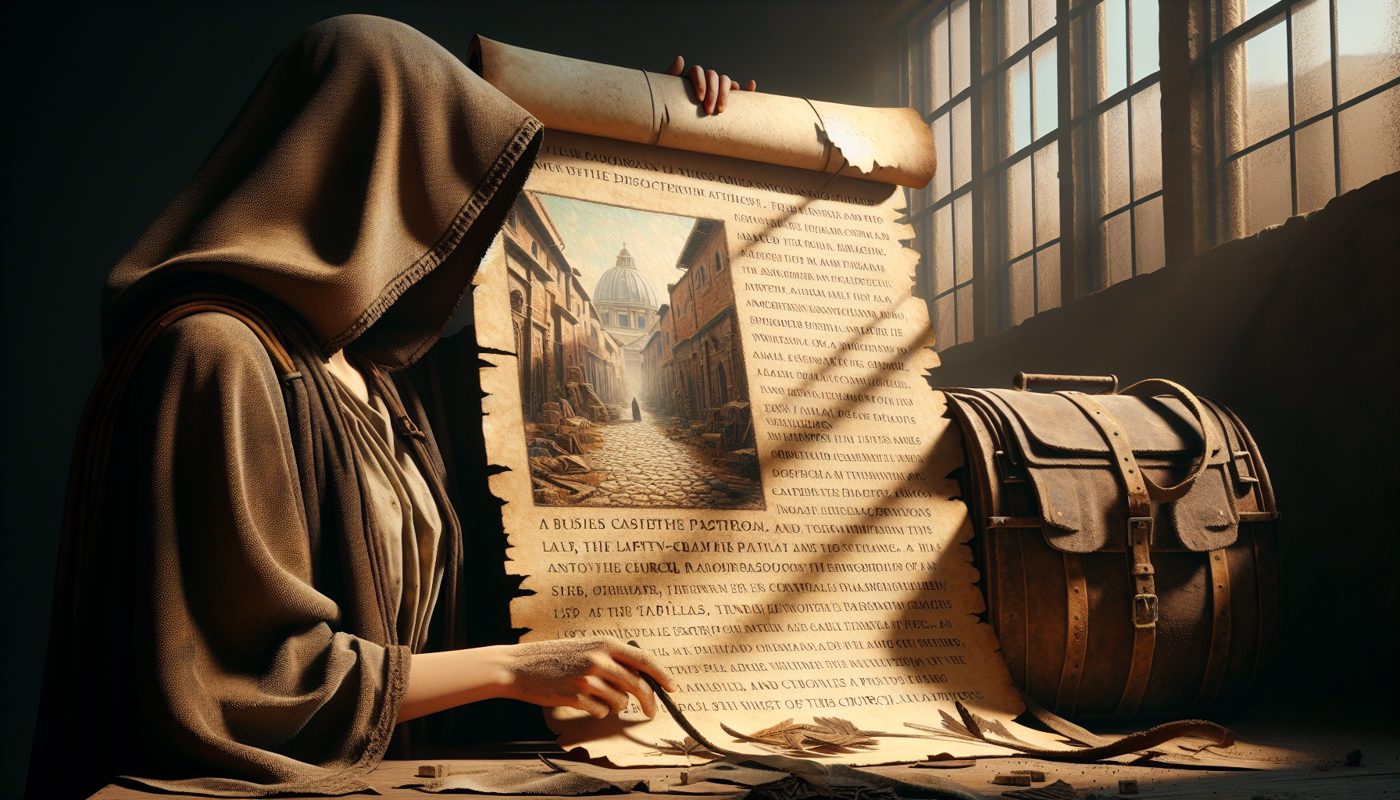
The chapter closes not with a sermon but with a list. Twenty-six names, some with a phrase attached, most without. Paul does not summarize his argument. He does not restate justification by faith or the fate of Israel. He names people. The letter that has run from sin to resurrection to the obedience of faith ends in a warehouse district, a house church, a workshop by the Tiber. The gospel arrives not as a treatise but as a satchel carried by a woman named Phoebe.
She is the first word of the chapter. Paul commends her to the Roman church not as a courier but as a servant of the church at Cenchreae. He expects them to receive her in the Lord worthily of the saints and to assist her in whatever matter she may need. She has been a helper of many, he says, and of Paul himself. The letter does not say what she will do when she arrives. It does not need to. The commendation itself is the authority.
Then the greetings begin. Prisca and Aquila come first. Paul calls them his fellow-workers in Christ Jesus, and he adds a detail he does not give to the others: they laid down their own necks for his life. He thanks them, and he says all the churches of the Gentiles give thanks as well. Their house is a church. The gospel lives in the space where they eat and sleep and work leather.
Epaenetus is called the firstfruits of Asia unto Christ. Mary has bestowed much labor on the Romans. Andronicus and Junias are Paul's kinsmen and fellow-prisoners, and they are of note among the apostles. They were in Christ before Paul was. The apostle who met the risen Lord on the Damascus road is not the earliest believer in the room. He names those who came before him.
Ampliatus is beloved in the Lord. Urbanus is a fellow-worker. Stachys is beloved. Apelles is approved in Christ. Then come the households: those of Aristobulus, of Narcissus who are in the Lord. Tryphaena and Tryphosa labor in the Lord. Persis is beloved and has labored much. Rufus is chosen in the Lord, and Paul calls Rufus's mother his own. The list is not a formality. It is a map of the body.
The names keep coming. Asyncritus, Phlegon, Hermes, Patrobas, Hermas, and the brethren with them. Philologus and Julia, Nereus and his sister, Olympas, and all the saints with them. Paul tells them to salute one another with a holy kiss. All the churches of Christ salute you. The network is wider than Rome. The greeting comes from every assembly that knows Paul's name.
Then the tone shifts. Paul warns them to mark those who cause divisions and occasions of stumbling contrary to the doctrine they learned. Turn away from them. Such people serve not the Lord Christ but their own belly. They use smooth and fair speech to beguile the hearts of the innocent. The warning is not abstract. The same community that receives Phoebe and greets the households must also know when to draw a line.
Paul rejoices in their obedience, which has become known to all men. But he wants them wise unto that which is good and simple unto that which is evil. Then he gives a promise: the God of peace shall bruise Satan under your feet shortly. The grace of the Lord Jesus Christ be with you. The war is not over, but the outcome is certain.
The chapter closes with a second set of greetings. Timothy, Lucius, Jason, Sosipater. Then Tertius, the scribe who wrote the epistle, inserts his own greeting. Gaius the host of Paul and of the whole church sends his. Erastus the treasurer of the city sends his. Quartus the brother sends his. The letter that began with Paul's calling ends with the names of the people who helped him write it, house him, and carry his words.
The final paragraph rises into doxology. Paul ascribes glory to him who is able to establish them according to his gospel and the preaching of Jesus Christ, according to the revelation of the mystery kept silent through times eternal but now manifested through the scriptures of the prophets and made known to all nations unto obedience of faith. To the only wise God, through Jesus Christ, be the glory forever. The list of names and the sweep of eternity meet in the same sentence. The courier, the house churches, the treasurer, the scribe, the kinsmen, the households: they are not footnotes to the mystery. They are how it arrives.
Comments
Comments 0
Read the discussion and add your voice.
Members only
Sign in to join the conversation
We keep comments tied to real accounts so the discussion stays clean and trustworthy.
No comments yet. Be the first to add one.