Leviticus 6 opens with the Lord speaking directly to Moses, delivering a sequence of commands that bind together the life of the community and the holiness of the sanctuary. The chapter does not begin with a narrative scene but with a legal case: a person who sins against the Lord by dealing falsely with a neighbor—whether in a matter of deposit, a bargain, robbery, oppression, or a lost thing found and lied about under oath. The Lord does not treat these as separate categories; they are all trespasses against him, and they all demand concrete repair.
The guilty party must restore the full value of what was taken or falsely kept, and add a fifth of its value more. This restitution is not optional and not delayed; it is to be given on the day the person is found guilty. Only after that restoration does the trespass offering come into play: a ram without blemish, brought to the priest, who makes atonement before the Lord. The chapter makes clear that forgiveness is tied to the actual return of what was wrongfully held, plus a penalty. There is no ritual that bypasses the neighbor.
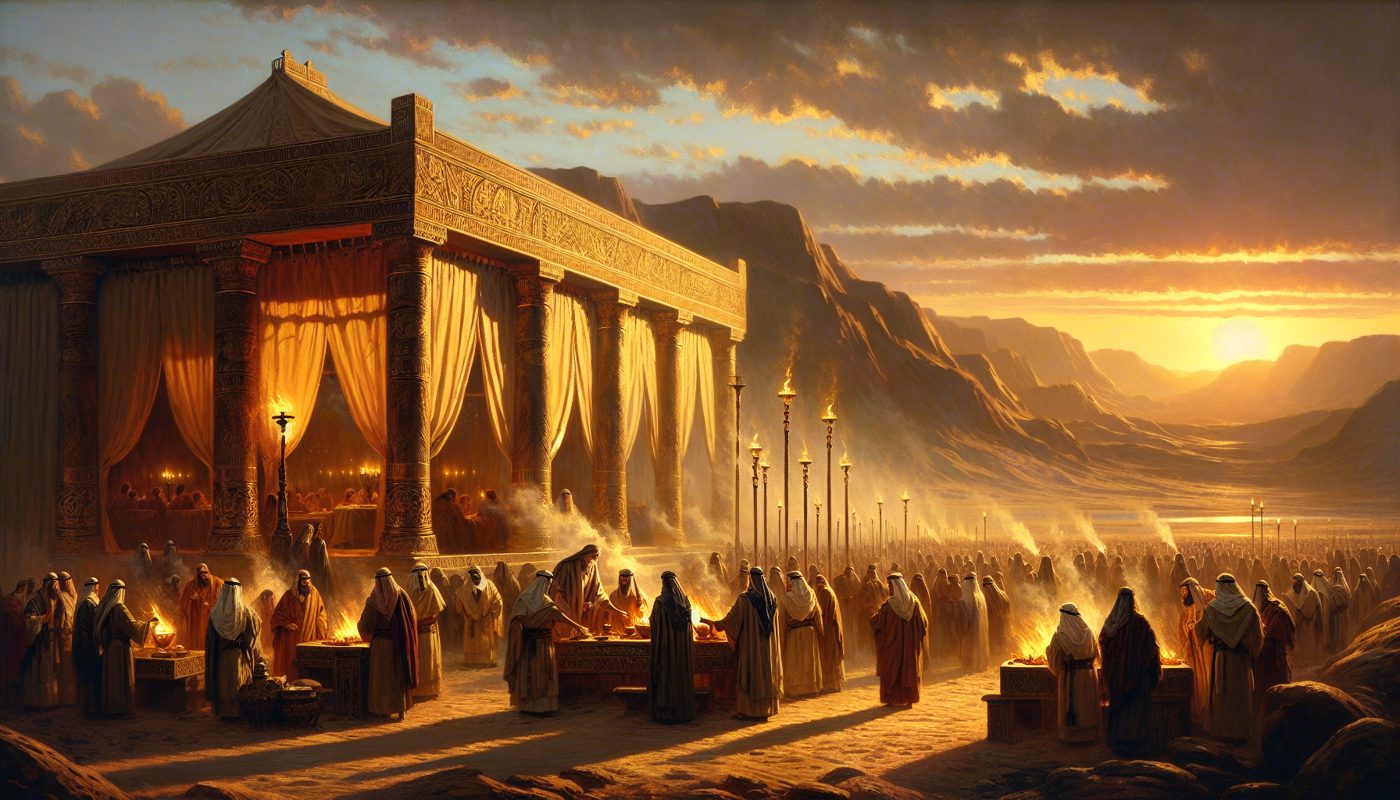
The Lord then gives the law of the burnt offering. The burnt offering itself stays on the hearth of the altar all night until morning, and the fire on the altar must be kept burning on it. The priest is to put on his linen garment and linen breeches, take up the ashes that the fire has consumed, and place them beside the altar. Then he changes into other garments, carries the ashes outside the camp, and deposits them in a clean place. The command is emphatic: the fire on the altar shall be kept burning; it must not go out. Every morning the priest adds wood, arranges the burnt offering, and burns the fat of the peace offerings. The fire is to be kept burning continually.
The law of the grain offering follows. The sons of Aaron present it before the Lord at the altar. The priest takes a handful of the fine flour and oil, with all the frankincense, and burns it on the altar as a memorial portion, a sweet aroma to the Lord. The rest belongs to Aaron and his sons, to be eaten without leaven in a holy place, in the court of the tent of meeting. It is most holy, like the sin offering and the trespass offering. Only males among Aaron's descendants may eat it, and whoever touches these offerings becomes holy.
The Lord then specifies the offering for the day of anointing: a tenth of an ephah of fine flour as a perpetual grain offering, half in the morning and half in the evening. It is prepared on a baking pan with oil, brought in soaked, and offered in baked pieces as a sweet aroma to the Lord. The anointed priest who succeeds Aaron's sons shall offer it; it is to be wholly burned, not eaten. Every grain offering of a priest is to be wholly burned; none of it may be eaten.
The final section of the chapter gives the law of the sin offering. It is killed in the same place as the burnt offering, before the Lord, and it is most holy. The priest who offers it for sin shall eat it in a holy place, in the court of the tent of meeting. Whatever touches its flesh becomes holy, and if any of its blood is sprinkled on a garment, that garment must be washed in a holy place. An earthen vessel used to boil the sin offering must be broken; a bronze vessel must be scoured and rinsed in water. Every male among the priests may eat it, but no sin offering whose blood is brought into the tent of meeting to make atonement in the holy place may be eaten; it must be burned with fire.
What holds these laws together is the insistence that the holy is not casual. The fire that never goes out, the ashes carried to a clean place, the garments changed between tasks, the vessels broken or scoured—each detail enforces a boundary between the common and the consecrated. The priests are not free to improvise. Their work is regulated down to the handful of flour and the location of the meal.
At the same time, the chapter anchors the entire system in the reality of human wrongdoing. Before the altar fire is tended, before the grain is offered, the Lord addresses the person who has stolen or lied or oppressed. That person must first make things right with the neighbor. The offerings do not float free from the social fabric; they are tied to the concrete act of restitution. The Lord receives the ram, but only after the stolen deposit or the oppressed neighbor has been repaid with interest.
The chapter does not explain why the fire must never go out, or why the priest's grain offering must be wholly burned. It simply states these things as statutes. The reader is left with the weight of the command itself, not with a rationale. The holiness of the Lord is enacted through these precise, repeated actions, and the priests are held to them without exception.
Leviticus 6 is not a story about a priest who let the fire die. It is a set of instructions that presuppose the fire is kept burning, the restitution is made, the offerings are eaten in the right place, and the blood is handled with care. The chapter's power lies in its refusal to soften the demands. The Lord speaks, and the priests are commanded. That is the entire frame.
Comments
Comments 0
Read the discussion and add your voice.
Members only
Sign in to join the conversation
We keep comments tied to real accounts so the discussion stays clean and trustworthy.
No comments yet. Be the first to add one.