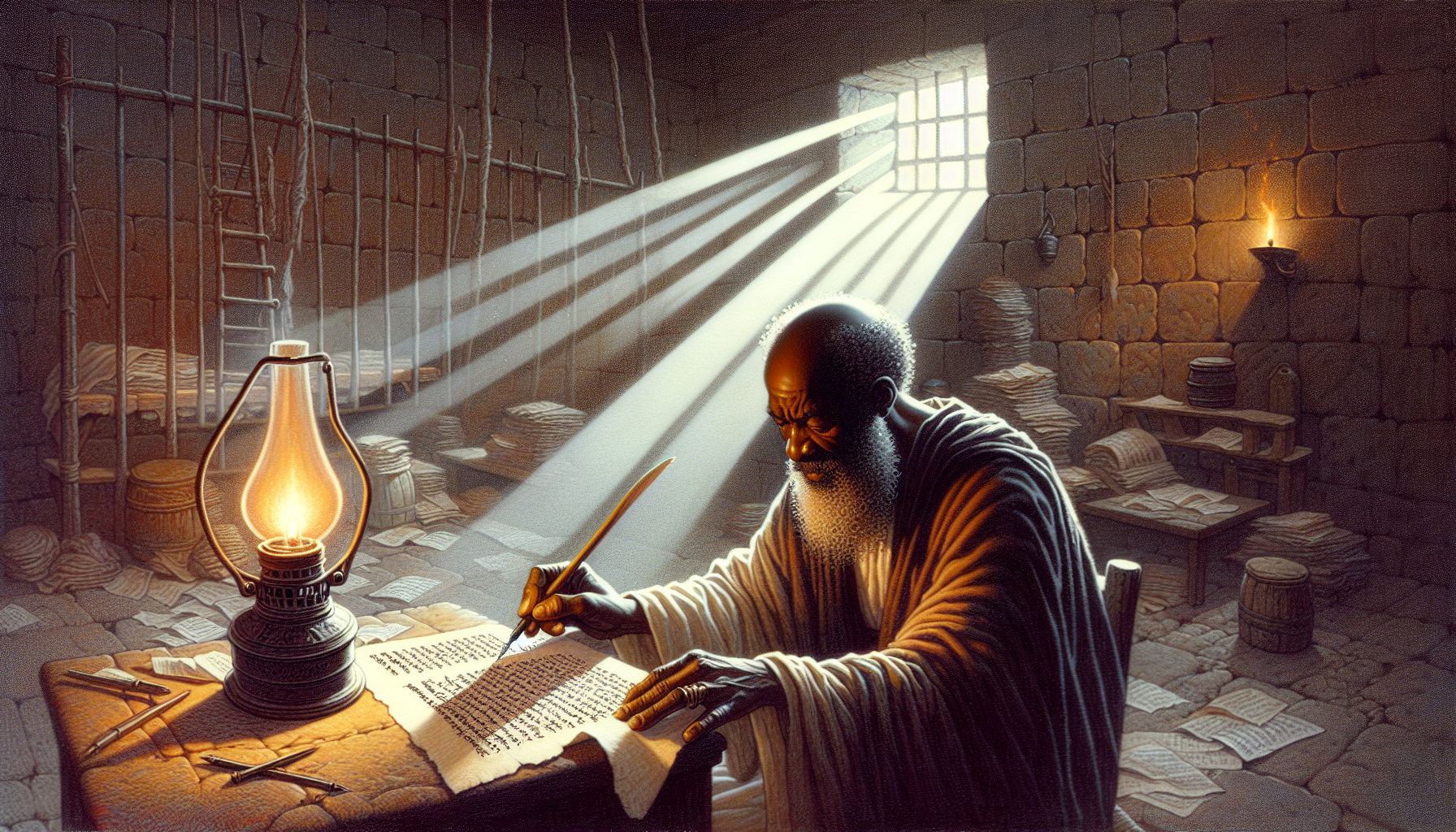
The lamp oil was nearly spent. Its faint, guttering light threw long shadows across the small cell, catching the dust motes that drifted in the still, warm air. Asaph, his fingers stiff and corded with age, traced the edge of the parchment before him. The Temple sounds—the distant clatter of morning preparations, the lowing of a single lamb—were a familiar hum. His task was simple, yet it felt heavier tonight. He was to copy the song, the great *Hodu*, for the new collection. Psalm 136.
He dipped his reed pen, the ink black as a moonless night. He began, not with the words, but with the silence that held them. *Give thanks to the Lord, for he is good.* The ink flowed. *For his steadfast love endures forever.* His hand moved, but his mind drifted back, seventy years, to the stories of his grandfather, who had marched out of Egypt.
The first line was a declaration. The second… the second was the heartbeat. The refrain. It would echo twenty-six times. A scribe might see monotony. Asaph, whose life had been a tapestry of tumult and quiet, saw a different pattern. It was the pattern of breath. Of a pulse. Of the regular crash of waves upon a shore that never, ever ceased.
He wrote of the great deeds. *To him who alone does great wonders.* He did not see abstract power. He saw, as his grandfather had described, a pillar of fire that was not mere light, but a presence. It did not illuminate the desert; it *claimed* the darkness, holding it at bay like a living wall. The love was in the leading. Not a path cleared, but a People carried.
*Who by understanding made the heavens.* His pen scratched. He remembered sitting as a boy, staring up at the vast, star-scattered bowl of the night sky over Bethlehem, feeling impossibly small. His father had put a hand on his shoulder. "Do not be afraid of the space, my son," he’d said. "See the order? The moon for seasons, the sun knowing its time to set? Such vastness, yet it runs with a precision finer than a loom. That is not the work of a distant hand. It is the work of a careful, present mind." The love was in the law woven into creation itself.
The stories unfolded under his hand. *Who struck down the firstborn of Egypt.* Here, his grandfather’s voice always grew quiet, thick with a memory that was not triumph, but awful, solemn awe. It was not a tale of victory cheers, but of a terrible, decisive severing. A door marked by blood, a line drawn in the plague-dark. The love was a fierce, protecting wing, a costly demarcation between death and life.
*And brought Israel out from among them.* The ink pooled slightly. This was the miracle that was not a single moment, but a million footsteps. The love was in the mud of the sea floor, exposed and strange, the walls of water not like crystal but like roaring, trembling mountains held back by a whispered word. It was in the bewildered, stumbling walk of a nation of slaves, suddenly free, their backs to a drowned army.
*Who led his people through the wilderness.* Ah, the wilderness. This, Asaph knew in his bones. Not the grand miracles, but the daily ones. The love was in the flaky, sweet taste of manna at dawn, always enough, never more. It was in the smell of rain on parched earth, the startling coolness of water from stricken rock. It was in the weariness of feet that knew the love was not in removing the journey, but in sustaining the traveler through every dusty, thirsty mile.
The names of kings flowed from his pen—Sihon, Og. Conquests. His grandfather spoke of these with a grim humility. They were not stories of Israel’s might, but of a promise being walked out, step by bloody step, across a land pledged long before. The love was the faithfulness of an oath-keeper, a promise-holder, working through the faltering obedience of men.
*It is he who remembered us in our low estate.* Asaph’s own eyes grew damp. He had seen low estates. Years of famine, of enemy raids, of faith grown thin. The love was there, not as a sudden rescue, but as a remembering. A God who does not forget. Who looks down into the pit, and whose gaze itself is the beginning of the rope.
*And rescued us from our foes.* The rescue was rarely swift. Often it was a long, grinding deliverance, like dawn slowly overcoming a stubborn night.
*Who gives food to all flesh.* His pen paused. Here was the shift, from the story of *us* to the story of *all*. The same hand that parted the Red Sea opens to feed the sparrow, to fatten the cattle on a thousand hills not Israel’s own, to paint the grape on the vine in a land that did not know His name. The love was vast, particular, and scandalously generous.
The lamp flame dipped, sending a ripple of shadow across the page. Asaph’s hand ached. He was nearing the end. *Give thanks to the God of heaven.* He wrote the final line. *For his steadfast love endures forever.*
He sat back, rolling his stiff shoulders. The parchment was full. Twenty-six declarations, each cradled, each answered, by the same relentless, rhythmic truth. It was not a boring repetition. It was the point of it all. The wonders were not to proclaim a mighty God, but to illustrate a loving one. The creation, the liberation, the battles, the bread—they were all just verses in the single, unending song of that love.
The dawn was beginning to grey the high window of his cell. The Temple would soon be alive with song. They would sing this. The young priests with strong voices would chant the lines of power and victory. The people would thunder back the refrain. And in the noise, Asaph hoped someone would hear it. Not just as a response, but as the very foundation. The fire was not the point; the love that lit it was. The freedom was not the point; the love that bought it was. The very earth under their feet was not the point, but a gift from the love that shaped it.
He sanded the ink, blew the dust away. The story was told. But the refrain… the refrain was still being sung. It was in the light growing at his window. It was in the memory of his grandfather’s voice. It was in the promise of the day to come. It endured. It simply, unfathomably, endured.