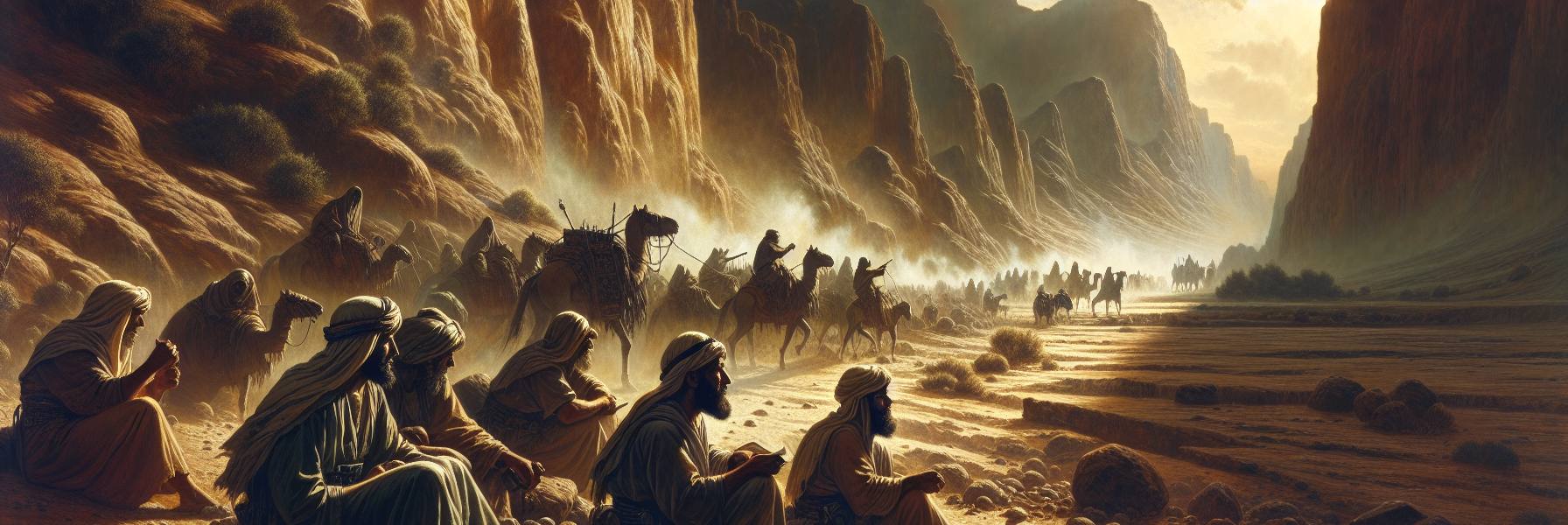

The waiting, I think, is the worst of it. Not the heat, though the sun beats the rock into a griddle and the air shimmers like a veil of cheap glass. Not the thirst, though your tongue swells and sticks to the roof of your mouth, tasting of dust and despair. It’s the waiting. The slow, crawling certainty that time itself has become your enemy, that each moment is a stone added to the wall of your own tomb.
They were up there, on the ridge. I could hear the occasional clink of harness, the murmur of voices carried on the dry wind. Saul’s men. Hunting. The cave mouth where I crouched was a ragged tear in the limestone, a shadow within shadows, and we were still as the bones of the earth. My men’s breathing was the only sound, a ragged rhythm of fear and stifled hope.
And in that stillness, the mire. You don’t feel it at first. It’s just a dampness, a cold seep through the soles of your sandals. But then it thickens. It clings. Every shift, every attempt to find a better position, only sinks you deeper. It’s not water, not mud—it’s the sludge of your own spirit. The shame of being hunted like an animal. The bitter memory of the king’s spear thudding into the wall where your head had been a breath before. The whispers of your own heart: *Perhaps he is right. Perhaps you are the traitor, the problem, the man God has abandoned.*
That was the pit. A pit with no walls, dug by my own racing thoughts. I was stuck, truly stuck. No strength in my legs to pull free. No cry in my throat that wouldn’t bring the sword down upon us all. I had prayed until the words were worn smooth and meaningless. I had waited until waiting felt like my permanent state of being.
Then… it wasn’t a sound. It was an absence. The absence of the mire’s grip. A memory, sharp and clear as the noonday sun outside, cut through the sludge. It was the song of the Levites in the Tabernacle, years ago, when I was just a boy with a shepherd’s smell still on me. The high, pure note of the silver trumpet. The smell of incense curling like a promise towards the sky. The feel of packed earth under my knees, not in desperation, but in awe.
And from that memory, a new one. Not a feeling, but a fact, solid as the rock at my back. The faithfulness of the Lord. His *chesed*—his stubborn, covenant love that doesn’t depend on the dryness of your throat or the cleanness of your hands. It was as if a hand, warm and sure, closed around my own. Not yanking me out, but holding me. Making the pit, for the first time, a place where He was also present.
I didn’t leap up. The soldiers were still on the ridge. But the mire was gone. In its place was a firm footing, a rock that had been there all along, beneath the muck. My heart, which had been a clenched fist, slowly opened. And a new song began to form there. Not a shout of victory—that would come later—but a hum, a steady, low tune of recognition. *He inclined to me. He heard my cry.*
We waited until dusk. When the shadows stretched long and purple, we slipped from the cave like shadows ourselves, melting into the wilderness of Engedi. The deliverance wasn’t dramatic, not then. No angels with flaming swords. Just the quiet, inexplicable gift of getting through the next hour, and the next.
Months later, in a rare moment of peace by a flickering fire, I finally understood. The rescue from the pit wasn’t the escape from the cave. It was the moment the song began in the darkness. He had put a new song in my mouth, a hymn of praise to our God. And that song changed everything. It changed how I saw the waiting. It changed how I saw the hunters. It changed how I saw myself.
I picked up my lyre, its wood warmed by the fire. The tune was simple, the words falling into place like stones in a sling.
*Blessed is the man who makes the Lord his trust, who does not turn to the proud, to those who go astray after a lie.*
I thought of the proud then—Saul, raging in his palace, leaning on his own understanding, his own bruised ego. My own path wasn’t clean. It was fraught with failure yet to come. But the trust was the thing. The song was the evidence of it.
The sacrifice and offering, the meticulous rites of the Law… He didn’t desire those, not first. He had given me ears to hear. Not just to hear the wind in the dry grass, or the approach of an enemy, but to hear *Him*. His quiet insistence in the pit. His whisper in the memory of a trumpet blast. “Behold, I have come,” the song wrote itself. “In the scroll of the book it is written of me: I delight to do your will, O my God; your law is within my heart.”
That was the true deliverance. Not just safety for my body, but a purpose for my spirit. To declare his righteousness, his faithfulness, his salvation in the great assembly. To not restrain my lips, as I had in the cave. To speak of his steadfast love and his truth, knowing both are deeper than any pit.
I finished the song, my fingers still on the strings. The fire cracked. An owl called from a nearby crag. The troubles weren’t over. Saul still hunted. My own sins still haunted. The final verses of the song were a plea, a recognition that need would always be my companion. *Do not withhold your mercy from me, O Lord… For evils without number surround me.*
But the tune was different now. It was sung from the rock, not from the mire. The waiting was still waiting, but it was now filled with a melody. And I knew, as surely as I knew the dawn would break, that the Lord was thinking of me. His thoughts towards me—they were more than the sand on the shore. To count them, a man would need eternity. And that, perhaps, was the point of it all.