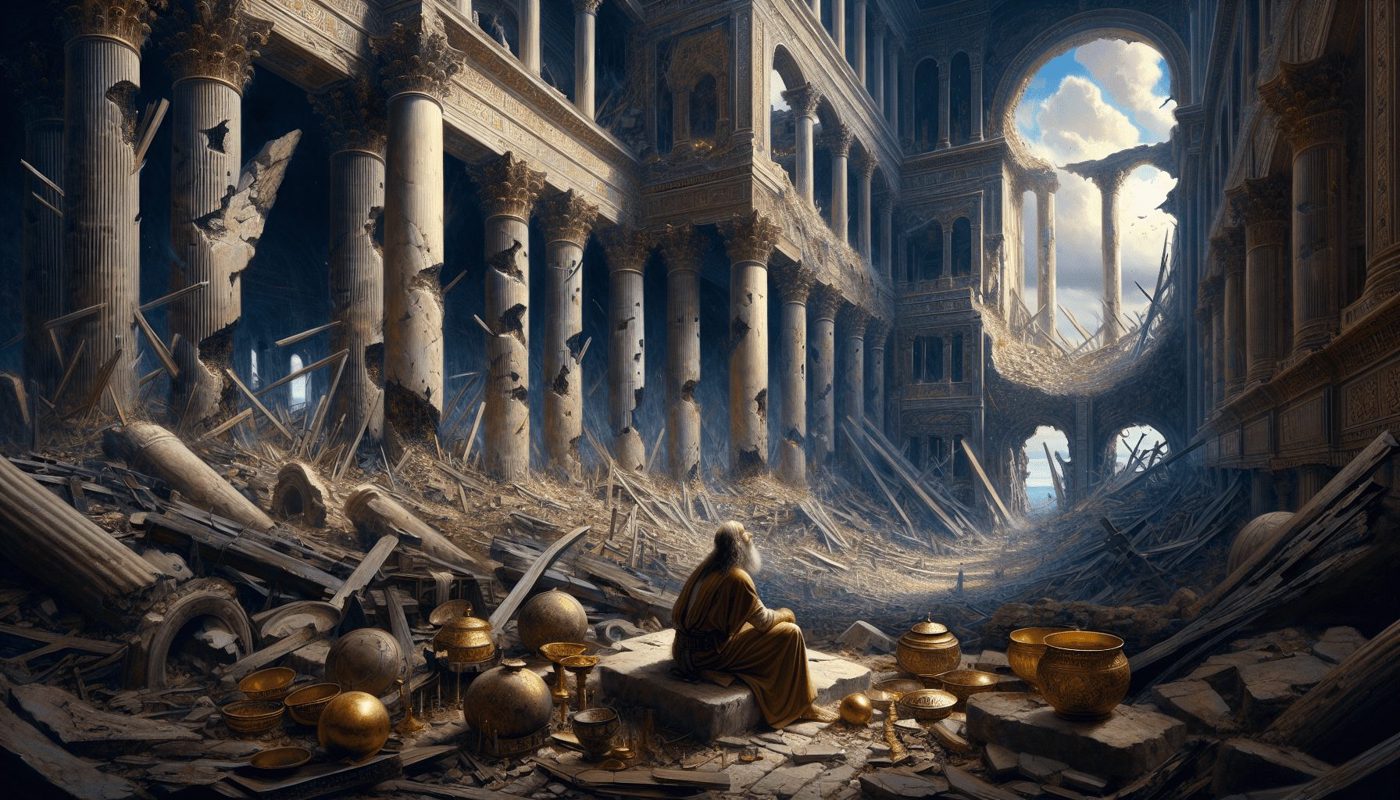
The psalm opens with a question that has no answer yet. Asaph, the writer, asks why the Lord has cast off his people forever, why his anger smokes against the sheep of his own pasture. The congregation is not a nameless crowd. It is the tribe of the Lord's inheritance, the people he redeemed long ago, the people who once gathered at Mount Zion where he dwelt. But now the sanctuary lies in ruins, and Asaph calls on God to lift his feet and walk through the perpetual devastation.
The enemy has done unspeakable things in the holy place. They roared in the midst of the assembly like beasts. They set up their own ensigns as signs, replacing the symbols of the Lord with their own banners. The psalmist compares them to men swinging axes against a thicket of trees. The carved work of the sanctuary, every piece of craftsmanship dedicated to the Lord, they broke down with hatchet and hammers.
They set the sanctuary on fire. They profaned the dwelling place of the Lord's name, casting it to the ground. And they said in their hearts, Let us make havoc of them altogether. They burned up all the synagogues of God in the land. There was no corner left untouched. The religious life of the people was erased by fire and iron.
Asaph looks around and sees no signs. There is no prophet left to interpret the times. No one knows how long this desolation will last. The silence of God is as crushing as the noise of the enemy. The reproach of the adversary is constant, and the blasphemy against the Lord's name is unending. Asaph cries out, How long, O God? Why do you hold back your right hand? Why do you keep it tucked in your bosom and refuse to consume the enemy?
Then the psalm pivots. Asaph does not stay in the rubble. He remembers that God is his King of old, working salvation in the midst of the earth. He rehearses the ancient acts of power: the dividing of the sea, the breaking of the heads of the sea monsters, the crushing of Leviathan whose carcass became food for the wilderness dwellers. These are not myths. They are the deeds of the Lord, the same Lord who now seems silent.
He remembers that the Lord cleaved the fountain and the flood, that he dried up mighty rivers. The day belongs to him, and the night belongs to him. He prepared the light and the sun. He set all the borders of the earth. He made summer and winter. The God who rules creation is the same God who seems to have abandoned his sanctuary.
Asaph calls on the Lord to remember. Remember that the enemy has reproached you. Remember that a foolish people has blasphemed your name. He pleads for the life of the Lord's turtledove, the helpless congregation, and begs that it not be delivered to the wild beast. He asks the Lord to look upon the covenant, because the dark places of the earth are full of the habitations of violence.
He does not want the oppressed to return ashamed. He wants the poor and needy to praise the Lord's name. He calls on God to arise and plead his own cause, to remember how the foolish man reproaches him all day long. The voice of the adversaries rises continually, and Asaph asks the Lord not to forget it.
The psalm ends where it began, with the tension unresolved. The sanctuary is still in ruins. The enemy is still roaring. But Asaph has anchored his complaint in the character of the Lord. He has reminded God of his own covenant, his own power, his own name. The lament is not a surrender. It is a demand that the Lord act according to who he has always been.
Comments
Comments 0
Read the discussion and add your voice.
Members only
Sign in to join the conversation
We keep comments tied to real accounts so the discussion stays clean and trustworthy.
No comments yet. Be the first to add one.