
The earth had grown old under a heavy sky. It was not the age of stone or riverbed that weighed upon it, but the accretion of a deeper rot, a settling of spiritual silt in the hearts of men. Generations had unfolded since the first exile from the garden, and the memory of that loss had curdled into something else entirely—a raw, grinning defiance.
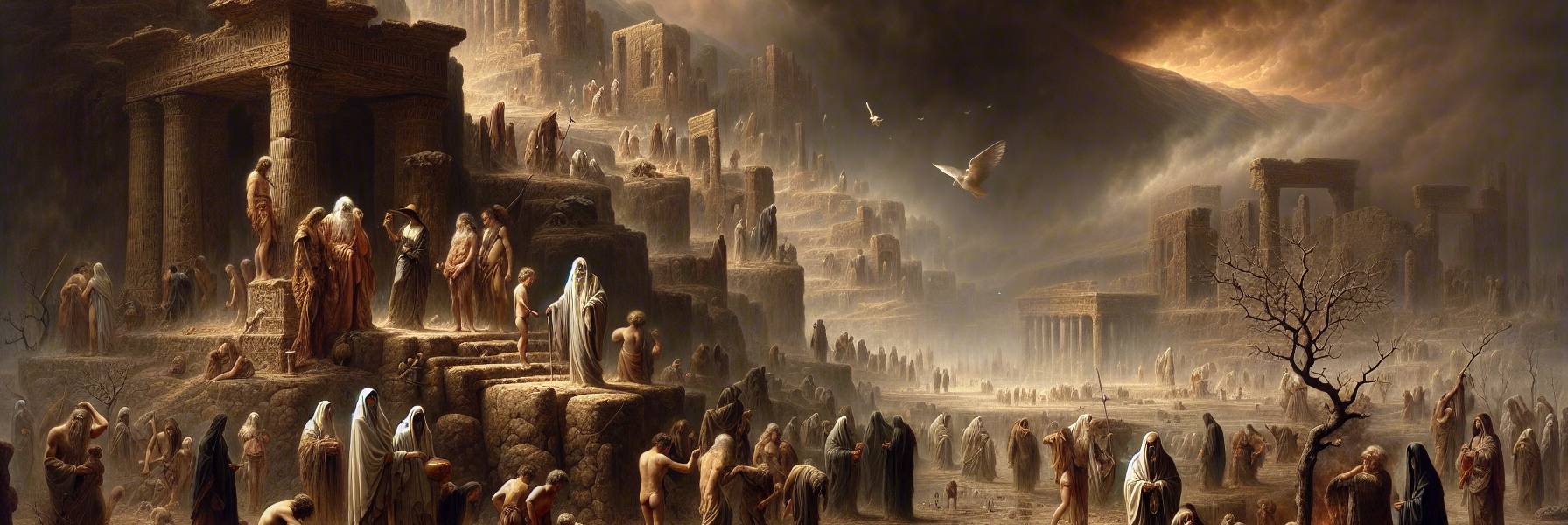
In those days, the air itself felt different. It carried not just the smoke of hearth-fires, but the thicker smoke from altars raised to nameless appetites. The sons of God—those ancient, mysterious lines of Seth, who once called upon the Lord’s name—saw the daughters of men. It wasn’t mere seeing. It was a calculated noticing, a covetous gaze that measured comeliness like a merchant weighs grain. They took wives, we’re told, whomever they chose. There was no covenant in it, only possession. And from these unions came the Nephilim, the “fallen ones,” giants of renown, but also of violence. Their legend was not of virtue, but of might, and the world after them grew into a echo-chamber of their example.
Every imagination, every silent thought of the human heart, had become only evil, continuously. It was a thorough thing. Not a stray wicked idea here and there, but the very substrate of thought, stained. You could see it in the markets, where a deal was a prelude to a knife. You could hear it in the laughter that held no joy, only scorn. You could smell it in the cities, a sweet-sour stench of spilled blood and spoiled offerings. The violence was what finally seeped up through the soil like a plague. It wasn’t just war; it was a principle, the first and last argument for everything. A man’s life was a brief, cheap thing, torn as easily as bread.
And the Lord… the text uses a word that aches: *yit’atzeb*. He was grieved to His heart. This isn’t the anger of a slighted monarch. This is the profound, personal sorrow of a maker watching his masterpiece deliberately smash itself to fragments. He had breathed His own breath into this clay, and now the clay gloried in its own filth. The regret was a divine, sorrowful truth: He had made man upon the earth, and it pained Him.
So He said, “I will blot out man whom I have created from the face of the land, from man to animals to creeping things and to birds of the sky.” The decree was total, a terrible unmaking. The corruption was so complete it had leached into the very order of creation; the animals, drawn into the sphere of human chaos, shared in the judgment. The earth itself was to be scrubbed clean.
But.
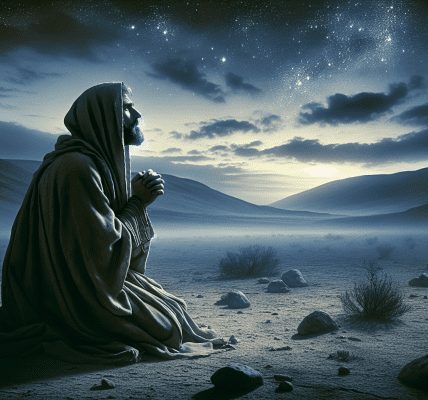
In the grinding machinery of that generation, one man found a different grain. Noah. A name that meant “rest.” In all that relentless noise, he was a space of quiet. He found favor in the eyes of the Lord. Not because he was perfect, but because he walked with God. It was an anachronism. In an age of sprinting toward depravity, Noah walked. Slowly, deliberately, in step with a presence everyone else had declared a fiction.
He had three sons: Shem, Ham, and Japheth. They were his world, his argument for continuity in a world bent on ends.
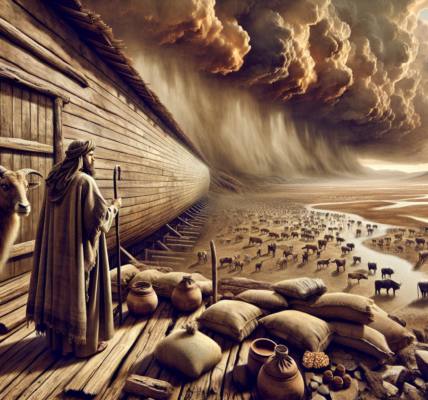
God spoke to Noah. The voice wasn’t in the thunder, but in the quiet of his own spirit, a dreadful certainty that settled into his bones. “The end of all flesh has come before Me,” the voice said. “The earth is filled with violence through them. Behold, I am about to destroy them with the earth.” The instructions that followed were absurdly specific. Gopher wood. Pitch. Three hundred cubits long, fifty wide, thirty high. A window. A door. Three decks. The precision of it was a lifeline in the coming chaos. A blueprint for salvation.
“I will establish My covenant with you,” God said. And with that sentence, the nature of everything changed. The story was no longer about universal blotting out. It was about a box, a family, a promise, and the careful, paired preservation of every creeping, flying, galloping thing.
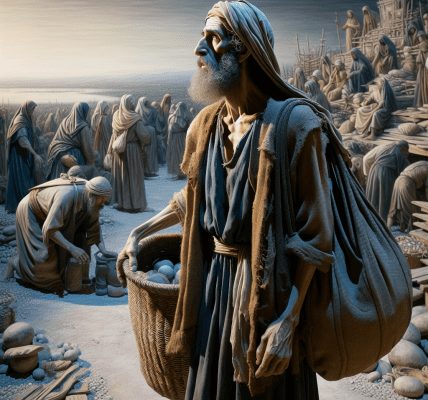
Noah didn’t argue. He didn’t ask for proof. The text simply says, “Thus Noah did; according to all that God had commanded him, so he did.” The obedience was as complete as the corruption around him. For decades, in a world that saw only his foolishness, he bent his back to the wood. The sound of his hammer must have been a joke to his neighbors—the steady *thock-thock-thock* of a man building a giant barge on dry ground, under a perpetually cloudless, pitiless sky. He was a spectacle. But he kept walking with God, and the ark took shape, rib by rib, a skeletal testament to a faith that smelled of fresh-cut timber and pungent pitch.
And as he worked, the grief of heaven and the obedience of this one man hung in a fragile balance, while the world, unaware, feasted on the last days of its own decaying fruit. The clouds, when they finally began to gather, were not yet seen. But Noah felt the change in the air. It was the smell of coming rain, and of a terrible, necessary mercy.