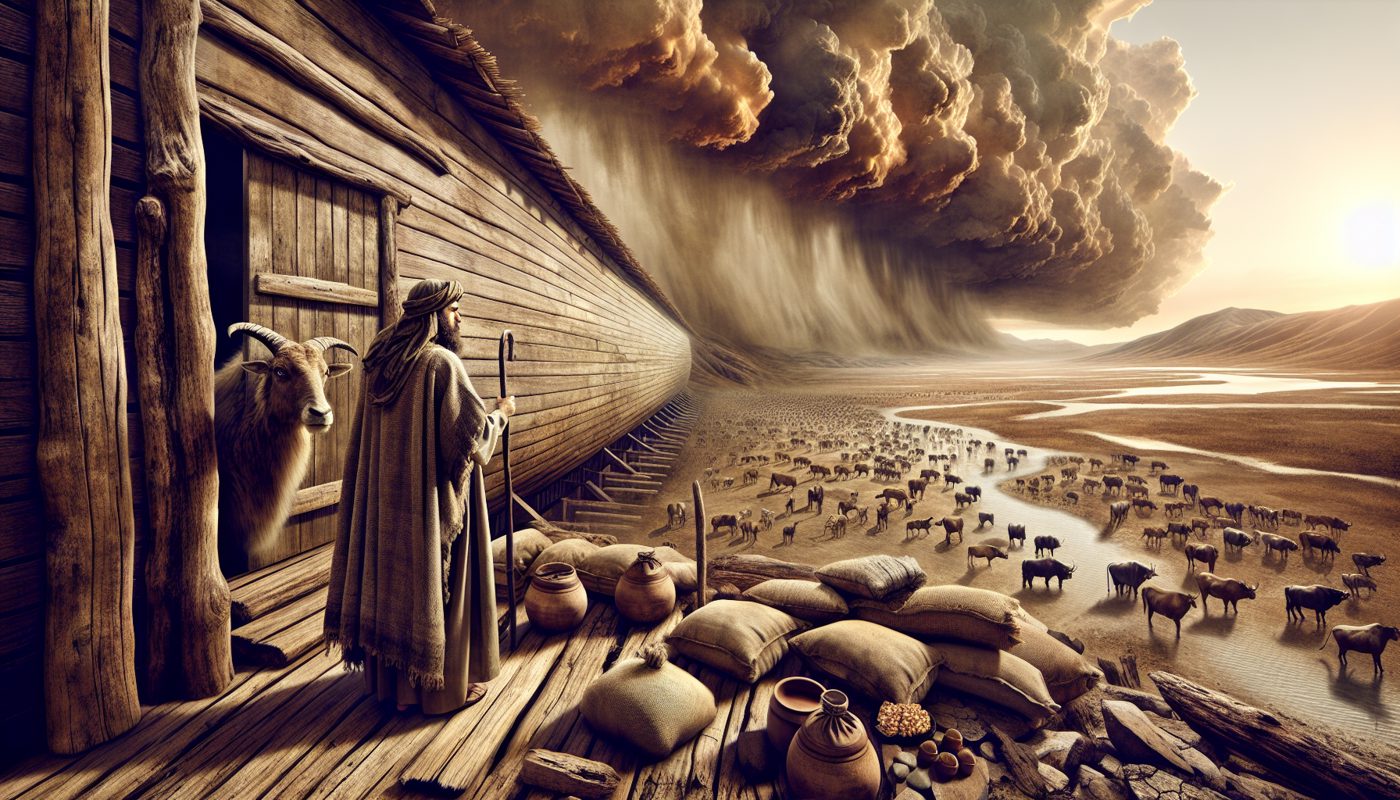
The Lord gave a direct command and a precise timeline. Seven days remained before the rain would come, forty days and forty nights of it, enough to destroy every living thing from the face of the ground. Noah was six hundred years old when the waters arrived, and he did exactly what he was told: he brought his family into the ark, his sons Shem, Ham, and Japheth, their wives, and his own wife. The animals came in pairs, male and female, clean beasts seven pairs, unclean beasts one pair, birds seven pairs, every creeping thing after its kind. They entered exactly as God commanded, two by two, all flesh that had the breath of life.
On the seventeenth day of the second month, in that same year, the breaking point came. It was not merely rain. The fountains of the great deep burst open from below, and the windows of heaven were thrown wide from above. The water came from both directions at once, a double assault that no structure on dry ground could withstand. The ark, sealed with pitch and timber, began to rise as the waters increased. It lifted off the earth and floated, carried on the face of the flood.
The text marks the moment with unusual precision. The Lord himself shut the door. No human hand sealed that entrance. Once Noah and his family were inside, once every creature had entered its place, the Lord closed them in. It was an act of divine finality, a door that could not be opened from the inside or out. The ark was now a vessel cut off from the world, adrift on a rising sea.
The waters prevailed for forty days. They did not simply cover the ground; they rose over the highest mountains, covering them by fifteen cubits. The mountains that had stood as landmarks for generations, the peaks that shepherds knew and travelers used to orient themselves, were swallowed entirely. No high place remained. No hilltop refuge offered safety.
Everything that moved on dry land died. Birds, cattle, wild beasts, creeping things, every human being—every creature with the breath of life in its nostrils perished. The text does not linger on their cries or their final moments. It states the fact with brutal economy: they were destroyed from the earth. The waters did not recede quickly. They prevailed for a hundred and fifty days, a span of nearly five months, during which the ark drifted without sight of land, without any sign that dry ground still existed.
Only Noah and those with him in the ark were left. The phrase carries the weight of absolute reduction. Out of all the men, women, children, and animals that had filled the earth, only eight people and a cargo of paired creatures remained. The ark was not a zoo or a museum; it was a survival capsule, a wooden box holding the only breath of life left on the planet.
The chapter does not explain why the Lord chose to destroy everything. It does not mention the violence or corruption that preceded the flood. It simply records the execution of the judgment, the mechanics of the catastrophe, and the stark fact that Noah alone found favor. The door that the Lord shut was both an act of mercy for those inside and an act of finality for those outside.
The rain itself is mentioned almost as an afterthought. The real force of the destruction came from the deep, from the fountains that had been locked beneath the earth since creation. The windows of heaven opened, but the deep broke open. The flood was not a storm; it was a cosmic undoing, a return to the watery chaos that preceded the dry land in the beginning. The ark floated on that chaos, held by the same hand that had shut the door.
Noah's age, six hundred years, is given without comment. It anchors the event in a specific life, a specific year, a specific date. This is not a legend told in vague time; it is a record with a timestamp. The second month, the seventeenth day—the day the deep broke and the door was sealed.
Comments
Comments 0
Read the discussion and add your voice.
Members only
Sign in to join the conversation
We keep comments tied to real accounts so the discussion stays clean and trustworthy.
No comments yet. Be the first to add one.