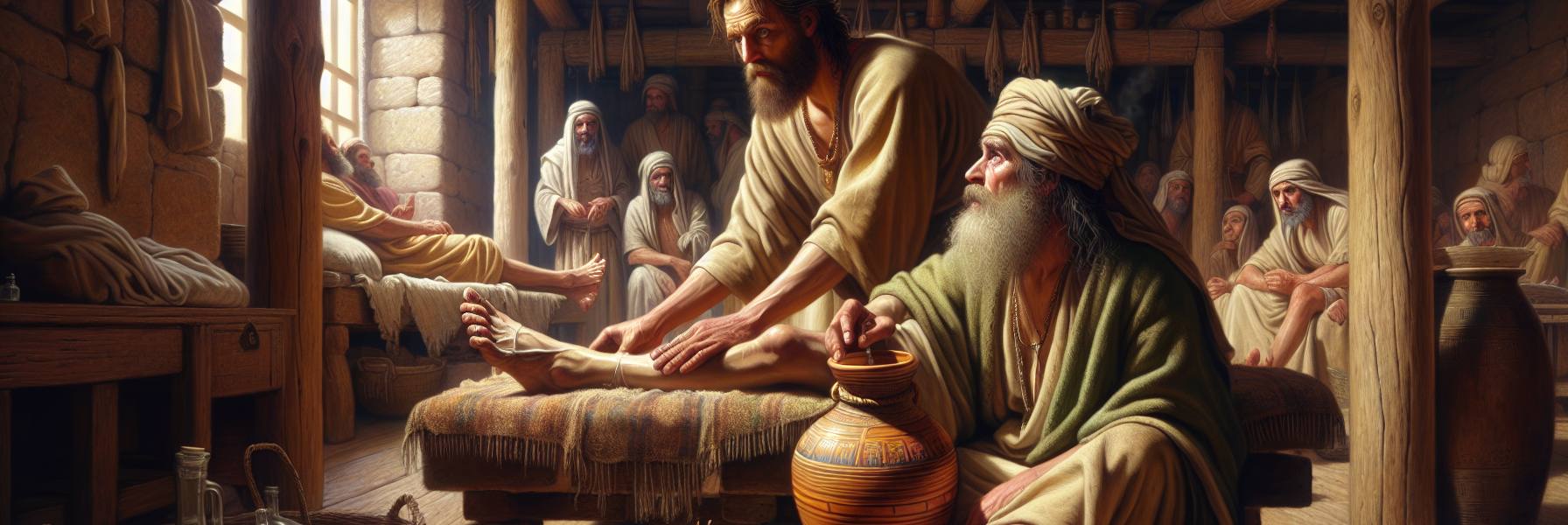

The smell of the ointment filled the house, a heavy scent of nard that clung to the beard and the robes and the very timbers of the roof. It was extravagant, a year’s wages broken open and poured out, and the shock in the room was a palpable thing. Judas Iscariot was the first to give it voice, a sharp, practical anger that masked a deeper, uglier disappointment. “This waste,” he muttered, but the word carried. “The poor…”
Jesus was reclining, His head close to the table’s low edge. He turned His face, and His eyes, tired but clear, settled not on Judas but on the woman, Mary, whose hands still trembled from the act. “Leave her alone,” He said, and His voice was quiet but it cut through the perfume-thick air. “She has done a beautiful thing to me. The poor you will always have with you, but you will not always have me.” He paused, and a shadow seemed to pass over His face, a knowledge that dimmed the lamp light in His eyes. “In pouring this ointment on my body, she has done it to prepare me for burial.”
A silence followed, colder than the criticism. The word *burial* hung there, unacceptable. Peter shifted uncomfortably, wanting to argue, to dismiss the gloom. But he caught the look on his Master’s face and held his tongue. It was then, some of them later recalled, that Judas got up and slipped out. No grand exit, just a man remembering an urgent errand. The door sighed shut behind him, and the night outside was very dark.
Two days later, with the Passover moon swelling in the sky, the tension in the city was a tight-drawn cord. In an upper room borrowed from a friend, the familiar rituals felt strange, charged. Jesus moved among them with a solemn tenderness. He took the bread, gave thanks, broke it. The sound was crisp in the quiet room. “Take, eat,” He said, and His hands were steady. “This is my body.” They passed it, rough fragments warm from His touch. Then the cup, red as a wound. “This is my blood of the covenant, which is poured out for many for the forgiveness of sins.” He drank first, a slow swallow. “I tell you, I will not drink again of this fruit of the vine until that day when I drink it new with you in my Father’s kingdom.”
They sang a hymn, voices ragged, and went out into the cool olive-scented night, toward the Mount of Olives. The road was pale under the moon. Peter, walking close, heard the Lord say, “You will all fall away because of me this night.” It struck him like a blow. “Even if all fall away,” he burst out, his voice too loud in the stillness, “I will not!” Jesus stopped walking. He looked at Peter, and the love in that look was more terrible than any rebuke. “Truly, I tell you, this very night, before the rooster crows, you will deny me three times.” Peter’s protest died in his throat, replaced by a hot, defiant shame. “Even if I must die with you,” he swore, low and fierce, “I will never deny you.” And all the others said the same.
Gethsemane was a grove of ancient, twisted trees, their gnarled roots gripping the hillside like old bones. He took Peter, James, and John deeper in. “My soul is very sorrowful, even to death,” He said, and the words were wrung from Him. “Remain here, and watch with me.” He went a little farther, a stone’s throw, and fell on His face. If they listened, they could hear His prayer, not words but a groan, the sound of a man wrestling with an unthinkable weight. “My Father, if it be possible, let this cup pass from me…” A long silence, broken by the rustle of an owl. Then, softer, “Nevertheless, not as I will, but as you will.”
He returned to find them asleep, their faces smoothed of worry in the moonlight. “So, could you not watch with me one hour?” The disappointment was weary, profound. He woke them, went and prayed again, the struggle deepening. When He came back a second time, they were asleep again, heavy with a sorrow they could not comprehend. The third time, He said simply, “Sleep and take your rest later. See, the hour is at hand.”
The torchlight came first, a bobbing, chaotic glare through the trees, then the clash of weapons and the murmur of many voices. Judas was at their head, his face a stiff mask. He stepped forward and kissed Jesus—a formal, hollow gesture. “Rabbi,” he said. Jesus met his eyes. “Friend,” He replied, the word layered with an infinite sadness, “do what you came to do.”
Then it was chaos. Peter, reacting, drew a sword and swung wildly, slicing off the ear of the high priest’s servant. Jesus’s voice cut through the din. “Put your sword back!” He touched the man’s ear and healed him, a final miracle in the gloom. Then to the armed crowd, “Have you come out as against a robber? I sat daily in the temple teaching.” But the hour had come. They seized Him and led Him away.
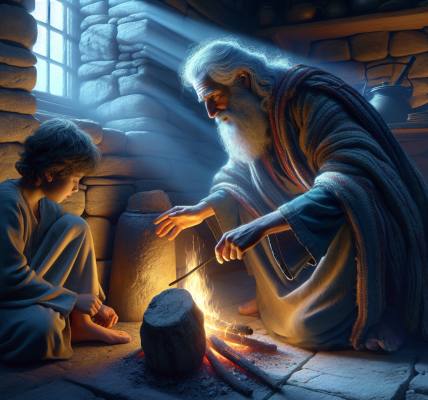
Peter followed at a distance, a ghost in the shadows, all the way to the high priest’s courtyard. He sat with the guards, trying to warm himself at their fire. The light flickered on anxious faces. A servant girl peered at him. “You also were with Jesus the Galilean.” The words were casual, but they froze him. “I do not know what you mean,” he said, his voice rough. He moved to the gateway. Another girl saw him and said to the bystanders, “This man was with Jesus of Nazareth.” Again, with an oath this time: “I do not know the man.” An hour passed, slow and terrifying. A relative of the man whose ear he’d cut stood forward. “Did I not see you in the garden with him?” This was the third time. Peter cursed. “I do not know the man!”
And immediately, the rooster crowed, a raw, tearing sound in the pre-dawn grey. Peter turned his head, and across the courtyard, through a doorway, he saw the Lord. They were leading Him somewhere, but for a fraction of a second, Jesus turned. He looked directly at Peter. Not in anger, not in triumph, but with a knowing, devastated compassion that saw the whole fractured truth of him.
Peter stumbled out into the street. The first pale light was staining the east. He walked, then ran, blind with a grief that had no tears yet, the sound of that crowing cleaving his world in two. He had not died with Him. He had only, terribly, proved Him right. And somewhere in a guarded hall, the long, silent hours of the morning began, as the Lamb prepared to be led to the slaughter.