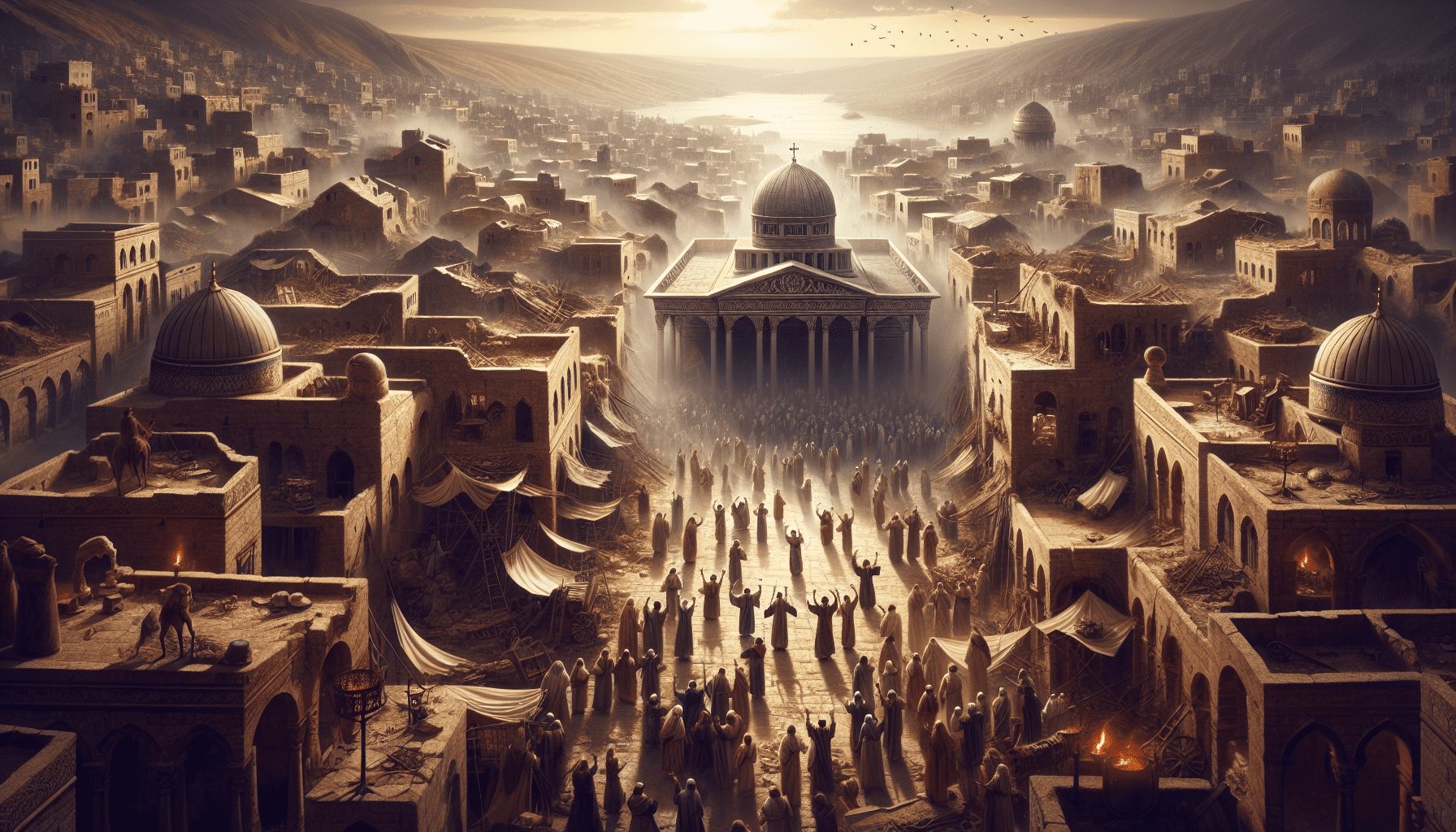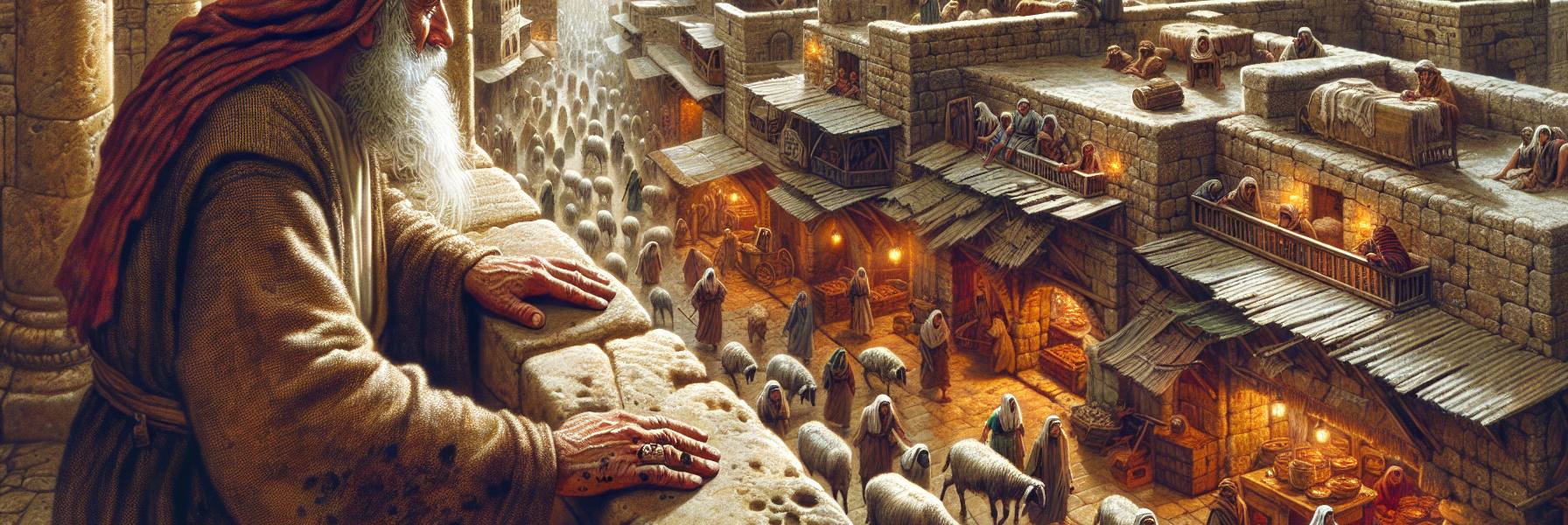

The heat in Jerusalem held a weight to it, a thick, honeyed heaviness that seemed to press the noise of the city down into the dusty stones. I, Nathan, once a scribe in the courts of Solomon’s son, now an old man with ink-stained fingers and a mind full of shadows, sought the slight breeze of my rooftop. Below, the business of the kingdom churned on—the call of merchants, the bleat of sheep for the Temple, the distant tramp of guards. It was all a machine, well-oiled and relentless. And I, having seen its gears from the inside, understood the truth of the Preacher’s words: *Who is like the wise? And who knows the interpretation of a thing?*
My thoughts drifted to a day years gone, a day that etched the eighth chapter of that weary, profound scroll onto my soul. I was not so old then, still obliged to serve in the palace. A command had come from the king—Rehoboam, a man whose folly was only outmatched by his brittle pride. It was not a wise decree. It was a tax, a new levy on the olive growers of Bethany, a spiteful measure born of a petty grievance. The order was written in stark, uncompromising lines. As I copied it for distribution, my stomach turned. I knew the farmers; they lived on a knife’s edge between harvest and hunger.
*Keep the king’s command, because of God’s oath to him.* The Preacher’s voice echoed in my memory. There was a sanctity to order, a divine allowance for authority, even when it was flawed. To rebel in haste was to invite a whirlwind. So I held my tongue. I did not join the murmurs in the scribes’ chamber. But neither could I make peace with it.
I took the scrolls to be sealed. In the throne room, the king was holding audience, a study in brooding power. His face was like a sealed document itself, revealing nothing. I thought of the verse: *Be not hasty to go from his presence. Do not take your stand in an evil cause, for he does whatever he pleases.* There is a craft to navigating the shadow of power, a slow, careful stepping back that is not flight. I presented the documents, bowed, and withdrew without lingering in the aura of his displeasure, which hung in the air like incense gone sour.
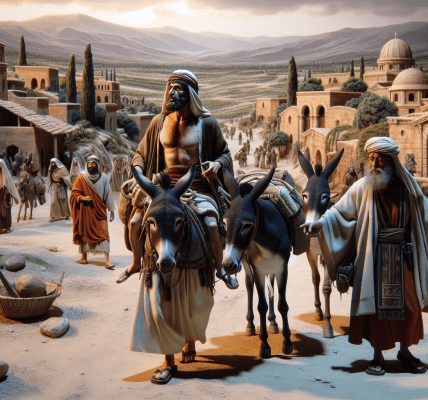
Later, I walked outside the city walls, towards the groves. I needed to see. Old Eliah was there, his hands like gnarled olive wood as he inspected a blighted branch. He saw my face and knew. “It is as the king has said?” he asked, his voice dry as the earth.
“It is,” I replied.
He nodded, a slow, weary descent of his chin. He did not curse. He did not rage. He looked up at the sky, a vast, indifferent blue. “The work must be done,” he said simply. “I have seen evil under the sun. A man labors in wisdom and knowledge and skill, but his lot falls to another. What remedy is there?” He spoke the Preacher’s words as if they were his own, because they were. They were everyone’s who had ever toiled and seen the fruit stolen.
I sat with him as the sun began its long, bloody descent. We spoke of times and seasons, of justice delayed. “It will not be well with the wicked,” I said, the doctrine firm in my mouth. But it tasted like dust.
Eliah smiled a thin, cracked smile. “No. It will not. But look.” He pointed a crooked finger towards the city, where the palace stood glowing in the twilight. “He is there, in his house of cedar, and his feast is prepared. And I am here, with this blighted branch. Where is the reckoning? It is a shadow I cannot catch. *Though a sinner does evil a hundred times and prolongs his life…* I have seen this, Nathan. I have seen it.”
The darkness gathered in the hollows of the hills. I walked back, the Preacher’s lament a drumbeat in my skull: *There is a vanity that takes place on earth, that there are righteous people to whom it happens according to the deeds of the wicked, and there are wicked people to whom it happens according to the deeds of the righteous.* It was the great, unbearable knot at the center of all things under the sun. Wisdom could see the knot, could describe its every twisted fiber, but could not untie it.
That night, from my rooftop, I watched the celebrations in the palace—pinpricks of torchlight, the faint drift of music. A feast for some visiting dignitary, a show of power and prosperity. It was all so utterly certain in its arrogance. And yet, I knew. *No man has power to retain the spirit, or power over the day of death.* That same truth waited for the king in his hall as it did for Eliah in his grove. There is no discharge in that war.
Years have passed since that evening. Rehoboam is dead. Other kings have risen and fallen. Eliah, too, is gone to his ancestors. I am left here, with the heat and the memories and the relentless, circling wisdom of the scroll.
I have applied my heart to all this, to know the work of God. And the conclusion is not a conclusion, but a posture. We cannot find it out. The work is unsearchable. We are to eat our bread with a measure of gladness, drink our wine with a willing heart, labor with our hands as best we can, and give honor where it is due—not because the machine of the world is just, but because God has allowed it, for a time, to turn. And in the turning, amidst the vanity and the striving and the inexplicable sorrow, there are still moments where the light falls on an olive leaf just so, or a word of kindness is spoken, and it is, faintly, a gift. We cling to that. We must. For who can bring us to see what will be after us? The darkness, when it comes, is total. But until then, we have the toil, the little joys, and the terrible, weighty, God-given burden of wisdom that knows its own limits.