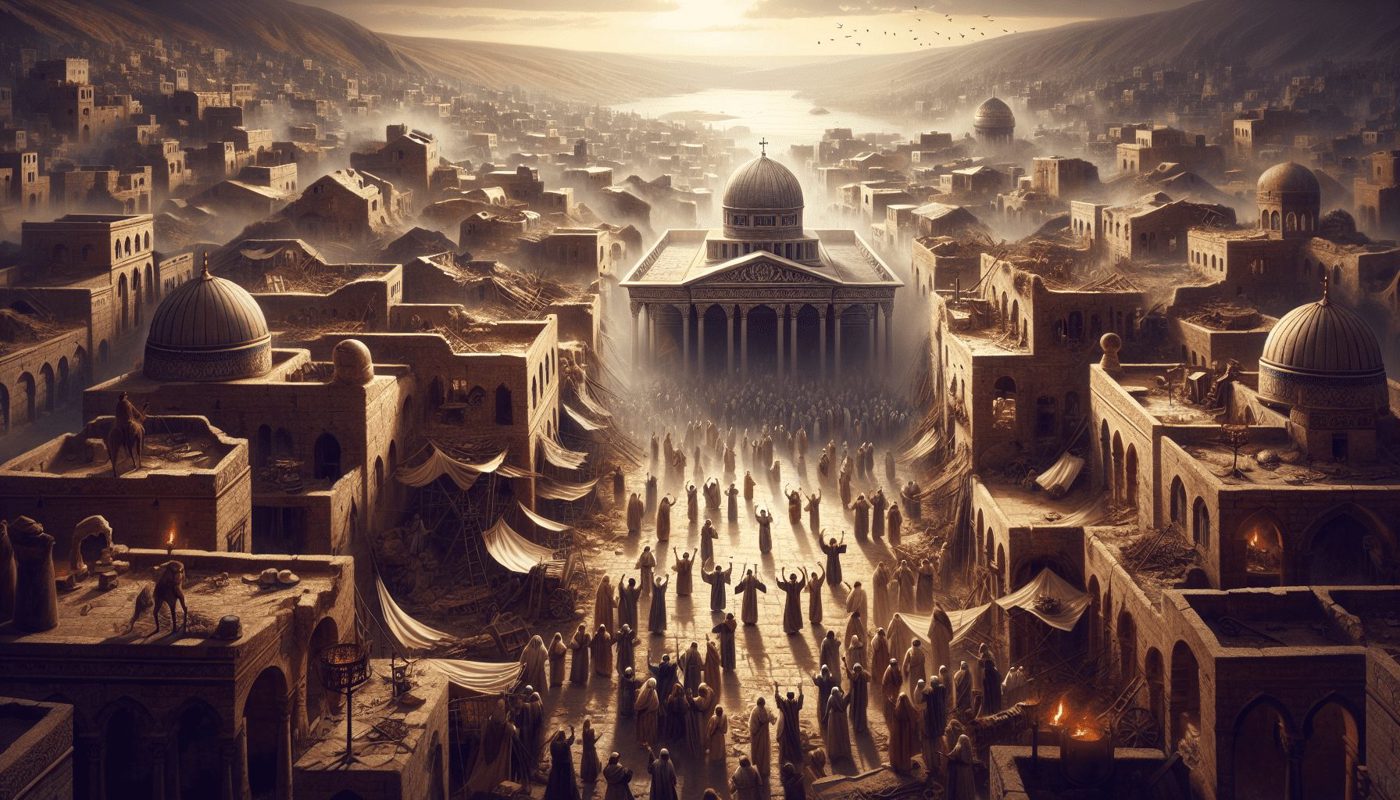
The chapter opens with a promise that cuts straight through the wreckage of exile. The Lord declares that He will be the God of all the families of Israel, and they shall be His people. This is not a vague hope but a specific claim on a scattered nation. The people who survived the sword found favor in the wilderness, and the Lord says He loved them with an everlasting love. That love is the ground of the restoration that follows, not their merit or their sorrow.
The Lord speaks directly to the virgin of Israel, telling her that she will be built again. She will take up her tambourines and go out in the dances of merrymakers. The vineyards on the mountains of Samaria will be planted again, and the planters will enjoy the fruit. Watchmen on the hills of Ephraim will call the people to go up to Zion, to the Lord their God. The restoration is not just a return to land but a return to worship and joy.
The Lord commands the nations to hear and declare that He who scattered Israel will gather them like a shepherd gathering his flock. He will bring them from the north country, from the farthest parts of the earth, including the blind, the lame, the pregnant woman, and the woman in labor. They will come with weeping, but the Lord will lead them with supplications, walking them by rivers of water on a straight path where they will not stumble. He calls Himself a father to Israel, and Ephraim His firstborn.
The people will come and sing on the height of Zion. They will flow to the goodness of the Lord, to grain, new wine, oil, and the young of the flock and herd. Their soul will be like a watered garden, and they will not sorrow anymore. The virgin will rejoice in the dance, the young men and the old together. The Lord will turn their mourning into joy, comfort them, and make them rejoice from their sorrow. He will satiate the priests with fatness, and His people will be satisfied with His goodness.
Then the tone shifts. A voice is heard in Ramah, lamentation and bitter weeping. Rachel weeps for her children; she refuses to be comforted because they are not. The Lord answers her directly. He tells her to refrain her voice from weeping and her eyes from tears, for her work will be rewarded. Her children will come again from the land of the enemy. There is hope for her latter end, and her children will return to their own border.
Ephraim is heard bemoaning himself. He admits that the Lord chastised him, and he was chastised like a calf unaccustomed to the yoke. He asks to be turned, and he will be turned. After he was turned, he repented. After he was instructed, he smote his thigh in shame and confusion, bearing the reproach of his youth. The Lord responds with a question that reveals the depth of His feeling: Is Ephraim a dear son, a darling child? Even when the Lord speaks against him, He earnestly remembers him. His heart yearns for him, and He will surely have mercy.
The Lord commands the people to set up waymarks and guideposts, to set their heart toward the highway by which they went, and to turn again, O virgin of Israel, to these your cities. He asks how long the backsliding daughter will go hither and thither, for the Lord has created a new thing in the earth: a woman shall encompass a man. The meaning is not explained, but the command to return is clear.
The Lord of hosts declares that in the land of Judah and its cities, when He brings back the captives, they will say, The Lord bless you, O habitation of righteousness, O mountain of holiness. Judah and all its cities will dwell together, the husbandmen and those who go about with flocks. The Lord has satiated the weary soul and replenished every sorrowful soul. The prophet awakes and says his sleep was sweet.
The Lord announces that He will sow the house of Israel and the house of Judah with the seed of man and beast. Just as He watched over them to pluck up, break down, overthrow, destroy, and afflict, so He will watch over them to build and to plant. In those days, they will no longer say that the fathers have eaten sour grapes and the children's teeth are set on edge. Every man will die for his own iniquity; the one who eats the sour grapes will have his own teeth set on edge.
Then comes the central promise. The Lord declares that He will make a new covenant with the house of Israel and the house of Judah, not according to the covenant He made with their fathers when He brought them out of Egypt, which they broke. This new covenant will be written on their inward parts and on their hearts. He will be their God, and they will be His people. They will not need to teach each other to know the Lord, for all will know Him, from the least to the greatest. He will forgive their iniquity and remember their sin no more.
The Lord grounds this promise in the fixed order of creation. He gives the sun for light by day, the moon and stars for light by night, and stirs up the sea so that its waves roar. If these ordinances depart from before Him, then the seed of Israel will cease from being a nation before Him forever. If heaven above can be measured and the foundations of the earth searched out, then He will cast off the seed of Israel for all that they have done. The promise is as stable as the cosmos.
The chapter ends with a specific building plan. The city will be built to the Lord from the tower of Hananel to the gate of the corner. The measuring line will go out straight onward to the hill Gareb and turn about to Goah. The whole valley of dead bodies and ashes, and all the fields to the brook Kidron and the horse gate toward the east, will be holy to the Lord. It will not be plucked up or thrown down anymore forever.
Comments
Comments 0
Read the discussion and add your voice.
Members only
Sign in to join the conversation
We keep comments tied to real accounts so the discussion stays clean and trustworthy.
No comments yet. Be the first to add one.