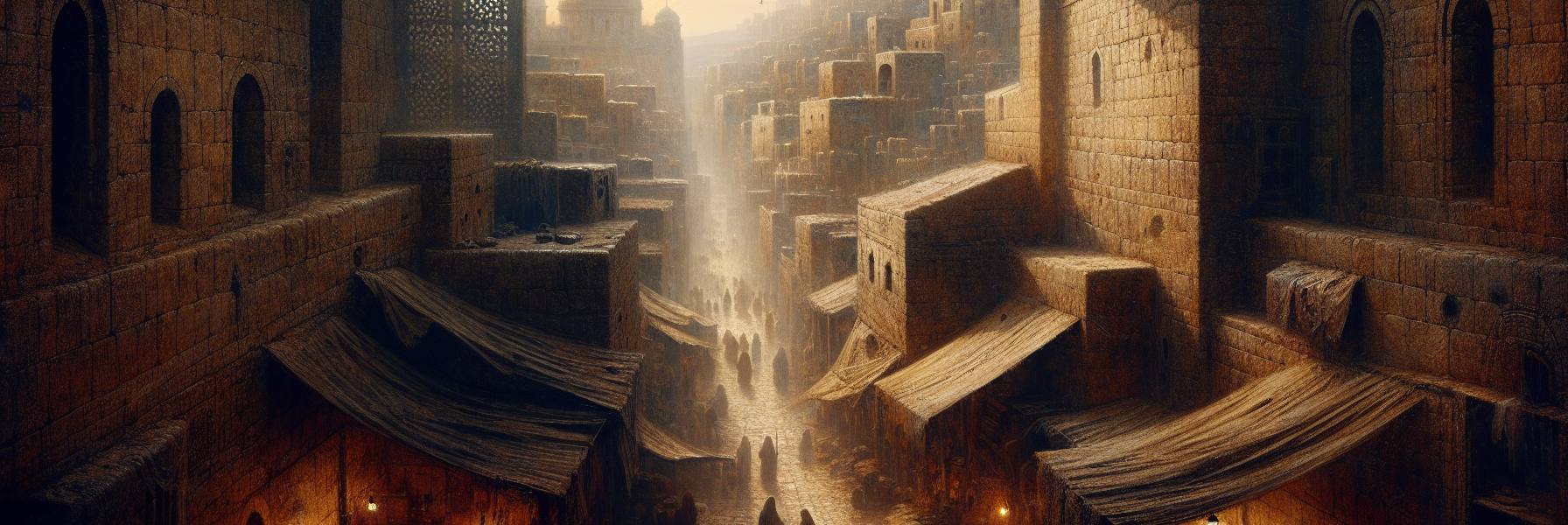

The heat had settled over the city like a wool blanket, thick and suffocating. It was the kind of evening where the very stones of the walls seemed to exhale the day’s stored warmth, and the air hung still, heavy with the scent of dust and myrtle. I remember it, son, not as a parable, but as a window I happened to peer through.
My own son was young then, perhaps near your age. I’d been speaking to him of wisdom, of holding her close as a sister, of understanding as a kinswoman. Words can feel thin in the twilight. But life, life has a way of providing its own illustrations.
From the lattice of my upper room, the view cut down into the street, a narrow artery pulsing with the last of the day’s business. The merchants were shuttering their stalls, their voices a tired murmur. That’s when I saw him—a youth, one of the many who seem to walk with a shadow of purpose but no substance. He wasn’t wicked; he was empty. His steps were aimless, a meander that took him down the lane toward the house of a certain woman. Not just any woman. You could sense it even from a distance. She had a reputation that clung to her like perfume, noticeable three streets away.
She emerged just as the last ribbon of sun bled over the western wall. Dressed not for the market, but for the shadows. Her garments spoke of expensive linen, but the way she wore them… it was an art. A calculated disarray. Her eyes were kohl-rimmed pools that didn’t just look, they hunted. She was restless, a caged creature pacing the mouth of her own dwelling, now leaning in a doorway, now drifting to the corner where the alleys converged.
And then her gaze caught him. The young man, adrift on the tide of his own boredom. I saw her posture shift. The restless pacing melted into a posture of sudden, delighted surprise. It was so practiced it seemed genuine, if you didn’t know to look for the calculation in the curve of her smile.
She seized him. Not with her hands, at first, but with a voice that carried on the thick air—brazen, yet pitched with a laugh that was meant to sound girlish. “I have peace offerings!” she called out, as if this were a happy coincidence. “Today I paid my vows. So I came out to meet you, to seek you eagerly, and I have found you.”
The young man stammered something I couldn’t hear. His shoulders, which had been slumped, straightened a little. She was painting a picture for him, and he was starting to see himself in it. The diligent woman, the religious duty fulfilled, and now… a feast. Just for him.
She drew closer. I could see her hand brush his arm, a gesture both casual and possessive. “I have spread my couch with coverings,” she murmured, her voice dropping to a conspiratorial thread I could barely catch, “colored linens from Egypt.” She spoke of myrrh and aloes and cinnamon as if describing the very air in her room. An entire world of sensory delight, constructed in a dozen words.
“Come,” she said, and the word was a hook. “Let us take our fill of love until morning; let us delight ourselves with love.” Her logic was a dark, seductive river. “For my husband is not at home; he has gone on a long journey; he took a bag of money with him; he will not come home until the full moon.”
It was the removal of consequence. The husband was a distant idea, a calendar mark. The path was clear. Safe, even.
The boy listened. God help him, he listened. His resistance was the faintest of protests, a cloud that vanishes before the wind. She swayed him with the force of her will, with the press of her lips, with the smoothness of her speech. “With much seductive speech she persuades him; with her smooth talk she compels him.”
And then he went. All at once, like an ox going to the slaughter, or a stag stepping into a noose. He followed her into the dim interior of the house, and the door closed softly behind them. The street was empty again, just the deepening blue of dusk and the first pricks of stars. The whole transaction had taken moments, yet it felt like watching a soul drown in slow motion.
The image that came to me then, and haunts me still, was not of passion, but of idiocy. A bird, seeing the net, rushing into it. A dart striking the liver. He did not know—he chose not to know—that it would cost him his life. Her house was not a home; it was a highway to Sheol, descending to the chambers of death.
I turned from the window. The room was dark. My own son was asleep, his breathing steady and untroubled. The weight of what I had witnessed settled on me. It wasn’t just a moral failure; it was a failure of imagination. The boy could not see beyond the next moment, the next pleasure. He had stored up no wisdom, no understanding, to draw upon when the empty hours and the smooth words came.
So I write this to you now, not as a strange tale, but as a street scene from the world you walk in every day. The details change. The street might be a digital square, the garments might be different, the seduction might be an ideology or a quick path to success that asks you to lay down your character. But the heart of it is the same: a soul, unguarded, adrift at twilight, listening to a voice that promises life but deals in death.
Keep my words. Treasure my commandments. Bind them on your fingers; write them on the tablet of your heart. Because the twilight always comes, and the empty street awaits, and you must know, deep in your bones, where it leads before you ever set foot upon it.