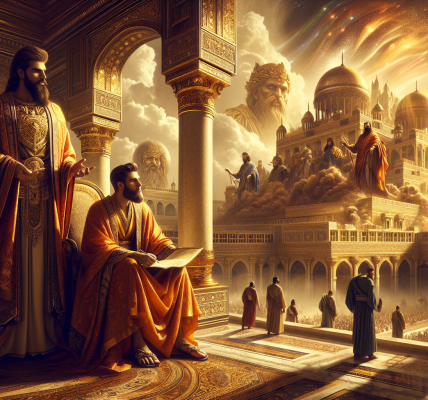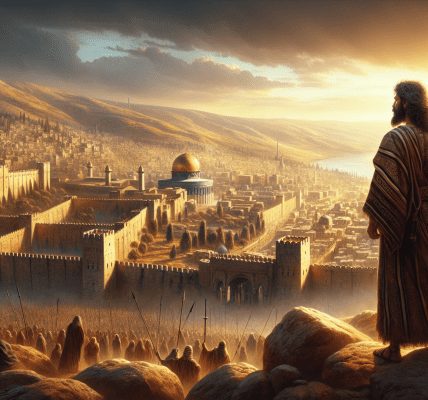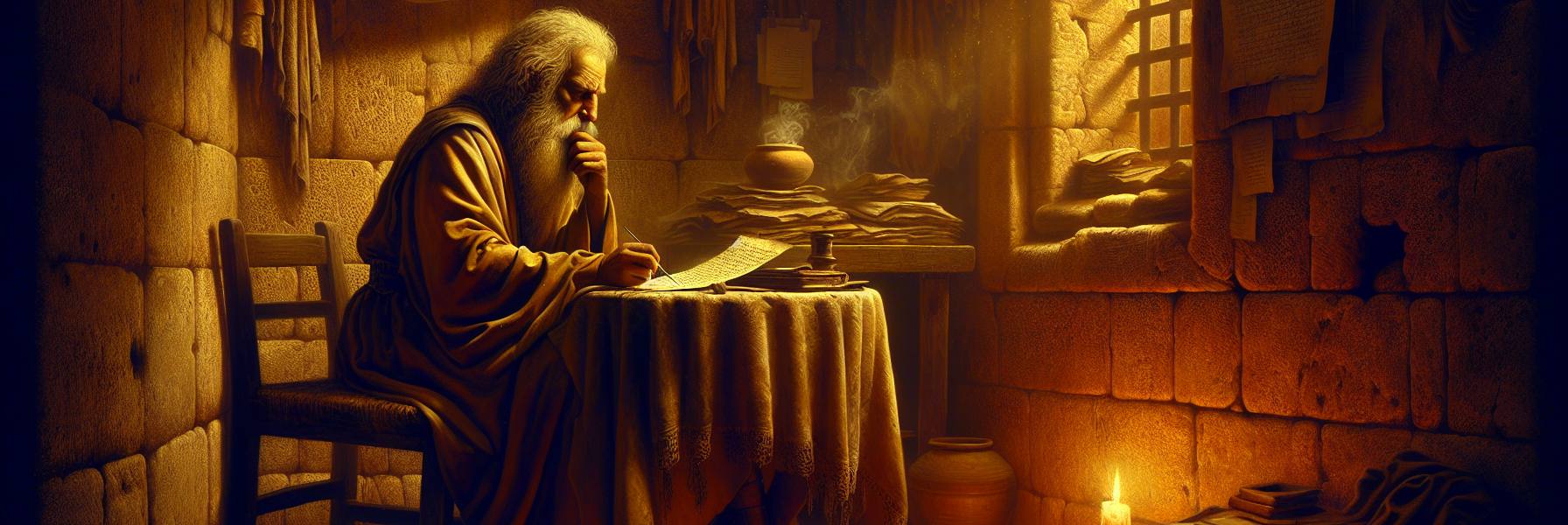

The ink on the papyrus was dry, but the words still felt wet in Asaph’s mind. It was one of those heavy, bronze-skied evenings in Jerusalem, where the heat of the day pooled in the narrow streets like spilled wine. He sat in the small, shadowed room he used for writing, the last light bleeding through the high window and catching the motes of dust that drifted, timeless, in the air. He was tired. Tired from the ceremonies, tired from the petty intrigues of the court, tired from the weight of the covenant that sometimes felt less like a promise and more like a millstone around the neck of a stubborn people.
The verse had come to him not in a thunderclap, but in a slow, cold seep, like groundwater finding a crack in stone. *Elohim takes his stand in the divine assembly; among the gods he pronounces judgment.*
He leaned back on his stool, the wood creaking a protest. How to give it flesh? It wasn’t a history. It was a glimpse behind the curtain, a truth seen sidelong, and to write it straight would render it absurd. The truth of visions required a different kind of telling.
He let his eyes close, not to sleep, but to see.
***
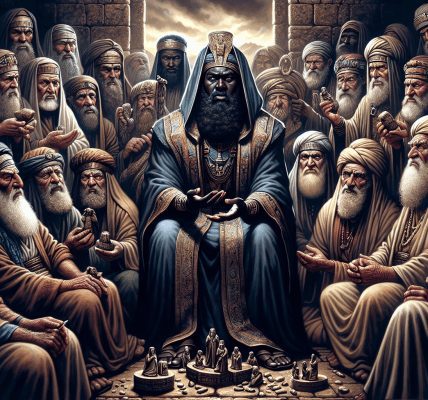
The council was not in heaven, not as we imagine it. It was in the foundations. The room, if it could be called that, was hewn from the granite of reality itself, a space where the weight of all that is pressed in from a darkness older than light. The air was not air, but the substance of law, cold and motionless. There were no torches. The light came from the figures seated in a rough circle, a dull, borrowed glow that clung to them like a second skin, illuminating nothing else.
They were the *elohim*. The word echoed in Asaph’s inner sight. Powers. Authorities. Beings entrusted with the custody of nations, the steering of seasons, the keeping of the deep wells of human potential. He saw them not as angels with wings, but as worn statues, their forms grand but blurred, as if carved by a wind that had blown for millennia. One had the semblance of a bull, shoulders vast and stooped with a burden. Another flickered like a desert mirage, its outline shifting between a man and a lion. A third sat perfectly still, its face a smooth oval where the features had long since eroded away, leaving only the impression of watchfulness.
They were silent. The silence was the loudest thing Asaph had ever heard.
Then, a movement. A presence entered the circle, not taking a seat, but standing. It was not taller than the others, but it occupied space differently. Where they were dense, heavy with their own jurisdiction, this one was… clear. A lens through which the unbearable source of all light might be viewed without being consumed. Yahweh. He did not shout. His voice was the sound of the foundation stone settling.
**“How long will you judge unjustly and show partiality to the wicked?”**
The words were not questions. They were declarations of a broken condition. They landed among the seated powers like stones dropped into a stagnant pool. Ripples of something—shame? defiance? weariness?—disturbed their stagnant light.
**“Give justice to the weak and the fatherless; maintain the right of the afflicted and the destitute. Rescue the weak and the needy; deliver them from the hand of the wicked.”**
Each clause was a hammer blow. Asaph, in his vision, felt each one in his own chest. He saw the widow in Ziph, cheated of her field by a bribed magistrate. He saw the Phoenician slave boy on the docks of Joppa, eyes deadened by hunger and the lash. He saw the farmer near Bethlehem watching a locust swarm darken the sky, a tax collector’s scroll in his hand. These were not abstractions. They were the specific, gritty, tear-stained realities over which these cosmic magistrates presided. And they had presided poorly.
The silence returned, thicker now. The bull-headed one lowered its great head. The mirage-being stopped its shifting. The faceless one remained faceless.
They did not understand. The accusation hung in the legal air. They had, perhaps, followed the letter of some cosmic ordinance. They had kept borders, enforced cycles, managed the broad currents of human history. But they had missed the point entirely. The law was not for its own sake; it was for the sake of the creature in the dust, the image-bearer gasping for breath and dignity.
The standing One spoke again, and now his voice carried a colder timbre, the sound of stars going out.
**“They have neither knowledge nor understanding, they walk about in darkness; all the foundations of the earth are shaken.”**
That was it. The diagnosis. They were not evil in a mustache-twirling way. They were incompetent. They were negligent landlords of creation. In their ignorance, in their failure to love justice as He loved justice, they had allowed the world’s very underpinnings to groan and shift. Every earthquake, every plague, every tyrannical dynasty was a symptom of this celestial malpractice.
Then, the sentence. It was not delivered in wrath, but with a terrible, grieving finality.
**“I said, ‘You are gods, sons of the Most High, all of you; nevertheless, like men you shall die, and fall like any prince.’”**
The borrowed glow around the figures guttered. The bull-shape seemed to crumble at the edges, not into dust, but into irrelevance. The mirage dissolved into a mere sigh of arid wind. The faceless one’s perfect oval cracked, a hairline fracture with nothing but void behind it. They were stripped. Their divinity, a delegated authority, was revoked. They were demoted to mortality. They would fall, not in a battle, but in the quiet, inexorable way human empires fall: forgotten, their names rubbed smooth by time, their power revealed as a fleeting illusion.
The vision broke.
***
Asaph’s eyes snapped open. The room was dark. A single oil lamp sputtered on the table. The night sounds of Jerusalem—a distant dog, a crying child, the murmur of a late passerby—filtered in. They were the sounds of the world whose foundations still trembled.
His hand, almost of its own accord, reached for the stylus. The words poured out, not the vision itself, but its aching, human aftermath. He wrote the judgment, the terrifying promotion and catastrophic demotion of the gods. He wrote the crumbling of their shadowed reign.
But his soul, the part of him that had witnessed the standing One, could not end there. The council’s gavel had fallen, yet down here, in the dust and the blood, nothing seemed changed. The wicked still prospered. The foundations still felt unstable.
So he ended with a plea, a raw, human cry flung from the shaking earth to the only stable point in the cosmos. It was no longer the voice of the visionary, but the voice of the old man in a dark room, smelling the dust and the oil, feeling the immense weight of the unanswered question.
*Arise, O God, judge the earth; for you shall inherit all the nations.*
He put the stylus down. The story was told. It was a fragment, a glimpse of a lawsuit in the bedrock of existence. It explained nothing neatly. It offered no easy comfort. It only replaced a small, manageable ignorance with a vast, terrifying knowledge: that the problems of the world run far deeper than human failing, and that the only hope lies in a Judge who is not like the others. The papyrus lay before him, filled. Outside, the world, in all its glorious and terrible darkness, carried on. He blew out the lamp and sat in the dark, waiting for the dawn.