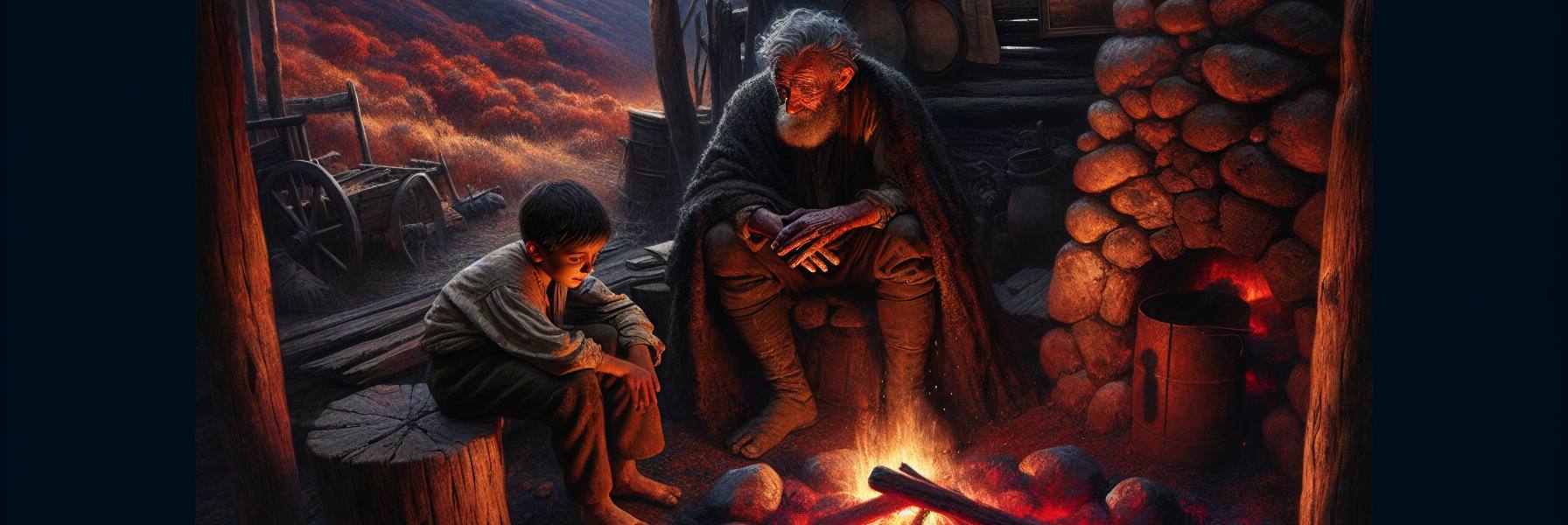

The fire had burned low, a bed of crimson coals pulsing like a tired heart in the hearthstone’s black embrace. Old Elam’s hands, mapped with a lifetime of grime etched deep into the creases, rested on his knees. They were hands that knew rock. Outside, the wind muttered across the ragged hills, a sound as constant as breath.
His grandson, a boy of ten summers with eyes too wide for his thin face, sat on a stool of rough-hewn pine. “Tell about the deep places,” the boy said, not for the first time.
Elam looked at his hands. He did not see hands, but tools. He saw the memory of the mountain’s belly.
“It’s not a place for telling,” he began, his voice a dry rustle like ore-cart wheels on a dusty track. “It’s a place of… absence. You go down, see, past the rabbit holes and the fox dens. Past where the roots of the great oaks taper off into nothing, thirsty and blind. You go down where the air grows old and still, and the weight of the world settles on your shoulders like a sodden cloak.”
He paused, listening to the wind. “Men like us, we follow a seam of something bright. A whisper in the stone. We’ll cut a channel through flint that sparks fury against our picks. We’ll hang by ropes in darkness so complete it feels solid, and we’ll swing our hammers at a vein of silver, watching it glitter in the lamplight like frozen starlight. We bring up things hidden since the foundations were laid. Iron from the stone, copper smelted from rock. We turn the inner darkness into a forge’s roar.”
The boy leaned forward, his shadow dancing on the wall. “What’s at the very bottom?”
A faint smile touched Elam’s cracked lips. “Darkness and mud. And silence. But that’s not the question, is it? You’re asking about the prize.”
He shifted, his joints complaining. “The birds, they don’t see it. The hawk’s eye is sharp for a mouse in the grass, but the riches under its wings? Blind. The proud lions on the crag, they know the path to the spring, but not the path to the sapphire. We are the ones. We overturn mountains from their roots. We split rivers with our galleries and let them drain away. Our lamps pierce every blackness.”
His voice dropped, taking on a wondering tone. “And we bring up… wonders. The ore of gold, which we refine till it’s like morning light held in your palm. Onyx from the secret places, stone that holds a universe of depth. We polish the quartz until the mountain’s heart shines. We dam the underground streams to get at what they hide. Things no living eye was meant to see, we drag them, grunting and straining, into the common sun.”
The fire cracked, sending a spiral of sparks upward. The boy was mesmerized. “So we know everything,” he whispered, a statement of faith.
Elam’s gaze left the fire and fixed on the boy. The fondness there was edged with a profound and weary sadness. “No,” he said, the word final as a dropped stone. “No, lad. That’s the joke of it. That’s the great and terrible joke.”
He reached for a clay cup of water, took a sip, letting the coolness sit on his tongue. “We can ransack the earth’s treasury. We can weigh wisdom on scales and buy understanding with the gold we’ve torn loose. But we cannot find *it*. The thing itself. The source.”
“Where does it come from?” the boy asked, his brow furrowed.
“Not from the land of the living,” Elam murmured, almost to himself. “The Deep says, ‘It is not in me.’ The Sea says, ‘It is not with me.’ You cannot buy it with the purest gold, nor weigh out its price in silver. It’s beyond the precious onyx, the crystal, the coral. Topaz from Cush holds no candle to it. It cannot be gotten for fine gold, or exchanged for a vase of worked silver.”
He looked at his gnarled hands again, these tools that had conquered depth and darkness. “Men can quarry rubies and cut lapis lazuli, but they cannot quarry wisdom. It is hidden from the eyes of all that live. Even the birds of the air, with their high views, cannot report it. The proud, things of destruction and death, they’ve only heard a rumor of it, a whisper on the wind.”
The room was very quiet now, save for the sigh of the ash in the hearth. The boy’s earlier excitement had settled into a deep, listening stillness.
“So where?” the boy finally breathed.
Elam’s old eyes seemed to focus on something beyond the mud-and-stone walls of the hut. “He understands its way,” he said, and the pronoun was heavy, capitalized in the quiet air. “He knows its place. For He looks to the ends of the earth and sees under the whole heavens. When He gave the wind its weight, and measured out the waters with a span. When He made a decree for the rain, and a path for the thunderbolt… then He saw it. He declared it. He established it. And He searched it out.”
Elam leaned forward now, capturing the boy’s gaze in the dim light. “And He said to man…” He stopped, cleared the gravel from his throat. “‘Behold, the fear of the Lord—that is wisdom. And to turn away from evil—that is understanding.’”
The words hung there, simple, stark, and utterly immense. They were not glittering. They held no weight you could heft in your hand. They were not buried in a mountain’s heart or sunk in an abyssal trench. They were just… there. In the quiet room. In the breath after the story. In the choice of the next moment.
The boy did not ask another question. He stared into the dying coals, his young mind trying to grasp the shape of a wisdom that could not be mined, only revered; a treasure that was not found, but lived.
Elam settled back. The lesson of the deep places was done. It was a story of glorious, futile strength, ending in a quiet, everlasting truth. The wind outside hadn’t changed its tune. But in the hut, the silence had become a different kind of thing. Not empty, but full. Not a void to be conquered, but a presence to be acknowledged. He watched his grandson think, and in the old miner’s weary heart, there flickered a light no lamp could ever replicate.