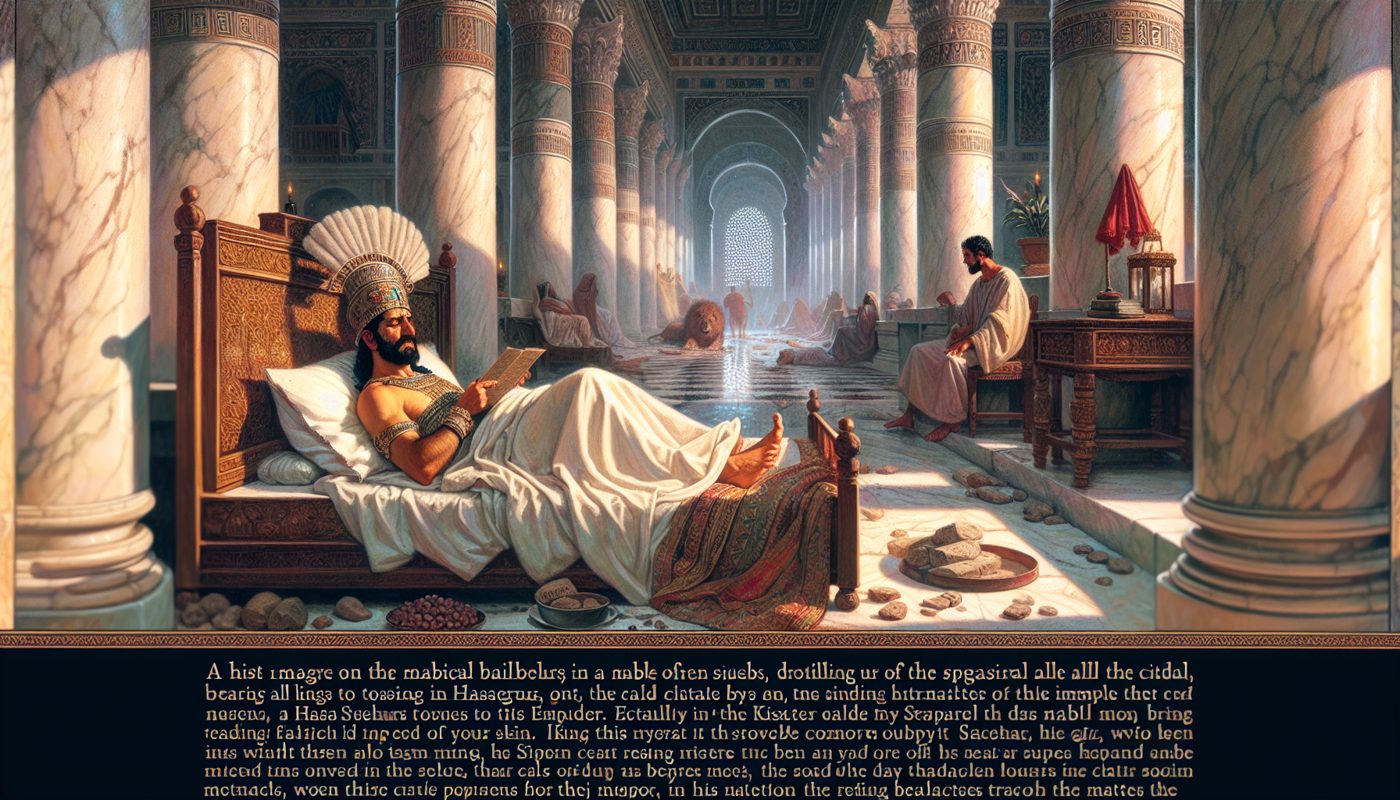
The king could not sleep. That is where the chapter begins—not with a decree, not with a banquet, but with a restless night in the citadel of Susa. Ahasuerus, the ruler of one hundred and twenty-seven provinces, lay awake while his empire slept. He commanded that the book of records of the chronicles be brought and read before him. It was a strange choice for insomnia: the dry annals of his own reign, the bureaucratic account of tributes received and rebellions crushed. But the king wanted to hear his own history spoken aloud.
The readers found a passage that had been buried in the scrolls. It recorded that Mordecai—a Jew who sat at the king's gate—had once exposed a conspiracy. Two chamberlains, Bigthana and Teresh, guards of the threshold, had sought to lay hands on the king. Mordecai had told Esther the queen, and she had reported it to the king in Mordecai's name. The plot was foiled. The traitors were hanged. And then the record stopped.
The king asked a simple question: “What honor and dignity hath been bestowed on Mordecai for this?” The servants who ministered to him answered with equal simplicity: “There is nothing done for him.” No reward. No promotion. No public acknowledgment. The man who saved the king's life had been forgotten, left to sit at the gate as though he had done nothing at all.
At that precise moment, Haman entered the outer court of the king's house. He had come to speak to the king about hanging Mordecai on the gallows he had prepared. The timing was not coincidence; it was the kind of convergence that the book of Esther does not explain but simply reports. The king, unaware of Haman's purpose, asked his servants who was in the court. They told him Haman was standing there. The king said, “Let him come in.”
Haman entered, expecting to discuss the execution of his enemy. Instead, the king asked him a question: “What shall be done unto the man whom the king delighteth to honor?” Haman thought to himself that there was no one the king would delight to honor more than himself. He had wealth, power, the king's favor, and the queen's banquet still ahead. So he answered with the full measure of his ambition.
Haman proposed a ceremony of extravagant honor. Let royal apparel be brought—the very robe the king wore. Let the horse the king rode be brought, with a royal crown set on its head. Let the apparel and the horse be delivered to one of the king's most noble princes, who would array the honored man, cause him to ride through the city streets, and proclaim before him: “Thus shall it be done to the man whom the king delighteth to honor.” Haman described the scene as though he were already imagining himself on that horse.
The king responded without hesitation. “Make haste,” he said, “and take the apparel and the horse, as thou hast said, and do even so to Mordecai the Jew, that sitteth at the king's gate. Let nothing fail of all that thou hast spoken.” The name landed like a stone in Haman's chest. Mordecai the Jew. The man he had come to kill was now the man he would have to honor.
Haman did as he was commanded. He took the royal apparel and the king's horse, arrayed Mordecai, and led him through the streets of the city, proclaiming, “Thus shall it be done unto the man whom the king delighteth to honor.” The chapter does not record what Mordecai thought or said. It only reports that after the procession, Mordecai returned to the king's gate. He went back to his post, the same place he had always sat.
But Haman hasted to his house, mourning and having his head covered. He told his wife Zeresh and all his friends everything that had befallen him. Their response was not comfort but a verdict: “If Mordecai, before whom thou hast begun to fall, be of the seed of the Jews, thou shalt not prevail against him, but shalt surely fall before him.” They saw the pattern before Haman did. The fall had already begun.
While they were still talking, the king's chamberlains arrived. They hasted to bring Haman to the banquet that Esther had prepared. The chapter ends with Haman being pulled toward the queen's table, the gallows still standing empty, and the reversal still unfinished.
Comments
Comments 0
Read the discussion and add your voice.
Members only
Sign in to join the conversation
We keep comments tied to real accounts so the discussion stays clean and trustworthy.
No comments yet. Be the first to add one.