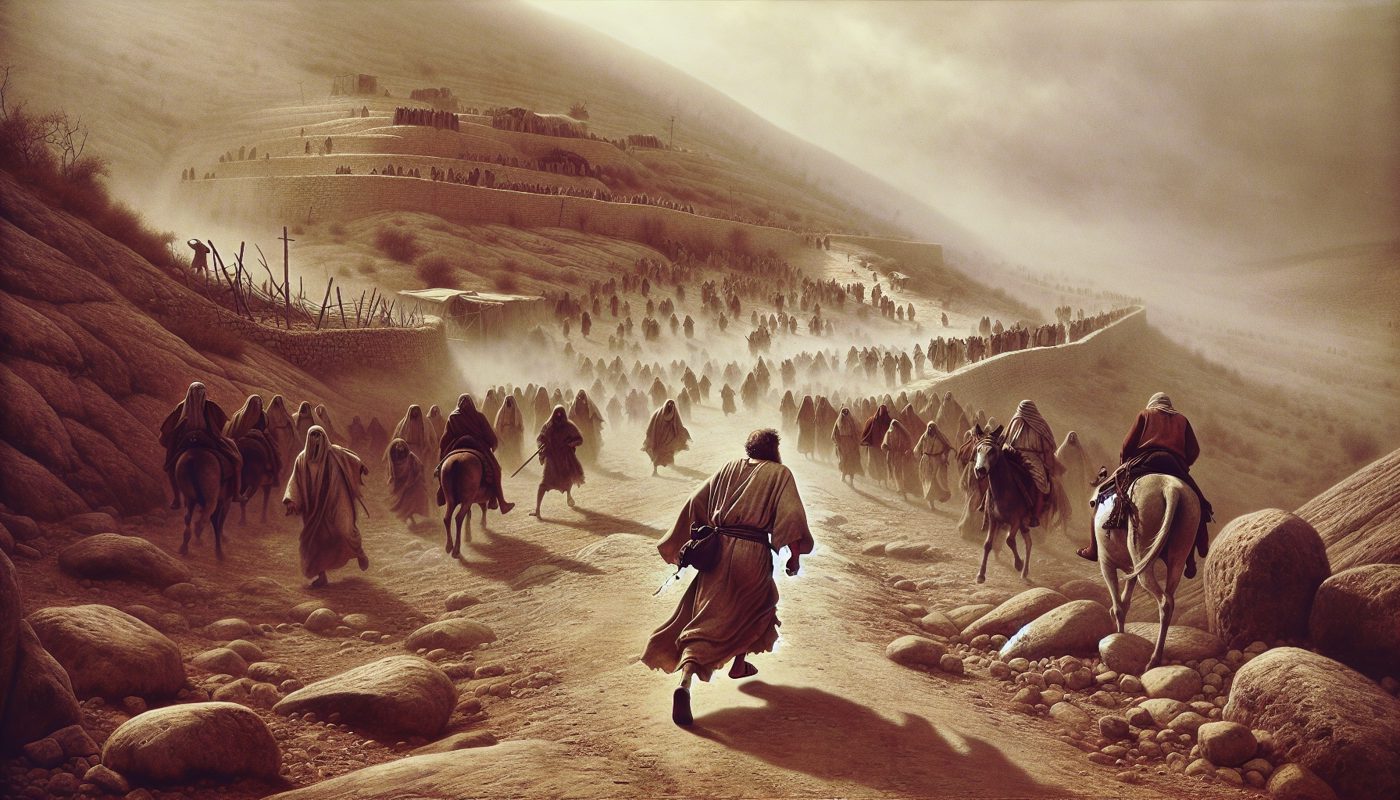
The road from Jerusalem bent downward, and David took it not as a king but as a fugitive. Before he had cleared the summit, a servant named Ziba met him with donkeys saddled and provisions—two hundred loaves, a hundred clusters of raisins, a hundred summer fruits, and a skin of wine. Ziba said the donkeys were for the king’s household to ride, the food for the young men, the wine for the faint in the wilderness. David asked where Mephibosheth was. Ziba answered that Saul’s grandson had stayed in Jerusalem, expecting the house of Israel to restore him the kingdom that day. David, without verifying a word, gave Ziba everything that belonged to Mephibosheth. Ziba bowed and asked only for favor. The transaction was swift, and the king moved on.
At Bahurim, a village of Benjamin, the road turned raw. A man named Shimei, son of Gera, of the house of Saul, came out cursing as he walked. He threw stones at David and at all the servants of the king, though the people and the mighty men flanked David on both sides. Shimei’s curses were not vague; they were specific accusations. He called David a man of blood and a base fellow. He said the Lord had returned upon David all the blood of the house of Saul, that the Lord had delivered the kingdom into Absalom’s hand, and that David’s ruin was upon him because he was a man of blood.
Abishai, son of Zeruiah, heard the curses and reacted like a man trained to end threats. He asked the king why a dead dog should be allowed to curse the king, and he requested permission to cross over and take off Shimei’s head. It was a direct offer—swift, violent, and final. David refused. He told Abishai and the other sons of Zeruiah that he had nothing to do with them. If the Lord had said to Shimei, “Curse David,” then who could question it?
David then spoke to Abishai and all his servants in a tone that revealed the weight he carried. His own son, who came from his own body, sought his life. If that was true, then a Benjamite from the house of Saul could certainly curse him. David told them to let Shimei alone, to let him curse, because the Lord had bidden him. There was no anger in the command, only a grim acceptance that the curses might be part of a larger reckoning.
David added a thin hope. He said that perhaps the Lord would look on the wrong done to him and requite him good for the cursing that day. It was not a confident prophecy; it was a man leaving room for God to act, without demanding that God act. Then David and his men continued on the road, and Shimei went along the hillside opposite them, still cursing, still throwing stones, still casting dust. The king and all the people with him came weary to a place where he refreshed himself.
The chapter then shifts to Jerusalem, where Absalom and all the men of Israel had entered the city, and Ahithophel was with him. Hushai the Archite, David’s friend, came to Absalom and shouted, “Long live the king! Long live the king!” Absalom immediately questioned him. Was this the kindness Hushai showed his friend? Why had he not gone with David? Hushai answered with careful ambiguity. He said he would serve the one whom the Lord, the people, and all the men of Israel had chosen. And since Absalom was the son, Hushai claimed he would serve in the son’s presence as he had served in the father’s. The words were loyal in sound but hollow in substance.
Absalom then turned to Ahithophel for counsel. Ahithophel’s advice was brutal and strategic. He told Absalom to go in to his father’s concubines, the ones David had left to keep the house. The act would make all Israel hear that Absalom was abhorred by his father, and it would strengthen the hands of everyone with him. So they spread a tent for Absalom on the roof of the house, and Absalom went in to his father’s concubines in the sight of all Israel. It was a public declaration of rupture, a political act designed to burn the bridge of reconciliation.
The chapter closes with a note on Ahithophel’s counsel. In those days, his advice was treated as if a man inquired at the oracle of God. Both David and Absalom had relied on it. The statement is not praise; it is a measure of the weight Ahithophel carried. His counsel shaped events, and the chapter leaves the reader with the sense that the road David walked was not only dusty and cursed but also shadowed by the counsel of a man whose words carried the force of divine authority, even when they were used to dismantle a king.
Comments
Comments 0
Read the discussion and add your voice.
Members only
Sign in to join the conversation
We keep comments tied to real accounts so the discussion stays clean and trustworthy.
No comments yet. Be the first to add one.