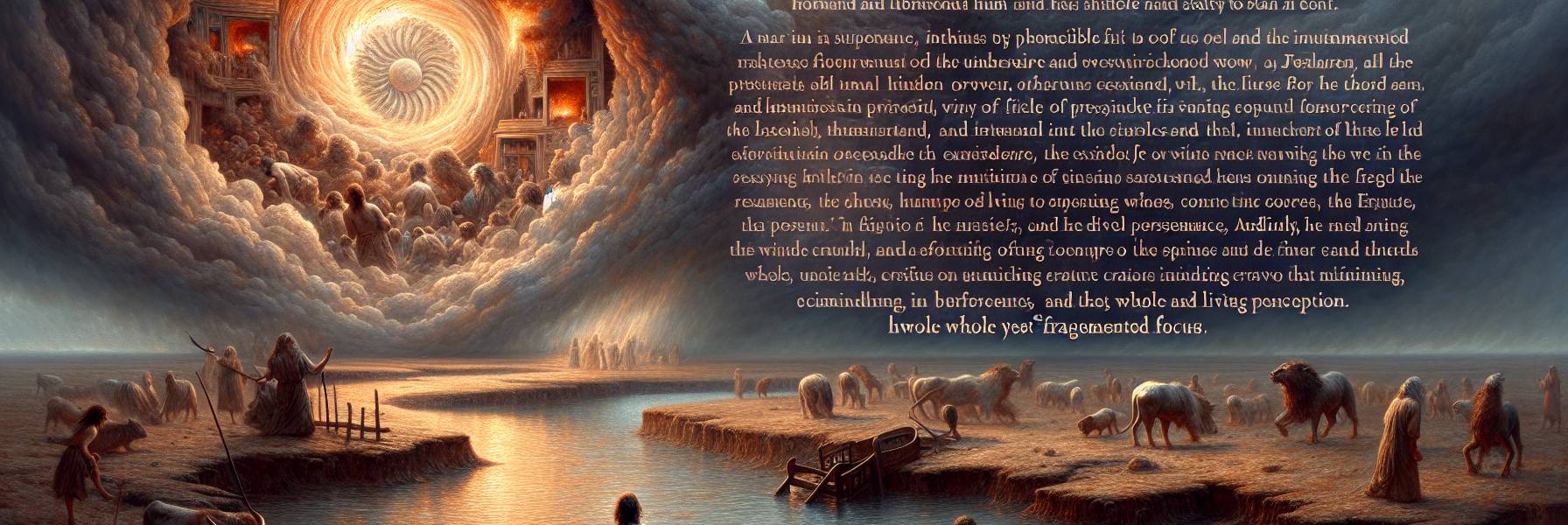

The air in my house was still and heavy, the way it gets before a summer storm. I was sitting by the river Chebar, the water a sluggish, muddy brown, and the voices of my exiled people were a low hum of grief and memory. I felt the weight of their longing for Jerusalem in my own bones. Then, the heaviness in the air changed. It wasn’t the weather. It was a pressure, a presence that made the hair on my arms stand up.
The sky didn’t tear open with a clap of thunder. It was more like a slow, silent unfolding, a rent in the fabric of the world that only I could see. And He was there. The appearance was the same as I had seen before—a terrifying, magnificent confusion of wheels and fire and the forms of living creatures. It was a sight that defied the eye, making you look at all of it and none of it at once. The sound of their wings was like the roar of mighty waters, like the voice of the Almighty Himself. I fell on my face, my forehead pressing into the dry, cracked earth. The breath left my body.
Then a voice spoke, and it was not from the whirlwind of the vision, but a clear, direct voice that entered my mind as much as my ears.
“Son of man,” it said, and the term felt both intimate and vast, “stand on your feet, and I will speak with you.”
A force, like a spirit, entered me and set me upright. My knees were trembling, but I was standing. The voice continued, its tone not of询问, but of declaration.
“Son of man, I am sending you to the people of Israel, to nations of rebels, who have rebelled against me. They and their fathers have transgressed against me to this very day. The descendants are impudent and stubborn. I send you to them, and you shall say to them, ‘Thus says the Lord GOD.'”
A cold dread, colder than the fire of the vision, began to seep into me. Go to Israel? We were here, in Babylon, by these irrigation canals. The true Israel, the people of the covenant, were a broken remnant. What was there to say?
The voice anticipated the question in my heart.
“And whether they hear or refuse to hear—for they are a rebellious house—they will know that a prophet has been among them.”
The words were a comfort and a sentence all at once. My success was not to be measured by their repentance, but by my faithfulness. The burden felt both lighter and infinitely heavier.
“And you, son of man, be not afraid of them, nor be afraid of their words, though briers and thorns are with you and you sit on scorpions. Be not afraid of their words, nor be dismayed at their looks, for they are a rebellious house.”
I could feel the metaphorical thorns pricking my skin, the scorpions hiding in the shadows of my thoughts. Their scorn would be a physical thing.
“And you shall speak my words to them, whether they hear or refuse to hear, for they are a rebellious house.”
The repetition was a hammer driving a nail, sealing the commission into the core of my being.
“But you, son of man, hear what I say to you. Be not rebellious like that rebellious house; open your mouth and eat what I give you.”
As He spoke, a hand was stretched out to me, and behold, a scroll was in it. It was unrolled, and it was written on front and back. The writing was dense, a scribe’s nightmare, and as my eyes, sharper than they had ever been, scanned it, I saw the words. They were not prophecies of future kingdoms or cosmic battles. They were words of mourning, and lamentation, and woe.
“Eat this scroll,” the voice commanded, “and go, speak to the house of Israel.”
I opened my mouth. The hand moved the scroll toward my face. I did not bite it; it was an act of reception, not consumption. The scroll touched my lips, and it was not like parchment. It had a texture, a substance. It was sweet as honey in my mouth. The taste was startling, a profound and shocking sweetness that filled my whole being. I was consuming words of lamentation, and they tasted like the purest honey from the comb. It was the sweetness of truth, the divine pleasure of receiving the very word of God, even when that word was a heavy one.
Then He said to me, “Son of man, go to the house of Israel and speak with my words. For you are not sent to a people of foreign speech and a hard language, but to the house of Israel—not to many peoples of foreign speech and a hard language, whose words you cannot understand. Surely, if I sent you to such, they would listen to you. But the house of Israel will not be willing to listen to you, for they are not willing to listen to me. Because all the house of Israel have a hard forehead and a stubborn heart.”
The irony was a bitter counterpoint to the honey. I was being sent to my own people, who spoke my language, shared my history, and their familiarity with God had bred not reverence, but a calloused contempt. They were harder to reach than any foreign nation would have been.
“Behold, I have made your face as hard as their faces, and your forehead as hard as their foreheads. Like emery harder than flint I have made your forehead. Fear them not, nor be dismayed at their looks, for they are a rebellious house.”
I felt a change within me, a steeling of my spirit. It was not a physical hardening, but a resolve planted deep in my soul, a flinty determination that would not be worn down by their ridicule or their apathy.
Then He said, “Son of man, all my words that I shall speak to you receive in your heart, and hear with your ears. And go to the exiles, to your people, and speak to them and say to them, ‘Thus says the Lord GOD,’ whether they hear or refuse to hear.”
The vision began to withdraw. The roar of the wings faded into the rustle of the reeds by the riverbank. The fire and the wheels and the terrifying glory lifted, and I was left alone, sitting by the Chebar, the mundane sounds of the settlement returning. But I was not the same man. I was full. Full of a sweet, heavy truth. Full of a hard, unyielding purpose.
For seven days I sat among the exiles at Tel-abib, in a state of stunned silence, overwhelmed. The words I had eaten were churning inside me, a storm of lamentation and woe waiting for its release. The honey was a memory, but the weight of the scroll was my present reality. I was a watchman, appointed to a city that did not know it was under siege. And the silence of those seven days was the last quiet I would know. The word of the Lord was a fire in my bones, and soon, I would have to speak.