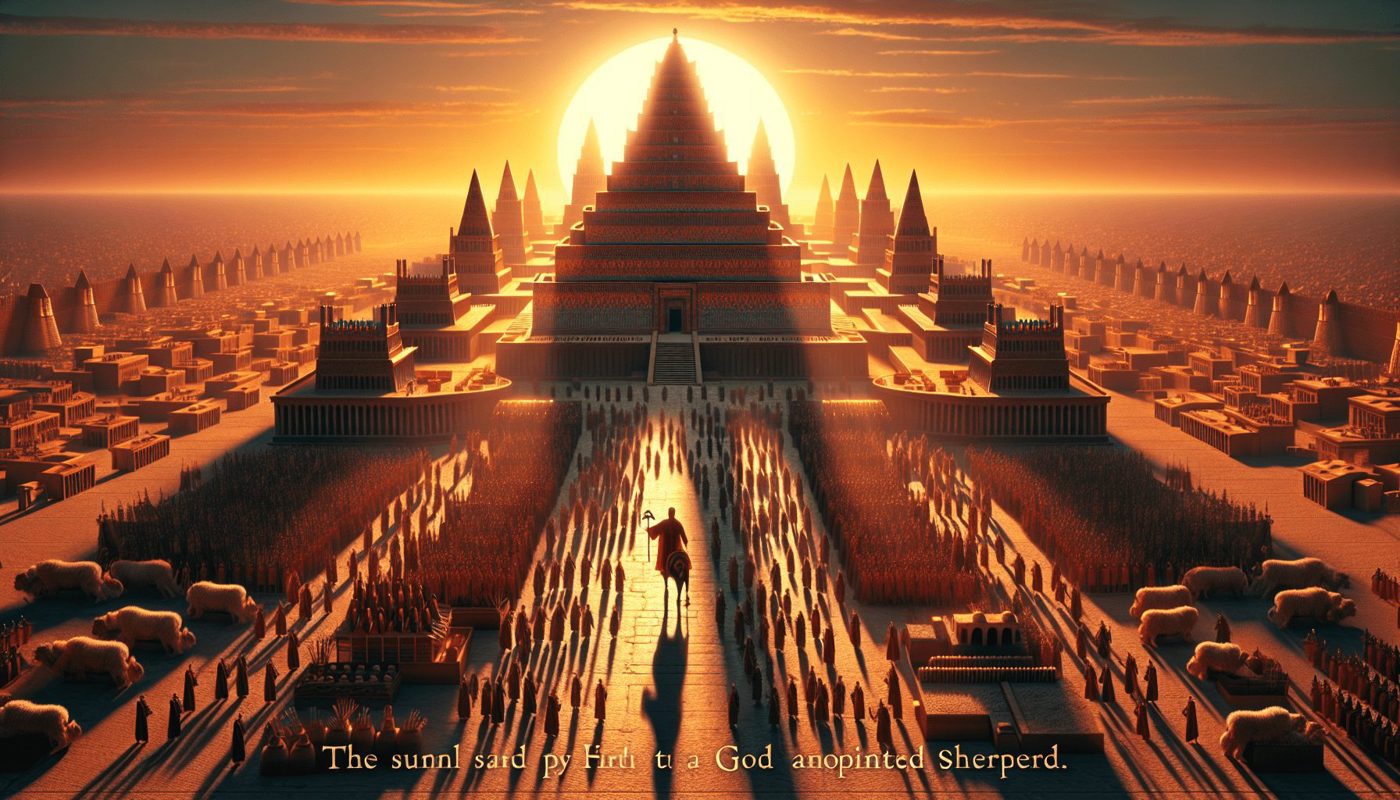
The Lord speaks directly to a Persian king who does not know Him. That is the pressure that drives Isaiah 45 from the first verse. The chapter opens with a blunt declaration: the Lord has taken hold of Cyrus’s right hand, will subdue nations before him, will break bronze doors and cut iron bars, and will hand over hidden treasures. All of this happens so that Cyrus will know that it is the Lord, the God of Israel, who calls him by name.
The claim is extraordinary. Cyrus is not an Israelite. He is not a worshiper of the Lord. He is a foreign ruler, a conqueror from the east, yet the Lord calls him “His anointed.” That word, anointed, is the same term used for Israel’s priests and kings. Here it is applied to a pagan king before he has done anything to deserve it. The Lord does not wait for Cyrus to convert. He acts first.
The chapter does not explain how Cyrus will receive this knowledge. It simply states that the Lord will give him the spoils of conquest—treasures of darkness and riches hidden in secret places—so that Cyrus will understand who is really behind his victories. The Lord is not bargaining. He is demonstrating sovereignty.
Then the Lord turns to the reason for this extraordinary choice. It is for the sake of Jacob, His servant, and Israel, His chosen. The Lord has called Cyrus by name and given him a title, even though Cyrus does not know Him. The point is not Cyrus’s merit. The point is the Lord’s purpose for His people.
The chapter then expands into a sweeping claim of exclusive divinity. The Lord declares that He is the Lord, and there is no other. He forms light and creates darkness. He makes peace and creates calamity. He does all these things. The heavens are commanded to distill righteousness, and the earth is called to open for salvation. The language is cosmic. The Lord is not a local deity. He is the only God, and He is acting in history.
A woe is pronounced against anyone who argues with their Maker. The image is blunt: a clay pot does not question the potter. A child does not interrogate the parent about why they were conceived. The Lord is the Holy One of Israel, and He has made the earth and stretched out the heavens. He has raised up Cyrus in righteousness and will make straight all his ways. Cyrus will build the Lord’s city and let the exiles go free, and he will do it for no payment or reward.
The chapter then shifts to a vision of nations coming to Israel. Egypt, Ethiopia, and the Sabeans will come over in chains and bow down, confessing that God is in Israel and there is no other. The Lord is described as a God who hides Himself, yet He is the Savior. Idol makers will be put to shame, but Israel will be saved with an everlasting salvation and will never be disgraced.
The Lord repeats His claim: He created the heavens and formed the earth to be inhabited, not a waste. He did not speak in secret or in a dark place. He did not tell Jacob to seek Him in vain. He speaks righteousness and declares what is right. The nations are summoned to assemble and present their case. Who predicted these things long ago? Only the Lord. There is no other God, a just God and a Savior.
The final verses issue a universal call. Look to the Lord and be saved, all the ends of the earth. The Lord has sworn by Himself that every knee will bow and every tongue will swear allegiance. Only in the Lord is righteousness and strength. All who were angry with Him will be put to shame. In the Lord, all the seed of Israel will be justified and will boast.
The chapter does not soften the tension. The Lord chooses a foreign king who does not know Him, uses him to free His people, and then calls the whole world to turn to Him. The anointing of Cyrus is not a story about Cyrus. It is a story about the Lord, who names His instruments before they know His name.
Comments
Comments 0
Read the discussion and add your voice.
Members only
Sign in to join the conversation
We keep comments tied to real accounts so the discussion stays clean and trustworthy.
No comments yet. Be the first to add one.