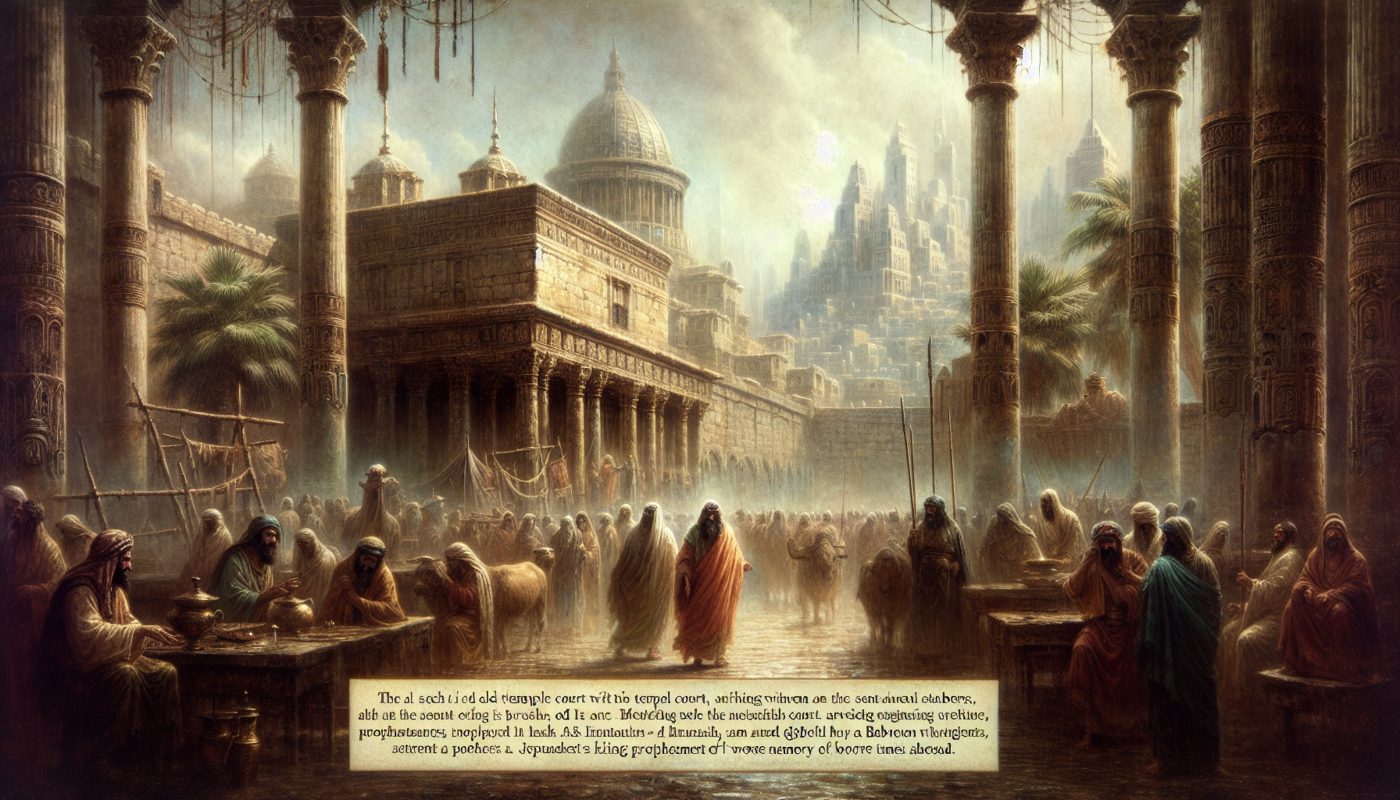
The confrontation took place in the temple court during the fourth year of Zedekiah, in the fifth month. Jeremiah was wearing a wooden yoke on his neck—a visible sign he had been giving to Judah for some time. Hananiah son of Azzur, a prophet from Gibeon, stepped forward in the presence of the priests and all the people gathered there. He spoke directly to Jeremiah, but his words were aimed at everyone listening.
Hananiah declared that the Lord of hosts, the God of Israel, had broken the yoke of the king of Babylon. He set a timeline: within two full years, all the vessels taken from the Lord's house would be returned to Jerusalem. Jeconiah the king and all the captives of Judah would come back. It was a clean, bold promise, and it contradicted everything Jeremiah had been saying.
Jeremiah answered in front of the same audience. He said, “Amen. May the Lord do so. May the Lord fulfill your words and bring back the vessels and the captives.” It was not sarcasm. Jeremiah genuinely wanted peace. But he did not stop there.
He reminded Hananiah and the people that the prophets before them had prophesied war, disaster, and plague against many nations. A prophet who prophesied peace could only be confirmed as sent by the Lord if the peace actually came. That was the test. Hananiah had made his claim. Now time would have to prove it.
Hananiah did not wait for time. He reached out, took the wooden bar from Jeremiah's neck, and broke it in front of everyone. Then he repeated his prophecy: the Lord would break the yoke of Nebuchadnezzar within two years. The crowd saw the wood snap. They heard the confident voice. Jeremiah said nothing. He simply went his way.
But after Hananiah had broken the wooden bar, the word of the Lord came to Jeremiah. He was told to go back and speak to Hananiah directly. The message was severe: you have broken bars of wood, but you have made bars of iron in their place.
The Lord declared that he had put a yoke of iron on the neck of all the nations, that they might serve Nebuchadnezzar. Even the beasts of the field had been given to him. The wooden yoke had been a symbol of submission that could be borne. The iron yoke would be unbreakable.
Jeremiah then confronted Hananiah with the core accusation: the Lord had not sent him. Hananiah had made the people trust in a lie. The charge was not a difference of opinion. It was rebellion against the Lord himself. And the judgment was immediate: Hananiah would die within the year.
Hananiah died in the seventh month of that same year. The wooden bar he broke was replaced by iron. The two-year promise he made never arrived. The confrontation in the temple court was not a debate between equals. It was a test of who actually spoke for the Lord, and the test was settled by what happened next.
Comments
Comments 0
Read the discussion and add your voice.
Members only
Sign in to join the conversation
We keep comments tied to real accounts so the discussion stays clean and trustworthy.
No comments yet. Be the first to add one.