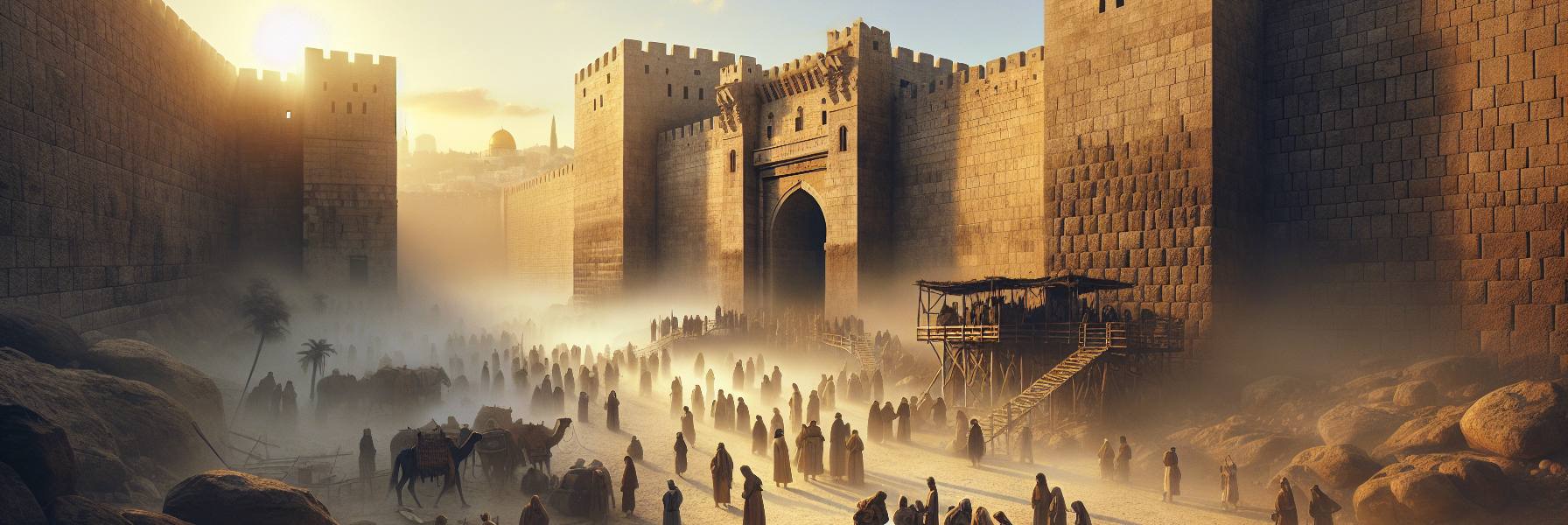

The air in Jerusalem held that peculiar quality of a morning after a long and weary labor. The dust, once churned by countless feet hauling stone, had finally settled. A crispness, the kind that whispers of a turning season, lingered in the shadows of the newly raised walls. The sun, climbing over the Mount of Olives, laid a gentle, golden warmth upon the Water Gate, its stones still smelling of fresh mortar and the sweat of a people redeemed from exile.
They came not as a mob, but as a single body, a quiet river of men, women, and all who could understand, flowing into the square before the gate. There was a solemnity to their gathering, a collective intake of breath. They had rebuilt the walls in fifty-two frantic days, a feat of defiance and faith under Nehemiah’s leadership. But the stones were just a shell. Now, they had come to seek the heart that must beat within it.
A wooden platform, built hastily for this purpose, stood in the open space. It was simple, unadorned timber, yet it commanded the attention of every soul. As the first hour progressed, the murmur of the crowd softened to a hush when Ezra the scribe ascended the steps, followed by a group of Levites whose names were familiar to those who remembered the old ways—Mattithiah, Shema, Anaiah, and others.
Ezra was an old man, his back slightly stooped from a lifetime bent over scrolls, but his eyes held a fierce, undimmed light. In his hands, he carried the Book of the Law of Moses. It was not a pristine, ceremonial object, but a well-worn scroll, its leather casing darkened by the oil of countless hands, the edges of the parchment softened with age. He unrolled it with a reverence that was palpable, a slow, deliberate motion that seemed to still the very air.
And then he began to read.
His voice did not boom; it carried, a clear, steady stream of words that flowed into the square. He read from early morning until midday, and the only sound, besides his voice, was the occasional rustle of a garment or the soft cry of an infant quickly soothed. The words were ancient, but they fell upon the people not as a distant history, but as a startling, immediate memory. They heard of covenants made with their fathers, of laws given in thunder and smoke, of a promised land and the conditions for dwelling in it. They heard their own story, and in hearing it, they recognized the long, winding path of their disobedience and the sheer, astounding grace that had brought a remnant back to this very spot.
A sound began to ripple through the crowd, starting as a stifled sob here, a choked gasp there. It grew, not into a wail of despair, but into a deep, collective weeping. Men covered their faces with their cloaks; women bowed their heads, their shoulders shaking. The Law was a mirror, and in it, they saw the true extent of their long exile, not just from a land, but from their God. The joy of the rebuilt walls crumbled before the weight of a broken covenant.
Nehemiah, the governor, who had been standing beside Ezra, saw this. He saw the grief threatening to swallow the day. He stepped forward, his voice cutting through the sound of mourning with a gentle authority.
“This day is holy to the Lord your God,” he said, his words simple and direct. “Do not mourn or weep.” He paused, letting the command settle. “Go your way, eat the fat and drink sweet wine, and send portions to anyone who has nothing ready, for this day is holy to our Lord. And do not be grieved, for the joy of the Lord is your strength.”
The Levites, too, moved among the people, calming them, explaining the words. “Hush,” they said, their voices quiet and firm. “Be still, for this day is holy; do not let sorrow be your master.”
And a remarkable transformation began. The weeping subsided. The grief, which was real and justified, was not erased, but it was met by a greater truth: the holiness of the day was a gift. It was an invitation back into God’s presence, and His presence was not a courtroom of condemnation, but a stronghold of joy. The people began to disperse, not with downcast eyes, but with a dawning wonder. They went to their homes, to their temporary shelters, and they did as they were told. They prepared feasts. They opened jars of rich food and skins of sweet wine. And more importantly, they bundled up portions and sought out those who had none, their doorways becoming places of unexpected bounty for the stranger and the poor.
The second day, the heads of the families, the priests, and the Levites gathered around Ezra again, their curiosity now fully ignited. They wanted to understand more, to delve deeper into the words they had heard. As Ezra read from the Law, a particular passage emerged, concerning the Feast of Booths. It was the seventh month, the very time appointed for it. A realization swept through them—a commandment had been given, one they had not kept for generations in the land.
A flurry of activity ensued. The word went out in Jerusalem and to all the towns of Judah: “Go out to the hills and bring branches of olive, wild olive, myrtle, palm, and other leafy trees to make booths, as it is written.”
The people went. They climbed the terraced hillsides, their laughter echoing where recently only the sounds of construction had been. They returned laden with armfuls of greenery, their scent of crushed pine and olive leaf filling the city. They built their booths on their roofs, in their courtyards, in the courts of the house of God, and in the squares by the Water Gate and the Gate of Ephraim. For seven days, the city of Jerusalem was transformed into a forest of fragile, leafy dwellings. It was a tangible, living memory of the wilderness, of total dependence on God.
And each of those seven days, from the first to the last, Ezra stood on his wooden platform and read from the Book of the Law of God. The people lived in their booths, the rustle of the leaves a constant accompaniment to the words of the covenant. On the eighth day, according to the ordinance, there was a solemn assembly, a final, quiet closing to the feast.
When it was over, the people did not simply return to their normal lives. They left that place not just with full stomachs, but with a mended spirit. They had come to the Water Gate seeking a word, and they had found a person—the God of their fathers, who had not forgotten His promises. The walls around them were strong, but the joy within them was stronger still. It was a quiet, steadfast joy that would be their true defense, long after the mortar had dried and the memory of the weeping had faded into a testimony of grace. A child, falling asleep that night in a home now empty of its festive branches, could still smell the scent of myrtle on the air, a faint, sweet promise that God was once again at home in Jerusalem.