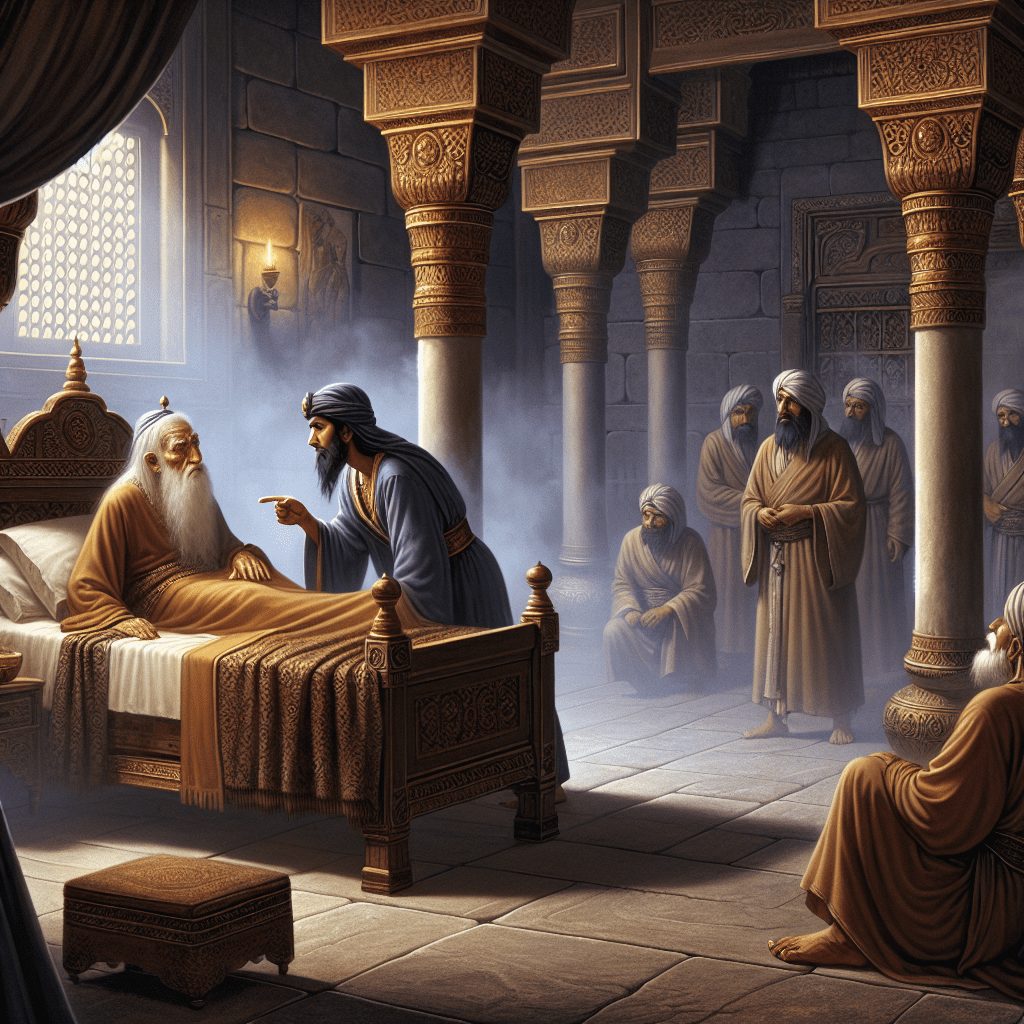
The chapter opens with David near death, giving Solomon a charge that is both religious and political. He tells his son to keep the statutes of the Lord as written in the law of Moses, so that the Lord may fulfill his promise that a man from David's line will always sit on Israel's throne. Then David shifts to specific men still alive who must be dealt with.
David does not speak in generalities. He names Joab son of Zeruiah, who killed Abner and Amasa in peacetime, and tells Solomon to use his wisdom to bring Joab's gray head down to Sheol in blood. He also tells Solomon to show kindness to the sons of Barzillai the Gileadite, who helped David when he fled from Absalom. And he mentions Shimei the Benjamite, who cursed David bitterly during that flight but later received a sworn oath of safety at the Jordan. David says Solomon is wise enough to know what to do with Shimei, and that his gray head should also go down to Sheol with blood.
David dies and is buried in the city of David. He reigned forty years in total, seven in Hebron and thirty-three in Jerusalem. Solomon sits on his father's throne, and his kingdom is firmly established.
Then Adonijah, Solomon's older brother who had earlier tried to claim the throne, comes to Bathsheba with a request. He says the kingdom was his and all Israel wanted him to reign, but the Lord gave it to Solomon. He asks only one petition: that Solomon give him Abishag the Shunammite as a wife. Bathsheba agrees to speak to Solomon on his behalf.
Bathsheba goes to Solomon, who rises, bows to her, and seats her at his right hand. When she asks for Abishag to be given to Adonijah, Solomon immediately sees the move as a claim to the throne. He asks why she asks only for Abishag, and says she might as well ask for the kingdom for Adonijah, along with Abiathar the priest and Joab. He swears by the Lord that Adonijah has spoken against his own life, and that he will be put to death that day.
Solomon sends Benaiah son of Jehoiada, who goes and kills Adonijah. Then Solomon deals with Abiathar the priest, who had supported Adonijah. He does not kill him because Abiathar carried the ark before David and shared in David's afflictions. Instead, Solomon banishes him to his fields at Anathoth, removing him from the priesthood. This fulfills the word the Lord spoke about the house of Eli at Shiloh.
Joab hears what has happened and flees to the Tent of the Lord, seizing the horns of the altar. Solomon sends Benaiah to strike him down. Benaiah goes and tells Joab to come out, but Joab refuses, saying he will die there. Benaiah reports back to Solomon, who orders him to do as Joab said, to fall upon him and bury him, so that the blood Joab shed without cause will be removed from David's house. Benaiah goes up and kills Joab, and Joab is buried in his own house in the wilderness. Solomon then puts Benaiah in command of the army and makes Zadok priest in Abiathar's place.
Finally, Solomon summons Shimei and gives him a conditional pardon. He orders Shimei to build a house in Jerusalem and not to leave the city. If he crosses the Kidron brook, he will die, and his blood will be on his own head. Shimei agrees and lives in Jerusalem for three years. But then two of his servants run away to Gath, and Shimei goes after them, retrieves them, and returns. When Solomon learns of this, he summons Shimei, reminds him of the oath he swore by the Lord, and pronounces judgment. He says Shimei knows the wickedness he did to David, and the Lord will return it on his own head. Benaiah goes out and kills Shimei. The chapter ends with the kingdom firmly established in Solomon's hand.
Comments
Comments 0
Read the discussion and add your voice.
Members only
Sign in to join the conversation
We keep comments tied to real accounts so the discussion stays clean and trustworthy.
No comments yet. Be the first to add one.