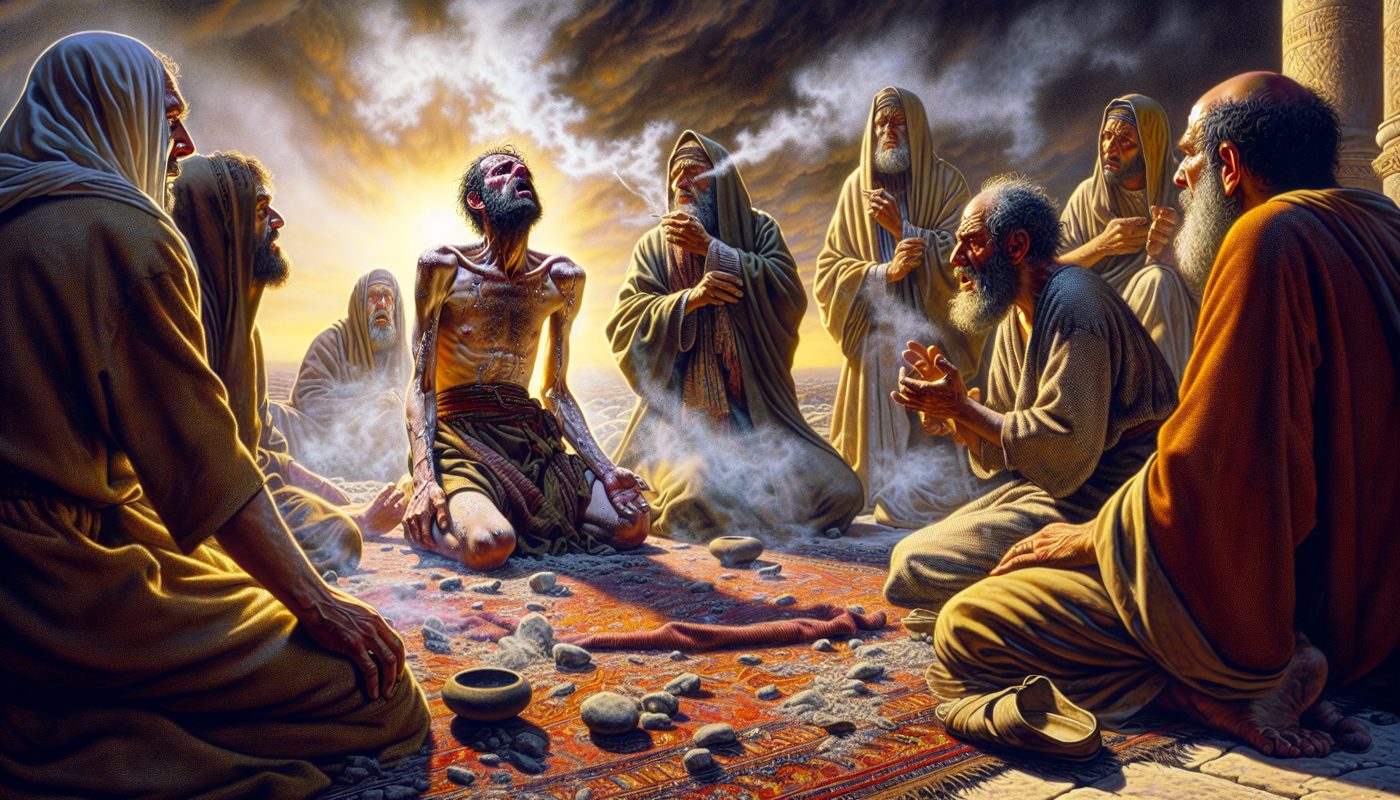
Bildad the Shuhite opens his mouth and the room grows colder. He has heard Job's speeches—the defiant claims of innocence, the accusations that God has become an enemy. But Bildad does not hear a suffering man. He hears a man who has torn himself in his own anger, and he asks a question that carries the weight of a verdict: Shall the earth be forsaken for you? Shall the rock be removed from its place? The questions are rhetorical, and they are final.
Bildad's answer is no. The earth does not bend for any man, and the rock does not move. The world is a fixed system of cause and consequence, and Job's insistence on his own righteousness is not a plea but a rebellion against the order of things. Bildad will not entertain the possibility that the innocent suffer. His theology is a machine that crushes exceptions.
What follows is a catalogue of destruction. Bildad does not speak in abstractions. He speaks in images that press against the skin. The light of the wicked shall be put out, he says. The spark of his fire shall not shine. The lamp above him goes dark. The steps of his strength are narrowed. His own counsel casts him down. Every line is a tightening loop.
The net appears first. The wicked man is caught by his own feet. He walks on the toils—the hidden snares laid in the path. A gin takes him by the heel. A noose is hid in the ground. The trap is not a divine ambush from above; it is the ground itself that rises to seize him. The world is woven with consequences, and the wicked man walks into them as though blind.
Then the terrors come. They do not arrive as a single blow. They surround him on every side and chase him at his heels. There is no escape because the threat is not external—it is the shape of the path he chose. Bildad describes a man whose strength is eaten by hunger, whose calamity stands ready at his side like a servant waiting for a command.
The body itself is devoured. Bildad calls it the firstborn of death, a phrase that suggests something primordial, a hunger that predates every grave. The members of his body are consumed from within. There is no dignity in this end. The man is rooted out of his tent, the place where he trusted, and brought to the king of terrors. Bildad does not name this king. He does not need to.
The tent, once a shelter, becomes a place of alien habitation. Brimstone is scattered on his dwelling. The roots beneath dry up. The branch above is cut off. The man is erased from both directions—nothing below to hold him, nothing above to grow from him. His remembrance perishes from the earth. He has no name in the street. He is driven from light into darkness and chased out of the world.
There is no son and no son's son. No remaining trace among his people. Those who come after are astonished at his day, and those who went before are affrighted. The man becomes a lesson, a monument of warning. His suffering is not pitied; it is studied.
Bildad concludes with a flat, unyielding summary: Surely such are the dwellings of the unrighteous, and this is the place of him that knoweth not God. The logic is sealed. There is no room for Job's protests, no space for the possibility that the innocent might walk through the same snares. Bildad has built a world where suffering is always evidence, and Job sits in the ashes as the evidence itself.
The chapter ends with the silence of Job. He has heard the verdict. But the reader knows that the rock has not been removed, and the earth has not been forsaken. The snare is real, but so is the man who sits in the ashes, refusing to confess what he has not done.
Comments
Comments 0
Read the discussion and add your voice.
Members only
Sign in to join the conversation
We keep comments tied to real accounts so the discussion stays clean and trustworthy.
No comments yet. Be the first to add one.