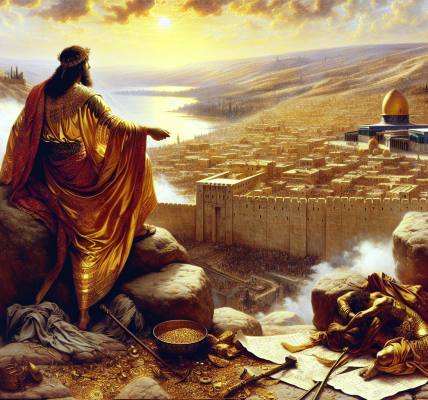

In the days when the word of the Lord came to Jeremiah, a heavy silence fell over the land of Judah, a silence that spoke louder than the clamor of the marketplace or the solemn chants in the temple courts. The prophet stood alone on the rocky outcrops overlooking the desolate stretches of wilderness, where the sun beat down upon cracked earth and the wind whispered through dry thorns. It was there that the voice of the Almighty seized him, and he began to speak with a sorrow that seemed to age his face beyond his years.
“Thus declares the Lord,” Jeremiah’s voice carried over the barren hills, “the sin of Judah is engraved with an iron pen, inscribed with a point of diamond upon the tablet of their hearts and on the horns of their altars.”
He described how the people had forsaken the living waters, digging for themselves broken cisterns that could hold no water. Their children played in the ashes of foreign altars where their parents sacrificed to gods of wood and stone, gods whose eyes saw nothing and whose hands could not save. The memory of Zion had become like a dream to them, and the law of the Lord was treated as a forgotten scroll gathering dust in some dark chamber.
Then the word of the Lord painted two visions before the people’s eyes—two ways a soul might choose to walk.
“Blessed is the man who trusts in the Lord,” Jeremiah proclaimed, his voice swelling with sudden hope, “whose confidence is in Him alone.”
And he described this blessed one as a tree planted by waters, not the stagnant pools of man’s making, but by the river of God’s own provision. Its roots stretched deep, drinking from underground streams that never failed, even when the summer heat scorched the land. Its leaves remained green and vibrant, and it did not fear when the drought came. In the year of anguish it bore fruit still, for its life was hidden in sources unseen. The birds of the air nested in its branches, and travelers found shade beneath its boughs. This tree stood as a testament to the faithfulness of God, a living monument to the soul that rests in divine care.
But then Jeremiah’s countenance darkened, and his voice dropped to a grave tone.
“Cursed is the man who trusts in man, who draws strength from mere flesh, whose heart turns away from the Lord.”
He depicted this cursed one as a juniper in the desert, a stunted, lonely shrub clinging to life in the salt flats where no rain fell. It dwelt in parched places, in the wilderness of dead hopes. Its branches twisted inward upon themselves, offering no shade, no fruit, no comfort. When the scorching winds blew from the eastern desert, it rattled with a sound like dry bones. No eye looked upon it with pleasure, and it stood as a monument to the soul that relies upon its own withered strength.
“For the heart is deceitful above all things,” Jeremiah continued, his words piercing like a surgeon’s lance, “and desperately sick—who can understand it? I, the Lord, search the heart and examine the mind, to reward each person according to their ways, according to the fruit of their deeds.”
He spoke of a partridge that gathers a brood not her own—so is the man who gains wealth by unjust means. In the midst of his days, it will forsake him, and at the end he will be proven a fool. The riches he hoarded would become like dust in his hands, and the alliances he forged would crumble like ancient parchment.
Then the prophet lifted his eyes toward the temple mount, where the people performed their rituals without heart.
“O Lord, the hope of Israel,” he cried, “all who forsake you will be put to shame. Those who turn away will be written in the dust, for they have forsaken the fountain of living water.”
He warned of the coming day when the Lord would test the minds and hearts, when the fire of divine judgment would reveal what was truly valuable. The silver and gold they had trusted in would not save them when the whirlwind of God’s wrath swept through the land.
Yet even in this severe warning, a thread of mercy wove through the prophecy. Jeremiah called the people to remember the Sabbath—not merely as a day of rest, but as a covenant sign, a sacred trust between God and His people. He pleaded with them to cease their striving, to stop carrying burdens through the city gates on the holy day, to turn from their own ways and find delight in the Lord.
But he knew, even as he spoke, that their ears were dull of hearing and their hearts were hardened like the packed earth of the wilderness paths. They preferred the fleeting shadows of their own devices to the enduring substance of God’s provision.
As the sun began to set over the hills of Judah, casting long shadows across the land, Jeremiah’s voice faded into the twilight. The two visions remained hanging in the air—the tree by the water, and the shrub in the desert. The choice stood before them, as it stands before every soul in every generation: to trust in the broken cisterns of human strength, or to send roots deep into the river of God’s faithfulness. And the word of the Lord echoed through the gathering darkness, a solemn promise and a grave warning that would reverberate through the centuries yet to come.