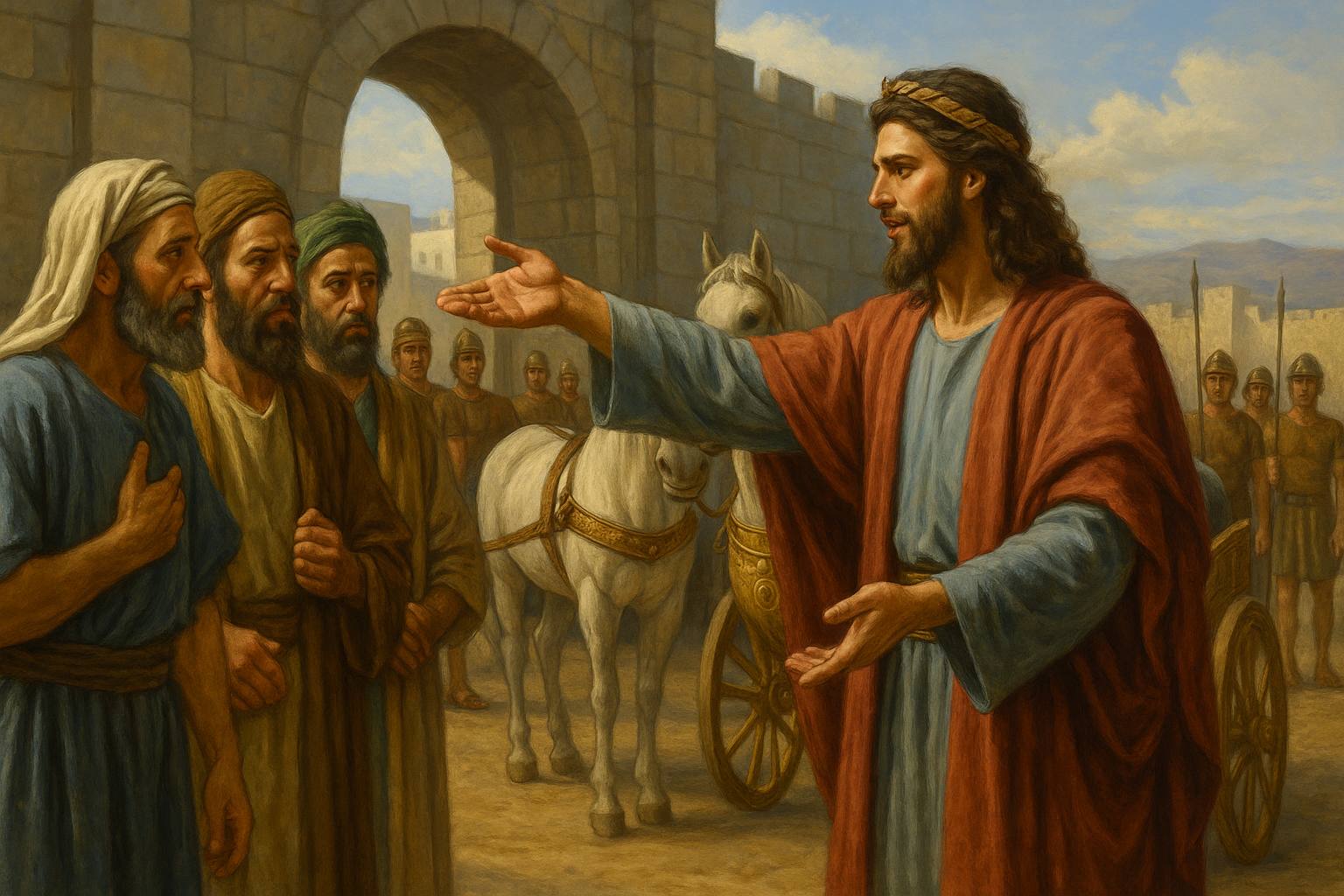

In the days when David reigned as king over all Israel, a shadow began to form within his own household, a darkness born of ambition and wounded pride. Absalom, David’s son, whose beauty was celebrated from the gates of Dan to the wells of Beersheba, began to weave a web of subtle treachery against his father. He prepared for himself a chariot and horses, and with fifty men to run before him, he rose early each morning and stood beside the way of the gate, the very place where justice was sought.
As men from every tribe came to the king for judgment, Absalom would call out to them, “From what city are you?” And when they answered, “Your servant is from such and such a tribe of Israel,” Absalom would say, “See, your claims are good and right, but there is no one appointed by the king to hear you.” He would add, with a sigh that feigned deep concern, “Oh, that I were made judge in the land, and every man who has any suit or cause would come to me, and I would give him justice!” When any man drew near to bow down to him, Absalom would stretch out his hand, take hold of him, and kiss him, stealing the hearts of the men of Israel with this carefully crafted charade of humility and accessibility.
Four years this deceit continued, a slow poison seeping into the loyalty of the people, until the day Absalom deemed the time ripe. He went to his father with a request veiled in piety: “Please, let me go and pay my vow which I have vowed to the Lord in Hebron. For your servant vowed a vow while I dwelt at Geshur in Syria, saying, ‘If the Lord shall indeed bring me again to Jerusalem, then I will serve the Lord.'” David, his heart still tender toward his son despite the rumors that must have reached his ears, blessed him, saying, “Go in peace.” So Absalom arose and went to Hebron, the very city where David had first been anointed king.
But this was no pilgrimage of devotion. It was the sounding of a trumpet for rebellion. Secretly, Absalom sent spies throughout all the tribes of Israel, saying, “As soon as you hear the sound of the trumpet, then you shall say, ‘Absalom reigns in Hebron!'” And with him went two hundred men from Jerusalem, invited in innocence, knowing nothing of the conspiracy, their presence lending an air of legitimacy to his treacherous gathering. Even Ahithophel the Gilonite, David’s own counselor, one whose wisdom was once compared to the oracle of God, was drawn into the plot, and his betrayal cut deeper than any sword.
The conspiracy grew strong, for the people increased continually with Absalom, their hearts turned by his flattery and promises. Then a messenger came to David, his face pale with fear, his words heavy as stones: “The hearts of the men of Israel are after Absalom.” And David, the warrior king who had faced Goliath and Philistine armies, felt a chill colder than any winter wind. He knew the city would soon be surrounded, its gates besieged, and the sword would turn against his own house. He said to his servants who were with him in Jerusalem, “Arise, and let us flee; for else none of us shall escape from Absalom. Make speed to depart, lest he overtake us suddenly, and bring evil upon us, and smite the city with the edge of the sword.”
So the king went forth, and all his household after him, a sad procession of loyalty and loss. But he left ten women, who were concubines, to keep the house, a decision that would later bear bitter fruit. The king went forth, and all the people followed him, pausing at the last house outside the city as the whole army passed by him: all his servants, the Cherethites, the Pelethites, and all the Gittites, six hundred men who had followed him from Gath, passing on before the king.
Then the king said to Ittai the Gittite, a foreigner who had but recently joined him, “Why do you also go with us? Return to your place, and abide with the king, for you are a foreigner and also an exile. Whereas you came but yesterday, should I this day make you go up and down with us, seeing I go wherever I may? Return, and take back your brethren with you in mercy and truth.” But Ittai answered with an oath that would be remembered in the annals of loyalty: “As the Lord lives, and as my lord the king lives, surely in what place my lord the king shall be, whether for death or for life, even there also will your servant be.” So David accepted his pledge, and Ittai passed over with all his men and all the little ones who were with him, a strange and beautiful testimony to devotion that transcended blood and nation.
All the country wept with a loud voice as the king passed over the brook Kidron, toward the way of the wilderness. There, by the ascent of the Mount of Olives, David went up weeping as he went, his head covered and his feet bare, the signs of deepest mourning. All the people who were with him covered every man his head, and they went up, weeping as they went, a river of grief flowing from the city of God.
Then they told David, saying, “Ahithophel is among the conspirators with Absalom.” And David prayed, “O Lord, I pray you, turn the counsel of Ahithophel into foolishness.” As David came to the summit of the mount, where God was worshipped, behold, Hushai the Archite came to meet him with his coat torn and earth upon his head, another mourner in this procession of sorrow. David said to him, “If you pass on with me, then you will be a burden to me. But if you return to the city, and say to Absalom, ‘I will be your servant, O king; as I have been your father’s servant in time past, so will I now also be your servant,’ then you may for me defeat the counsel of Ahithophel. And have you not there with you Zadok and Abiathar the priests? Therefore whatever you hear out of the king’s house, you shall tell it to Zadok and Abiathar the priests. Behold, they have there with them their two sons, Ahimaaz, Zadok’s son, and Jonathan, Abiathar’s son; and by them you shall send to me everything that you can hear.”
So Hushai, David’s friend, returned to the city, just as Absalom was entering Jerusalem, a spy in the court of the usurper, a thread of hope in the tapestry of despair. And David continued his journey into the wilderness, a king without a crown, a father betrayed by his son, yet still a man after God’s own heart, walking the path of suffering that would lead, in time, to restoration.