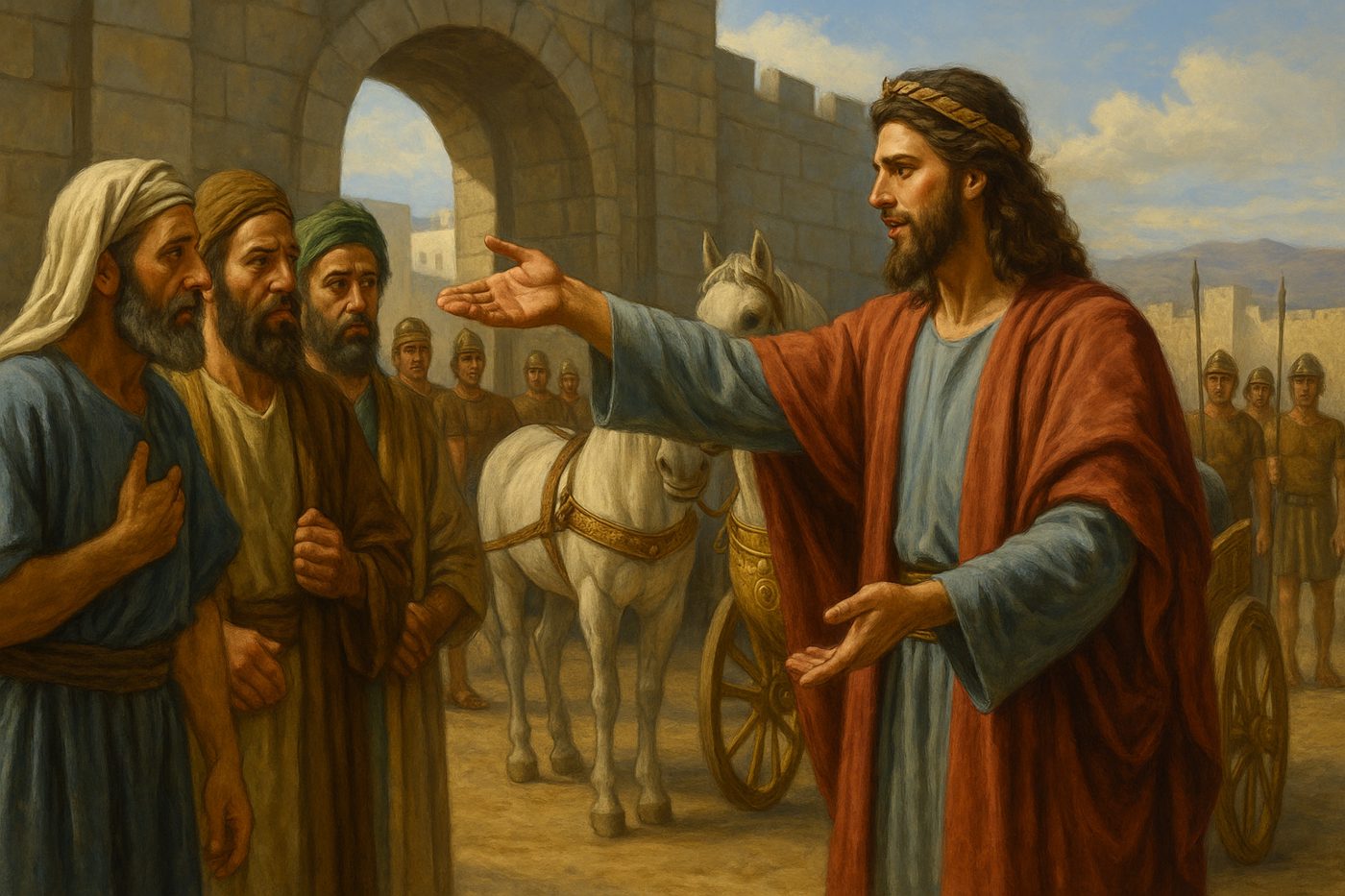
The chapter opens with a king's son who has no throne but moves like one who does. Absalom procures a chariot and horses, and fifty runners precede him—a retinue that announces power before he has any right to it. He stations himself at the city gate each morning, the place where petitioners seek the king's judgment, and he intercepts them one by one.
His method is patient and surgical. He asks each man where he is from, listens to the complaint, and then pronounces the matter good and right—but adds that no one from the king hears such cases. He sighs aloud that he himself were judge, that he might give every man justice. And when a man bows to him, Absalom reaches out, takes hold of him, and kisses him. The narrator states the result plainly: Absalom stole the hearts of the men of Israel.
After four years of this, Absalom approaches David with a religious request. He asks leave to go to Hebron to pay a vow he made while living in Geshur, in Syria—a vow that if the Lord brought him back to Jerusalem, he would serve the Lord. David tells him to go in peace. Absalom leaves, but he does not go to Hebron simply to sacrifice.
From Hebron, Absalom sends spies through all the tribes of Israel with instructions: when they hear the trumpet sound, they are to proclaim Absalom king in Hebron. Two hundred men from Jerusalem accompany him, invited in their simplicity, knowing nothing of the plot. And Absalom sends for Ahithophel the Gilonite, David's own counselor, to join him from his city while the sacrifices are being offered. The conspiracy grows strong, and the people continue to increase with Absalom.
A messenger reaches David with the news: the hearts of the men of Israel are after Absalom. David does not wait to verify the report. He tells his servants that they must flee at once, for otherwise none of them will escape Absalom. He fears that Absalom will overtake them and strike the city with the edge of the sword. The king's servants answer that they are ready to do whatever he chooses.
David goes out, and all his household follows him. He leaves ten concubines to keep the house. The people pass by him—the Cherethites, the Pelethites, and six hundred Gittites who had come after him from Gath. David notices Ittai the Gittite among them and tells him to return and stay with the king, since he is a foreigner and an exile. Ittai has only just arrived; David will not make him wander where David himself does not know where he is going.
Ittai answers with an oath: as the Lord lives, and as the king lives, wherever the king is, whether for death or for life, there his servant will be. David lets him pass over with all his men and the little ones with them. The whole country weeps with a loud voice as the people cross the brook Kidron toward the wilderness.
Zadok the priest and all the Levites come carrying the ark of the covenant of God. They set it down, and Abiathar goes up until all the people have passed out of the city. But David tells Zadok to carry the ark back into Jerusalem. If the Lord finds favor in David's eyes, he says, the Lord will bring him back to see both the ark and the Lord's habitation. But if the Lord says he has no delight in David, then David accepts it: here he is, let the Lord do to him as seems good.
David sends Zadok and Abiathar back into the city with their sons, Ahimaaz and Jonathan, to serve as his informants. He will wait at the fords of the wilderness until they send word to certify him. So Zadok and Abiathar carry the ark back to Jerusalem and remain there.
David goes up the ascent of the Mount of Olives, weeping as he goes, his head covered and his feet bare. All the people with him also cover their heads and weep as they ascend. When David is told that Ahithophel is among the conspirators with Absalom, he prays that the Lord would turn Ahithophel's counsel into foolishness. At the top of the ascent, where God is worshipped, Hushai the Archite meets him with his coat torn and earth on his head. David tells Hushai that if he comes with him, he will be a burden, but if he returns to the city and offers his service to Absalom as he once served David, he can defeat the counsel of Ahithophel. Hushai is to report whatever he hears from the king's house to Zadok and Abiathar, who will send word through their sons. So Hushai, David's friend, enters Jerusalem just as Absalom arrives.
Comments
Comments 0
Read the discussion and add your voice.
Members only
Sign in to join the conversation
We keep comments tied to real accounts so the discussion stays clean and trustworthy.
No comments yet. Be the first to add one.