
The sun had not yet fully risen over the rocky terrain of Gibeah, casting long shadows that seemed to mirror the grim disposition of the six hundred men who remained with King Saul. They were encamped beneath a pomegranate tree, their spirits as low as the morning mist that clung to the valleys. Among them, Jonathan, the king’s son, felt a divine restlessness stirring within his soul. He turned to his young armor-bearer, a faithful lad whose eyes reflected unwavering trust, and spoke in a hushed but fervent tone.
“Come,” Jonathan said, his voice steady with conviction, “let us cross over to the outpost of the Philistines on the other side. Perhaps the Lord will act on our behalf, for nothing can hinder the Lord from saving, whether by many or by few.”
The armor-bearer responded without hesitation, “Do all that is in your heart. Go then; I am with you heart and soul.”
Jonathan’s plan was both daring and dependent on divine guidance. “We will cross over toward the men and let them see us. If they say to us, ‘Wait there until we come to you,’ we will stay in our place and not go up to them. But if they say, ‘Come up to us,’ then we will go up, for the Lord has given them into our hand. This will be the sign to us.”
So the two of them revealed themselves to the Philistine garrison. The Philistines, spotting them from their vantage point, mocked and called out, “Look! The Hebrews are crawling out of the holes where they have hidden themselves! Come up to us, and we will teach you a lesson.”
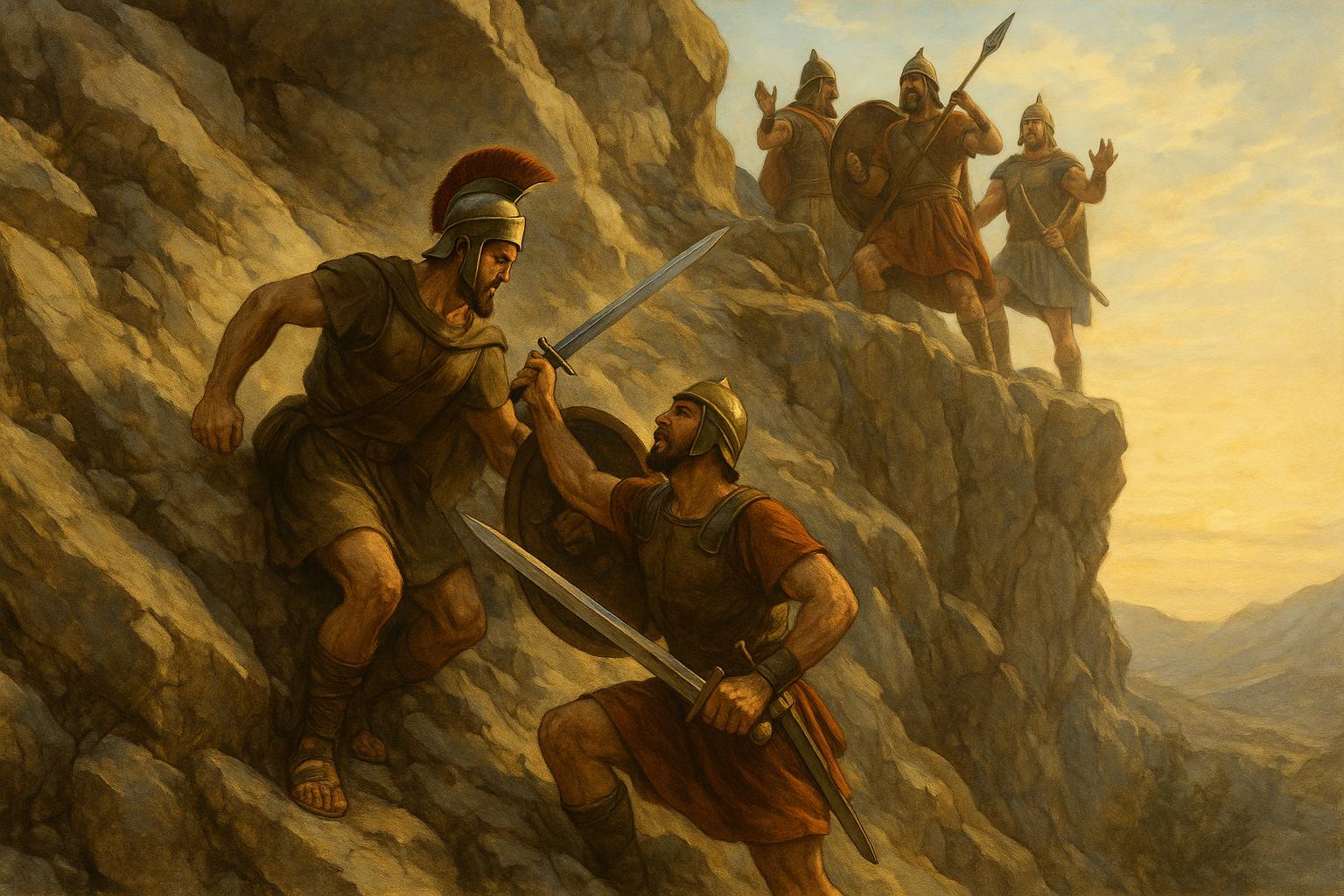
Jonathan turned to his armor-bearer, his eyes alight with holy fire. “Climb up after me, for the Lord has given them into the hand of Israel.” Then, with a strength that seemed more than human, Jonathan scaled the sharp, rocky incline on his hands and feet, his armor-bearer close behind. When they reached the top, Jonathan struck down the first Philistine soldier he encountered, and his armor-bearer followed, dispatching others in a swift and deadly dance of faith and steel. In that initial assault, they killed about twenty men within a half-furrow of land, a small plot that became a testament to God’s power working through the faithful few.
Suddenly, panic erupted in the Philistine camp, a terror sent by God Himself. The earth trembled beneath their feet, and a great confusion swept through the ranks. The mighty warriors of the Philistines turned their swords against one another, a chaotic massacre born of divine disarray. The watchmen of Saul in Gibeah beheld the astonishing sight: the vast Philistine army melting away in every direction, striking one another in their madness.
Saul, seeking guidance, commanded the priest Ahijah to bring the ark of God—for in those days it accompanied Israel to battle. But as the tumult in the Philistine camp grew, Saul cried out to the priest, “Withdraw your hand!” He then rallied his men, shouting, “Let every man charge straight ahead!” They rushed into the battle to find the Philistines in complete disarray, every man’s sword against his brother.
Now, there were Hebrews who had previously defected to the Philistines, and they too turned against their former masters, joining Saul and Jonathan. Likewise, those Israelites who had hidden in the hills of Ephraim, hearing of the Philistine retreat, emerged to pursue them in hot pursuit. So the Lord delivered Israel that day, and the battle swept beyond Beth-aven.
But in the heat of the conflict, Saul laid a foolish oath upon the people, cursing any man who ate food before evening came and before he had avenged himself on his enemies. So the entire army entered the forest, where honey was abundant, yet no one tasted it for fear of the oath. Jonathan, however, had not heard his father’s command. He dipped the end of his staff into a honeycomb and raised it to his mouth, and his eyes brightened with renewed strength.
One of the soldiers saw him and warned, “Your father bound the army with a solemn oath, saying, ‘Cursed be the man who eats food this day.’ And so the men are faint.”
Jonathan replied, “My father has troubled the land. See how my eyes have brightened because I tasted a little of this honey. How much better if the men had eaten freely today of the spoil of their enemies that they found! For now the slaughter among the Philistines has not been great.”
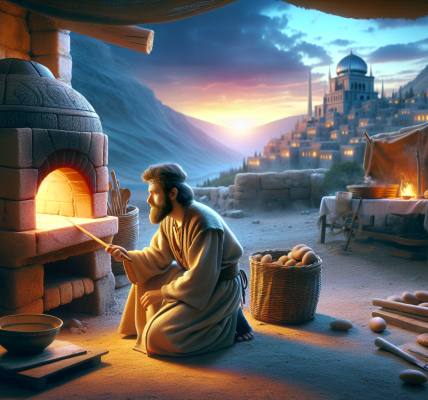
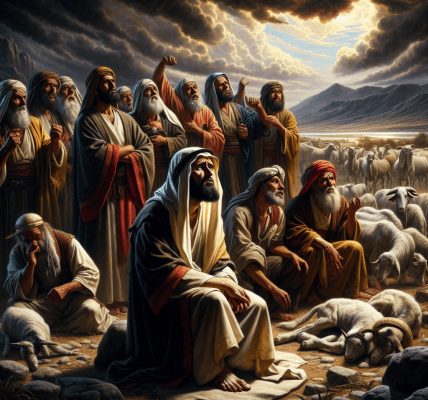
That day, the Israelites struck down the Philistines from Michmash to Aijalon, but the men were so weary and famished that they fell upon the spoil, slaughtering sheep, oxen, and calves on the ground, and eating them with the blood still in them. When Saul was told, “Behold, the men are sinning against the Lord by eating with the blood,” he was grieved and commanded, “Roll a large stone to me here.” Then he ordered, “Disperse among the men and say to them, ‘Bring each his ox and his sheep and slaughter them here and eat; do not sin against the Lord by eating with the blood.'” So every one of his men brought his animal that night and slaughtered it there. And Saul built an altar to the Lord; it was the first altar he had built to the Lord.
Saul then proposed, “Let us go down after the Philistines by night and plunder them until the morning light; let us not leave a man of them.” The people agreed, but the priest counseled, “Let us draw near to God here.” So Saul inquired of God, “Shall I go down after the Philistines? Will you give them into the hand of Israel?” But God did not answer him that day.
Perceiving that sin had broken their communion with the Lord, Saul gathered the people and said, “Come here, all you chiefs of the people, and let us find out how this sin has occurred today. For as the Lord lives, who saves Israel, even if it is in Jonathan my son, he shall surely die.” But not a man among all the people answered him.
Then Saul declared, “You shall be on one side, and I and Jonathan my son will be on the other side.” The people replied, “Do what seems good to you.” So Saul prayed, “O Lord, God of Israel, why have you not answered your servant this day? If this guilt is in me or in Jonathan my son, O Lord, God of Israel, give Urim; but if this guilt is in your people Israel, give Thummim.” And Jonathan and Saul were taken by the lot, and the people escaped.
Then Saul said to Jonathan, “Tell me what you have done.” Jonathan confessed, “I tasted a little honey with the end of the staff that was in my hand. Here I am; I will die.”
But Saul declared, “God do so to me and more also; you shall surely die, Jonathan.”
Then the people rose up and said to Saul, “Shall Jonathan die, who has worked this great salvation in Israel? Far from it! As the Lord lives, not one hair of his head shall fall to the ground, for he has worked with God this day.” So the people ransomed Jonathan, and he did not die. Then Saul withdrew from pursuing the Philistines, and the Philistines went to their own place.
Thus, the Lord delivered Israel through the faith of one man and the loyalty of the people, teaching them that obedience is better than sacrifice, and that He alone is the author of victory.