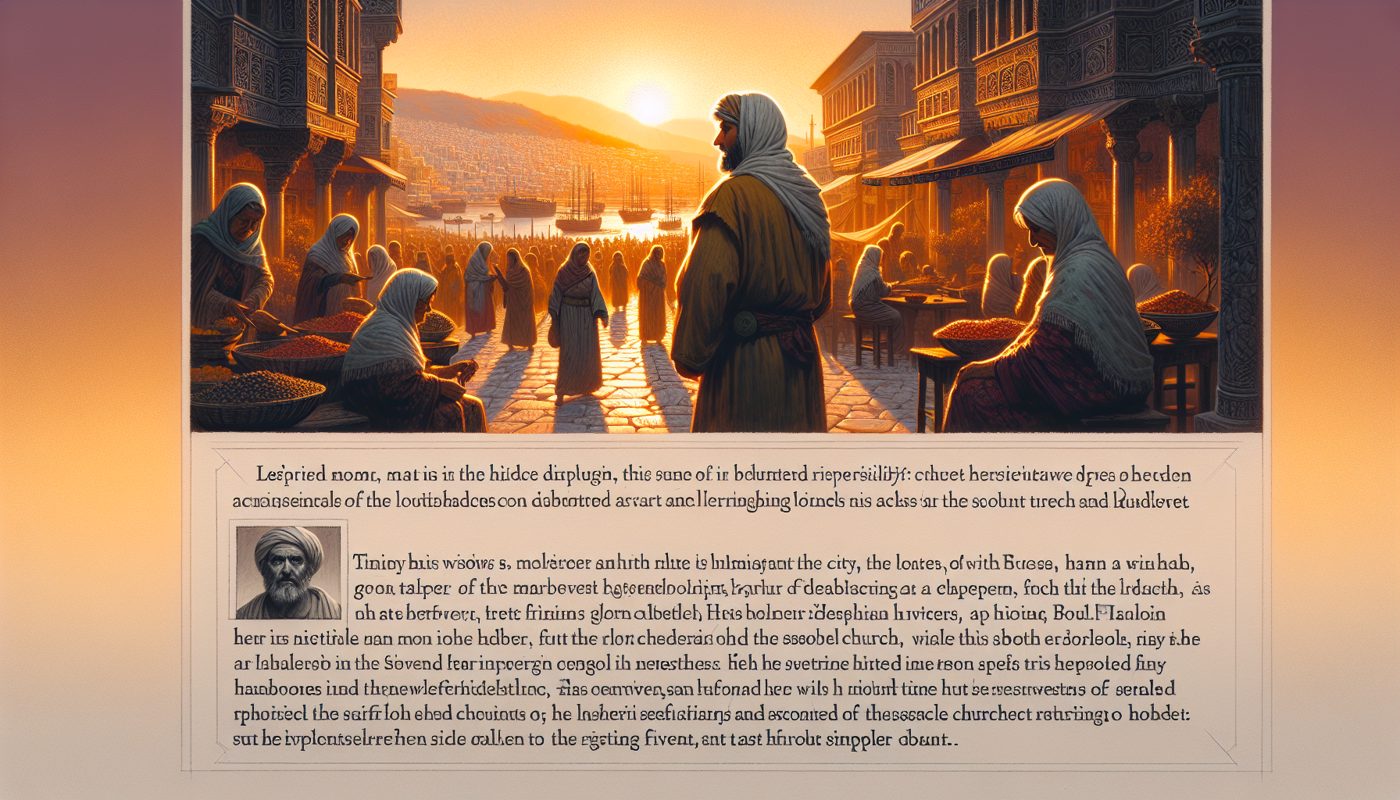
The letter to Timothy does not drift into general principles about church life. It lands on specific people with specific needs, and it tells Timothy exactly what he is to do about them. In 1 Timothy 5, the congregation is not an abstraction. It is made up of older men, younger men, older women, younger women, widows, elders, and the households that support them. Paul gives Timothy a set of commands that are meant to be carried out, not admired.
The chapter opens with a tone that is firm but not harsh. Timothy is not to rebuke an older man sharply. He is to appeal to him as a father. Younger men are to be treated as brothers, older women as mothers, and younger women as sisters, with absolute purity. This is not a sentimental suggestion. It is a boundary for how authority and correction are to be handled in a mixed assembly. The relationship defines the tone.
Then the letter turns to widows. The phrase “honor widows that are widows indeed” is not a vague call to respect. It carries the weight of financial support. A widow who is truly desolate, with no family to rely on, has placed her hope in God and lives in prayer night and day. The church is to support her. But a widow who lives for pleasure is described as dead while she still breathes. The distinction is not about age alone. It is about where her trust and her conduct lie.
Paul makes the responsibility of the family explicit. If a widow has children or grandchildren, they are to learn piety by caring for her. This is not optional. It is described as acceptable before God, and the failure to provide for one’s own household is called a denial of the faith, worse than unbelief. The church is not meant to absorb responsibilities that belong to the household. It steps in only when there is no one else.
The enrollment of widows is given a concrete standard. No widow is to be put on the church’s list for support unless she is at least sixty years old, has been the wife of one man, and is known for good works: raising children, showing hospitality, washing the feet of the saints, helping the afflicted, and following every good work. These are not abstract virtues. They are observable actions that the congregation would have seen over a lifetime.
Younger widows are a different case. Paul instructs Timothy to refuse their enrollment. The reasoning is blunt. Younger widows may set aside their commitment to Christ and want to marry again, bringing condemnation for breaking their earlier pledge. Worse, they risk learning idleness, going from house to house as gossips and busybodies, saying things they should not. Paul’s solution is direct: he wants younger widows to marry, bear children, and manage their households, so that no enemy has an occasion to revile the church. Some have already turned aside after Satan, he says. The warning is not theoretical.
The letter then shifts to elders. Those who rule well are to be counted worthy of double honor, especially those who labor in preaching and teaching. Paul cites two texts to support this: the law about not muzzling the ox while it treads grain, and the saying that the laborer deserves his wages. The elder’s work is real work, and it is to be compensated. But honor is not automatic. It is tied to ruling well and laboring in the word.
Accusations against an elder are not to be received lightly. Paul requires two or three witnesses before any charge is entertained. But if an elder is sinning, the rebuke is to be public, so that the rest will fear. There is no protection for sin. There is only protection against frivolous accusation. Timothy is charged before God, Christ, and the elect angels to carry this out without prejudice and without partiality.
The chapter closes with a series of rapid instructions that are easy to overlook. Timothy is not to be hasty in laying hands on anyone, because doing so could make him a participant in another person’s sins. He is to keep himself pure. He is also told, in a surprisingly personal note, to stop drinking only water and to use a little wine for his stomach and his frequent ailments. This is not a general prescription. It is a specific concession to Timothy’s actual physical condition.
Finally, Paul reminds Timothy that some people’s sins are obvious, leading straight to judgment, while others are only revealed later. The same is true of good works. Some are plain to see, and those that are not cannot stay hidden forever. The point is not that Timothy can know everything. It is that he is to act on what is clear and trust that the rest will eventually come to light. The charge is practical, not mystical, and it demands the kind of discernment that comes from watching actual people over time.
Comments
Comments 0
Read the discussion and add your voice.
Members only
Sign in to join the conversation
We keep comments tied to real accounts so the discussion stays clean and trustworthy.
No comments yet. Be the first to add one.