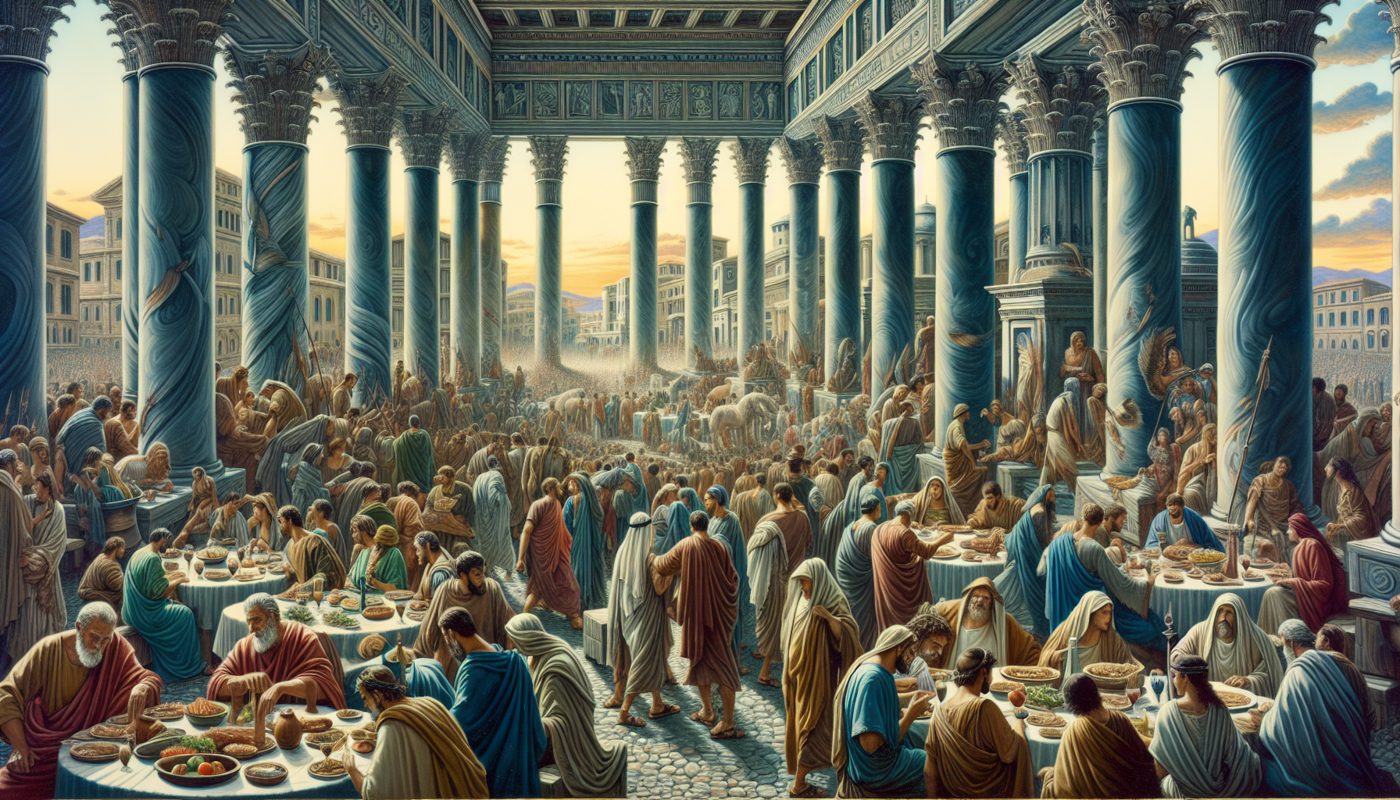
The church in Rome had no single table. Some believers ate meat without a second thought, while others refused it and took only vegetables. Some treated certain days as sacred, while others saw every day alike. Paul did not try to settle these disagreements by declaring one side right and the other wrong. Instead, he told them to stop despising and stop judging, because God had received both.
The weak in faith, Paul wrote, were not those with small belief but those whose consciences bound them where Scripture gave no command. They ate herbs. They kept days. And Paul said to welcome them, not to argue with them over opinions. The strong in faith, who understood that idols were nothing and that all food was clean, were not to treat the weak with contempt.
Paul grounded this command in a single fact: both the eater and the abstainer act for the Lord. The one who eats gives thanks to God. The one who abstains also gives thanks to God. Neither lives for himself, and neither dies for himself. Whether they live or die, they belong to the Lord. Christ died and lived again precisely so that he might be Lord of both the dead and the living.
This was not a call to indifference. It was a call to accountability before a single judge. Paul quoted Isaiah: every knee will bow to the Lord, and every tongue will confess to God. Each person will give an account of himself. That judgment belongs to God alone, and no believer is authorized to take the seat that belongs to Christ.
Paul then shifted the focus from judging others to examining oneself. The real question was not whether meat was clean but whether a believer was putting a stumbling block in a brother's way. Paul was persuaded that nothing was unclean in itself, but he added a sharp qualification: if someone considers a thing unclean, then for that person it is unclean. Conscience, even a misinformed one, carries weight.
The damage of careless eating was not about the food. It was about the brother. If a believer ate meat and grieved a brother whose conscience forbade it, that believer was no longer walking in love. Paul put it bluntly: do not destroy with your meat the one for whom Christ died. The good that the strong possess—their freedom in Christ—must not become something evil spoken of because it wounds the weak.
Paul reoriented the entire argument by defining the kingdom of God. The kingdom is not eating and drinking. It is righteousness, peace, and joy in the Holy Spirit. Anyone who serves Christ in these things is well-pleasing to God and approved by men. That was the standard, not the contents of a dinner plate.
He told them to pursue peace and mutual edification. Do not overthrow the work of God for the sake of meat. All things are clean, but it becomes evil when a person eats and causes offense. Paul was willing to go further than most: it is good not to eat meat or drink wine if doing so makes a brother stumble. That was not a new law. It was the shape of love.
The final paragraph pressed the matter of faith and doubt. Whatever a person does must come from faith. If a believer doubts whether he should eat, and eats anyway, he is condemned—not because the food is wrong, but because his action does not arise from faith. Whatever is not from faith is sin. That principle closed the chapter with a quiet severity. The issue was never really about meat or days. It was about whose judgment a person was living under.
Comments
Comments 0
Read the discussion and add your voice.
Members only
Sign in to join the conversation
We keep comments tied to real accounts so the discussion stays clean and trustworthy.
No comments yet. Be the first to add one.