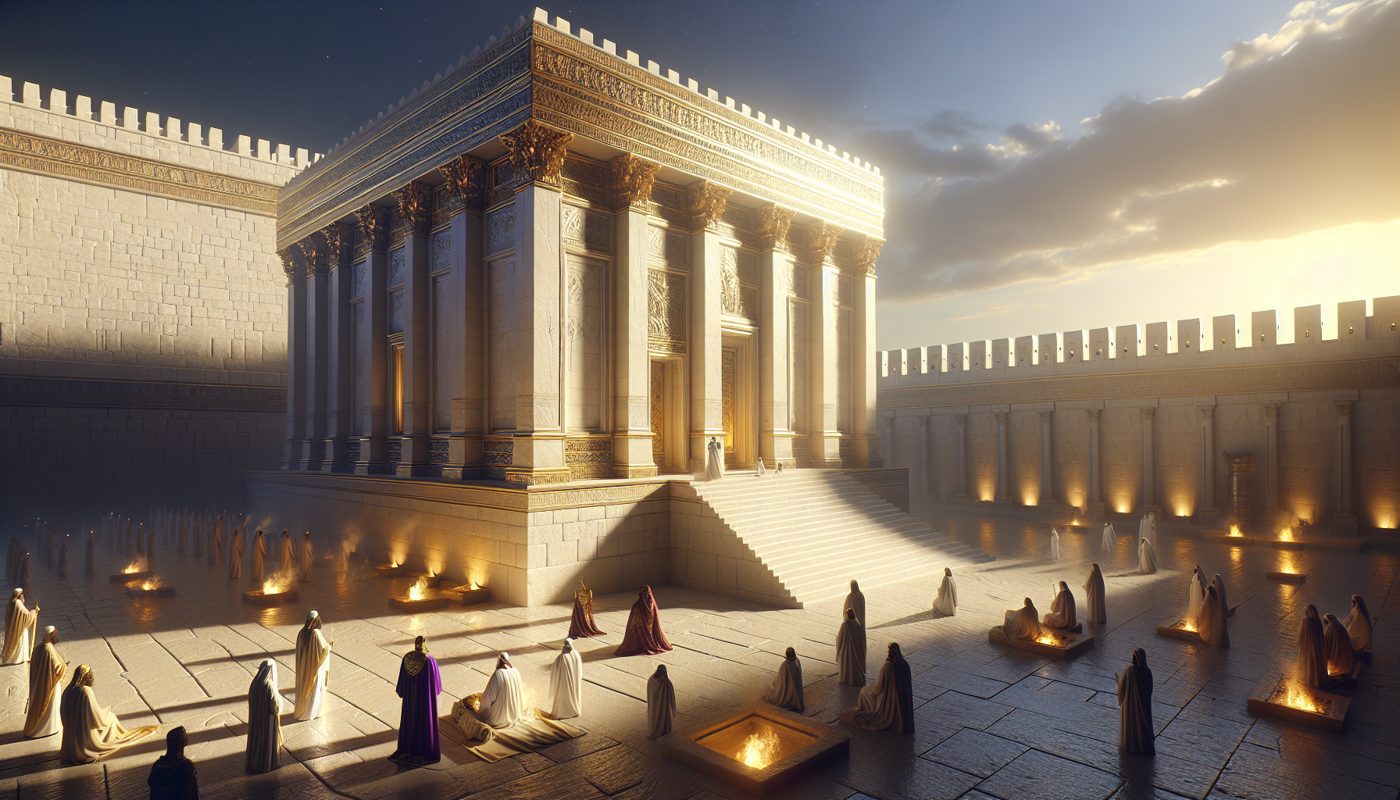
The chapter opens with a finished work. The temple stood complete. The king’s house stood complete. Every project Solomon had set his heart to was done. And then the Lord appeared to him a second time, as He had at Gibeon. That first appearance had been a gift of wisdom. This one carried a different weight. The Lord did not repeat the offer of wisdom. He gave a word about what comes after the building is finished.
The Lord told Solomon that He had heard his prayer and had hallowed the house. He said He had put His name there forever, and that His eyes and His heart would be there perpetually. That is a strong claim. The temple was not just a religious center. It was the place where the Lord had bound His own attention. But the Lord immediately turned from the house to the man. The permanence of the temple did not guarantee the permanence of the throne.
The condition was plain. If Solomon walked before the Lord as David his father walked, with integrity of heart and uprightness, keeping the Lord’s statutes and ordinances, then the throne of his kingdom would be established over Israel forever. The Lord tied the promise to conduct. The throne would last only as long as the king obeyed. That was not a vague hope. It was a direct covenant renewal with a warning built into the promise.
Then the Lord turned to the alternative. If Solomon or his children turned away from following Him, if they failed to keep His commandments and statutes, and if they went and served other gods and worshipped them, then the Lord would cut off Israel from the land He had given them. He would cast the temple out of His sight. The house that had been hallowed would become a ruin. Israel would become a proverb and a byword among all peoples. The Lord did not soften the warning. He spelled out the consequences in full.
The Lord even gave the words that future passersby would speak when they saw the temple reduced to rubble. They would be astonished and would hiss. They would ask why the Lord had done this to the land and to the house. And the answer would be that Israel forsook the Lord their God, who brought their fathers out of Egypt, and laid hold on other gods, worshipped them, and served them. The Lord Himself wrote the script of judgment. That is how seriously He took the covenant.
The chapter then shifts from the divine word to the king’s works. Twenty years had passed, and Solomon had built both the temple and the king’s house. He had also made a deal with Hiram king of Tyre. Hiram had supplied cedar, fir, and gold. In return, Solomon gave Hiram twenty cities in the land of Galilee. When Hiram came to see them, he was not pleased. He called them the land of Cabul, a name that stuck. The cities were not what he had expected. That transaction did not go well.
Solomon also raised a levy to build the temple, his own house, the Millo, the wall of Jerusalem, and the cities of Hazor, Megiddo, and Gezer. The chapter explains that Pharaoh king of Egypt had taken Gezer, burned it, killed the Canaanites living there, and given it as a dowry to his daughter, Solomon’s wife. Solomon rebuilt Gezer, along with lower Beth-horon, Baalath, and Tamar in the wilderness. He built store cities, cities for his chariots, cities for his horsemen, and whatever he desired to build in Jerusalem, Lebanon, and all the land of his dominion.
The labor force for these projects came from the descendants of the Amorites, Hittites, Perizzites, Hivites, and Jebusites who remained in the land. Those peoples had not been destroyed. Solomon made them a levy of bondservants. But the children of Israel he did not make bondservants. They served as men of war, servants, princes, captains, and rulers of chariots and horsemen. The chief officers over the work numbered five hundred and fifty. They ruled over the people who did the labor.
The chapter also notes that Pharaoh’s daughter moved out of the city of David into her own house that Solomon had built for her. After that, he built the Millo. And three times a year Solomon offered burnt offerings and peace offerings on the altar he had built to the Lord. He burned incense with them. So he finished the house. The worship was regular, but the chapter has already placed that worship under the shadow of the warning about turning away.
Finally, Solomon built a navy of ships at Ezion-geber, near Eloth on the shore of the Red Sea in the land of Edom. Hiram sent his own servants, men who knew the sea, to serve with Solomon’s men. They sailed to Ophir and brought back four hundred and twenty talents of gold. The king’s wealth continued to grow. But the chapter that began with the Lord’s solemn warning about the throne and the temple ended with ships and gold. The reader is left to wonder whether the king’s attention was still fixed on the word he had received.
Comments
Comments 0
Read the discussion and add your voice.
Members only
Sign in to join the conversation
We keep comments tied to real accounts so the discussion stays clean and trustworthy.
No comments yet. Be the first to add one.