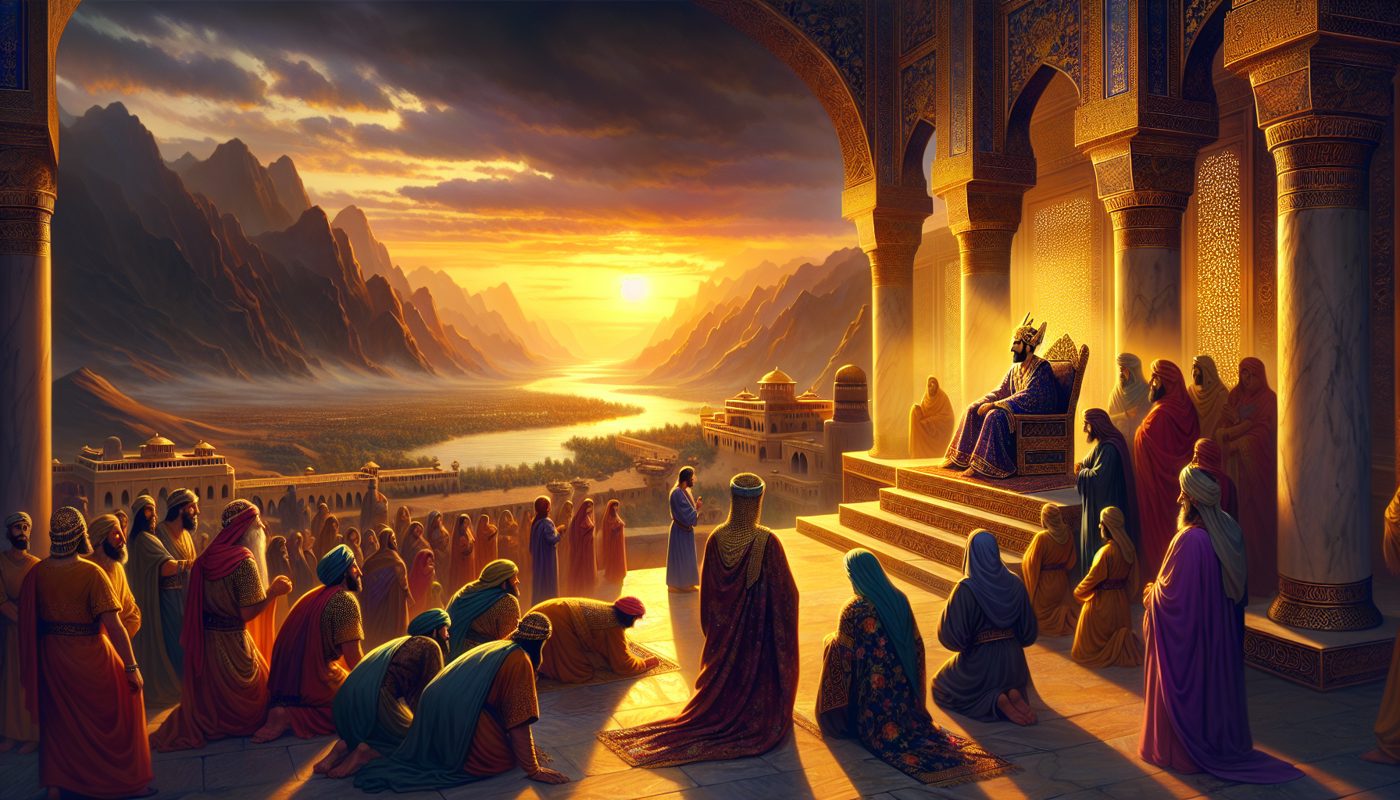
The first year of Cyrus king of Persia opened with a proclamation that reached every corner of his empire. The Lord stirred the spirit of Cyrus, and the king made it known in speech and in writing: the God of heaven had given him all the kingdoms of the earth, and that same God had charged him to build a house in Jerusalem, in Judah.
Cyrus spoke directly to the exiles of Israel. Whoever among them belonged to the Lord’s people was free to go up to Jerusalem and rebuild the house of the Lord, the God of Israel. The king added that those who remained behind should support the travelers with silver, gold, goods, and livestock, and also with a freewill offering for the house of God in Jerusalem.
The decree did not fall on passive ears. The heads of the fathers’ houses of Judah and Benjamin rose, along with the priests and the Levites—everyone whose spirit God had stirred to go up and build. Their neighbors strengthened their hands with vessels of silver, gold, goods, livestock, and precious things, beyond what was willingly offered.
Cyrus himself brought out the vessels of the house of the Lord that Nebuchadnezzar had carried away from Jerusalem and placed in the house of his own gods. The king handed them over to Mithredath the treasurer, who counted them out to Sheshbazzar, the prince of Judah.
The inventory was precise: thirty gold platters, a thousand silver platters, twenty-nine knives, thirty gold bowls, four hundred and ten silver bowls of a second sort, and a thousand other vessels. The total count of gold and silver vessels came to five thousand four hundred.
Sheshbazzar brought all these vessels up from Babylon to Jerusalem when the captives were brought up. The chapter records no ceremony, no weeping, no speeches. It simply notes that the Lord moved a foreign king, that the king issued a written decree, that the people responded, and that the temple vessels were returned by number.
The action in Ezra 1 is not dramatic in the usual sense. It is administrative, legal, and concrete. The Lord stirred Cyrus. Cyrus wrote. The people rose. The vessels were counted. That is the shape of the return.
No prophet appears in this chapter. No angel speaks. No miracle is performed. What the chapter shows is a king who acknowledges the God of heaven and a remnant whose spirit is stirred to rebuild. The decree itself is the hinge: the word of the Lord through Jeremiah is accomplished, and the house of the Lord in Jerusalem is again a project of the kingdom.
The chapter closes with the vessels in Sheshbazzar’s hands and the people on the move. Nothing is said about the journey, the arrival, or the foundation. Those details belong to the chapters that follow. Here, the record is one of divine initiative and human response, both measured in the language of proclamation and inventory.
Comments
Comments 0
Read the discussion and add your voice.
Members only
Sign in to join the conversation
We keep comments tied to real accounts so the discussion stays clean and trustworthy.
No comments yet. Be the first to add one.