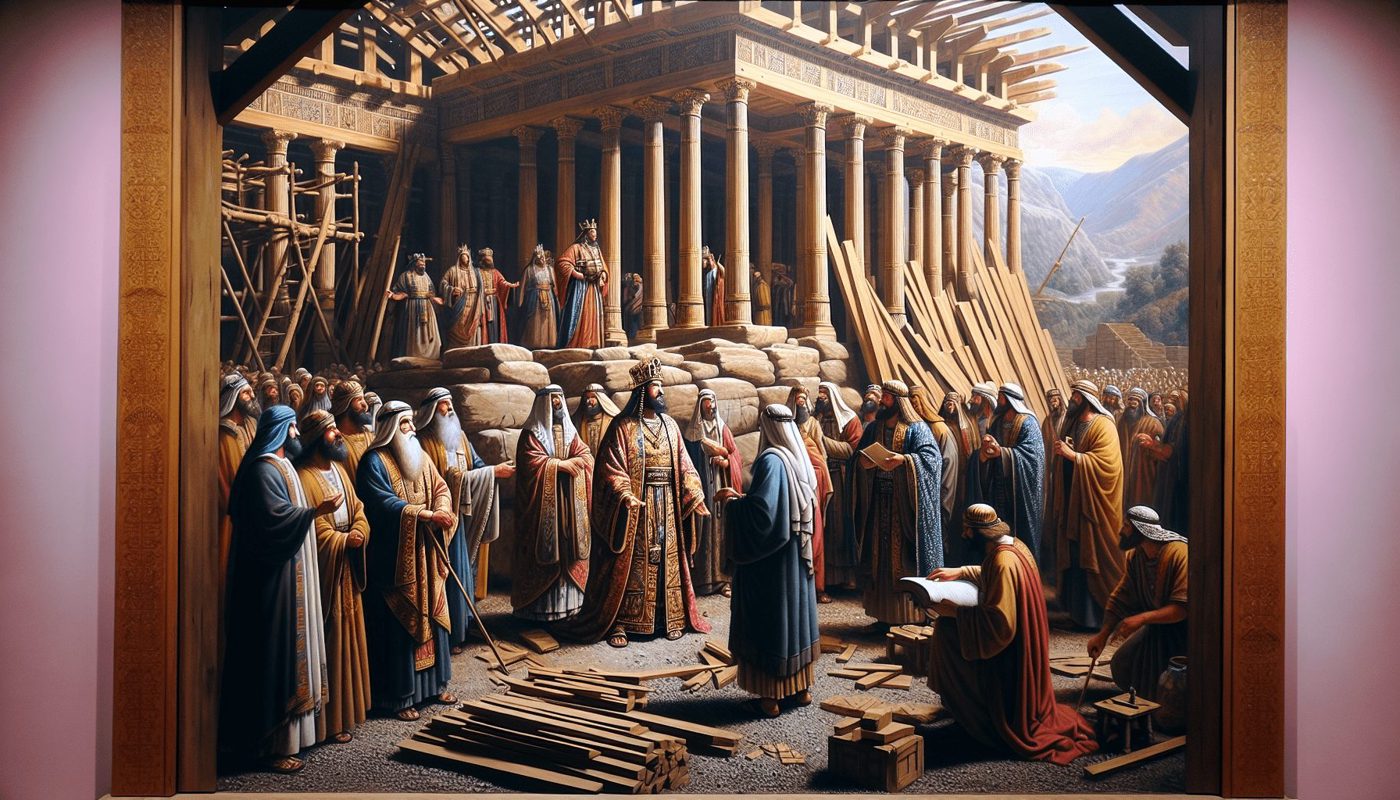
In the fourth year of Solomon’s reign over Israel, in the month Ziv, the second month, the king began to build the house of the Lord. The chapter gives the date with precision: four hundred and eightieth year after the children of Israel came out of Egypt. That chronological marker anchors the temple in Israel’s history—not as a vague project, but as a fixed event tied to the exodus.
The dimensions were set. The house was sixty cubits long, twenty cubits wide, thirty cubits high. The porch before the temple stretched twenty cubits across the width of the house and ten cubits deep. Windows of fixed lattice-work were made for the house. Against the walls, stories were built round about—side chambers on three levels, each story wider than the one below, so the beams would not be fastened into the temple walls themselves.
One detail stands out: the house was built of stone made ready at the quarry. No hammer, no axe, no iron tool was heard at the site while it was under construction. The silence of the work was not a footnote; it was a condition of the building itself. The stones arrived shaped and finished, and the assembly proceeded without the noise of shaping on holy ground.
Solomon built the house and finished it. He covered it with beams and planks of cedar. The side chambers were built against the house, each five cubits high, resting on the house with timber of cedar.
Then the word of the Lord came to Solomon. The message was conditional: if Solomon walked in the Lord’s statutes, executed His ordinances, and kept all His commandments, then the Lord would establish His word with Solomon—the word spoken to David his father. And the Lord would dwell among the children of Israel and would not forsake them. The temple was not a guarantee of divine presence apart from obedience; the promise was tied to the king’s faithfulness.
So Solomon built the house and finished it. The interior walls were lined with boards of cedar, from floor to ceiling. The floor was covered with boards of fir. At the rear of the house, twenty cubits were partitioned off with cedar boards from floor to ceiling, forming the oracle—the most holy place. The rest of the house, the temple before the oracle, was forty cubits long. Inside, cedar was carved with knobs and open flowers; no stone was visible.
In the oracle, the ark of the covenant of the Lord would be placed. The oracle was a cube: twenty cubits in length, twenty in breadth, twenty in height. Solomon overlaid it with pure gold. He covered the altar with cedar, then overlaid the whole house within with pure gold. Chains of gold were drawn across before the oracle. The entire house was overlaid with gold until it was finished, and the altar that belonged to the oracle was also overlaid with gold.
Inside the oracle, Solomon made two cherubim of olive wood, each ten cubits high. Each cherub had two wings, each wing five cubits, so that from wingtip to wingtip the span was ten cubits. The cherubim were set inside the inner house with wings stretched out: one wing touched the wall, the other wing touched the other cherub’s wing in the middle of the house. The cherubim were overlaid with gold.
All the walls of the house were carved round about with figures of cherubim, palm trees, and open flowers, both inside and outside. The floor was overlaid with gold, within and without. For the entrance of the oracle, doors of olive wood were made, with lintel and doorposts taking up a fifth part of the wall. The two doors were carved with cherubim, palm trees, and open flowers, and overlaid with gold. For the entrance of the temple itself, doorposts of olive wood were made, taking up a fourth part of the wall, and two doors of fir wood, each with two folding leaves. They were carved with cherubim, palm trees, and open flowers, and overlaid with gold fitted upon the graven work.
The inner court was built with three courses of hewn stone and a course of cedar beams. The foundation of the house of the Lord was laid in the fourth year, in the month Ziv. The house was finished in the eleventh year, in the month Bul, the eighth month. It took seven years to build.
Comments
Comments 0
Read the discussion and add your voice.
Members only
Sign in to join the conversation
We keep comments tied to real accounts so the discussion stays clean and trustworthy.
No comments yet. Be the first to add one.