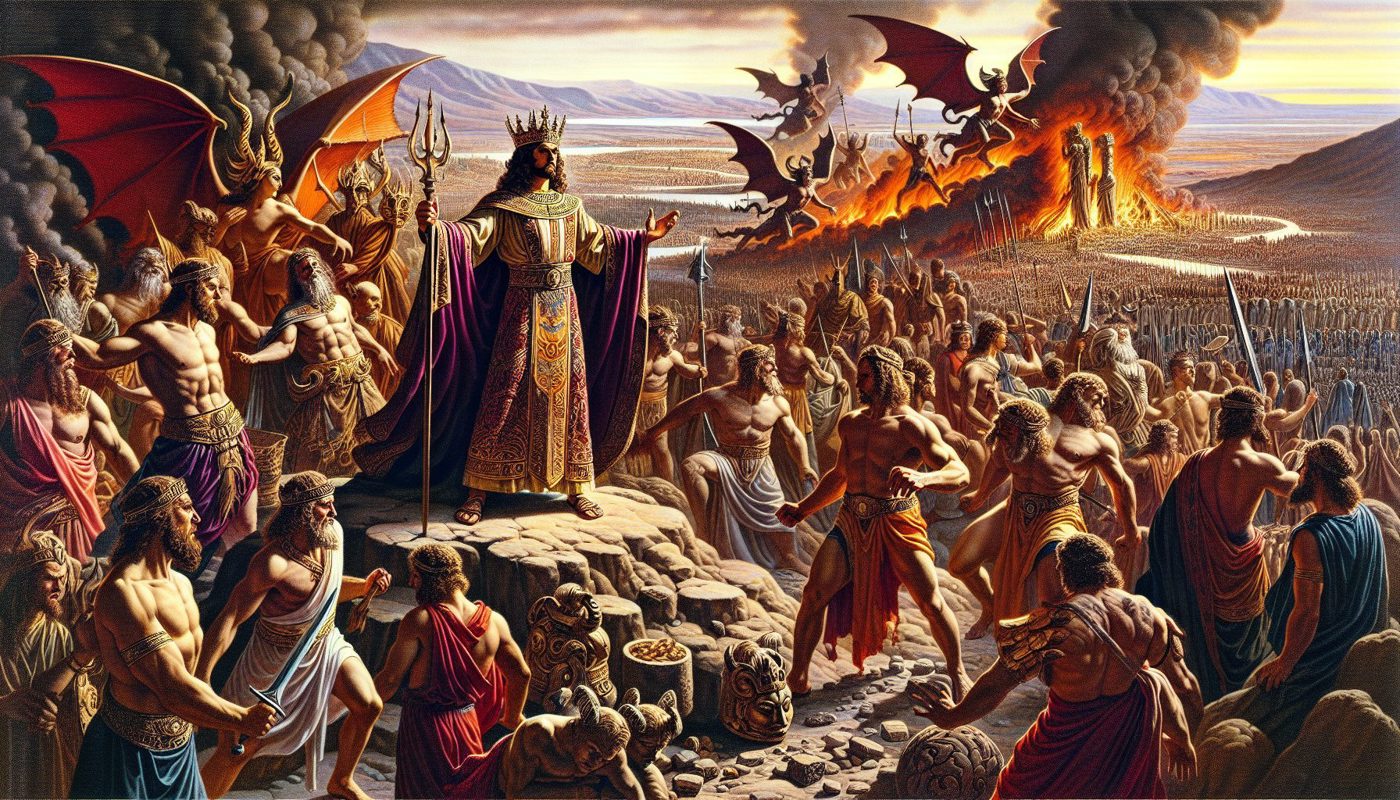
Ahaz was twenty years old when he became king of Judah, and he reigned sixteen years in Jerusalem. The chronicler states plainly what kind of king he was: he did not do what was right in the eyes of the Lord, unlike his ancestor David. Instead, he walked in the ways of the kings of Israel, casting metal images for the Baals. That was only the beginning.
He burned incense in the Valley of the Son of Hinnom, and there he burned his own children in the fire, copying the abominations of the nations the Lord had driven out before Israel. He sacrificed and burned incense on the high places, on the hills, and under every green tree. The chapter does not explain why he did these things. It simply records them.
Because of this, the Lord handed Ahaz over to the king of Syria. The Syrians struck him and carried off a great multitude of captives to Damascus. He was also handed over to the king of Israel, who inflicted a massive slaughter. In a single day, Pekah son of Remaliah killed 120,000 valiant men of Judah. The reason given is direct: they had forsaken the Lord, the God of their fathers.
During that battle, Zichri, a mighty man of Ephraim, killed Maaseiah the king’s son, Azrikam the steward of the palace, and Elkanah, who was second in rank to the king. The Israelites took 200,000 captives—women, sons, and daughters—along with much plunder, and brought everything to Samaria.
But a prophet of the Lord named Oded met the returning army in Samaria. He told them that the Lord’s wrath against Judah had indeed delivered Judah into their hands, but that they had slaughtered them with a rage that reached heaven. He warned them not to enslave their own brothers and sisters, because they themselves had trespasses against the Lord. He commanded them to send the captives back, for the fierce wrath of the Lord was upon Israel.
Four leaders of Ephraim—Azariah son of Johanan, Berechiah son of Meshillemoth, Jehizkiah son of Shallum, and Amasa son of Hadlai—stood up against the returning soldiers. They told the soldiers not to bring the captives into Samaria, because that would add to Israel’s already great trespass and bring fierce wrath upon them. The armed men listened. They left the captives and the plunder before the princes and the assembly.
Then those four men, named in the text, took the captives. They used the plunder to clothe everyone who was naked, gave them sandals, fed them, gave them drink, anointed them, and carried the feeble on donkeys. They brought them to Jericho, the city of palm trees, and returned to Samaria. The chapter does not say that the captives praised anyone. It simply says they were brought back to their brothers.
At that same time, Ahaz sent to the kings of Assyria for help. The Edomites had struck Judah again and carried off captives. The Philistines had invaded the lowland and the Negeb of Judah, capturing Beth-shemesh, Aijalon, Gederoth, Soco, Timnah, and Gimzo with their villages, and settled there. The chronicler states the reason: the Lord brought Judah low because of Ahaz, king of Israel, for he had acted recklessly in Judah and had trespassed greatly against the Lord.
Tilgath-pilneser, king of Assyria, came to Ahaz, but he distressed him rather than strengthening him. Ahaz took silver and gold from the house of the Lord, from the king’s house, and from the princes, and gave it to the king of Assyria, but it did not help him. In his distress, Ahaz trespassed even more against the Lord. He sacrificed to the gods of Damascus, reasoning that since the gods of the kings of Syria had helped them, he would sacrifice to those gods so they would help him. But those gods became his ruin and the ruin of all Israel.
Ahaz gathered the vessels of the house of God, cut them to pieces, and shut the doors of the house of the Lord. He made altars in every corner of Jerusalem and built high places in every city of Judah to burn incense to other gods, provoking the Lord, the God of his fathers, to anger. The rest of his acts are written in the book of the kings of Judah and Israel. He died and was buried in Jerusalem, but not in the tombs of the kings of Israel. His son Hezekiah reigned in his place.
Comments
Comments 0
Read the discussion and add your voice.
Members only
Sign in to join the conversation
We keep comments tied to real accounts so the discussion stays clean and trustworthy.
No comments yet. Be the first to add one.