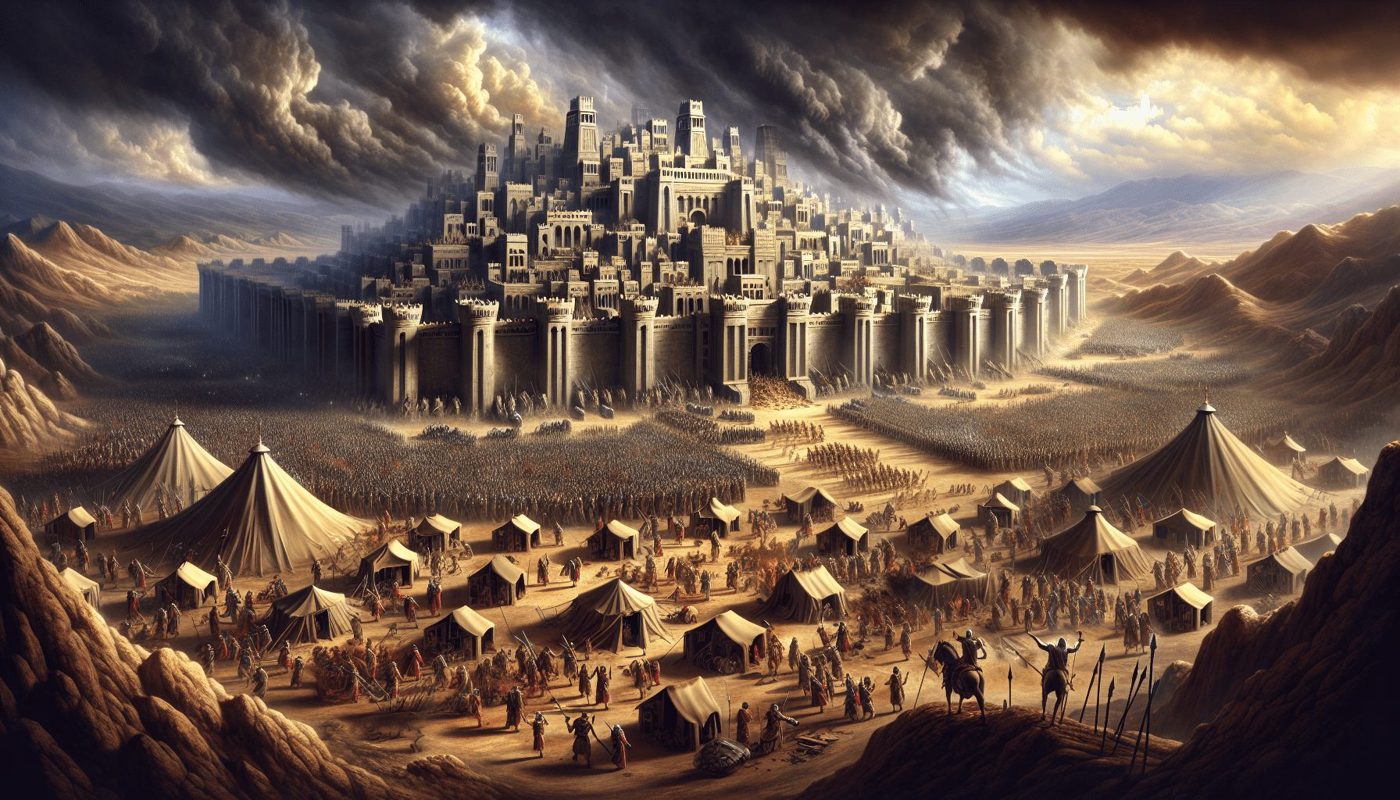
The chapter opens with a blunt announcement: a day of the Lord is coming, and the spoil of Jerusalem will be divided inside the city itself. There is no softening this. The Lord says he will gather all nations against Jerusalem for battle. The city will be taken, houses rifled, women ravished, half the population led into captivity. But a residue remains; they are not cut off from the city. The pressure is immediate and physical.
Then the Lord goes forth to fight those nations, as he fought in the day of battle. His feet stand on the Mount of Olives, east of Jerusalem. The mountain splits in two, half moving north, half south, creating a very great valley from east to west. The people flee through that valley, the text says, as they fled from the earthquake in the days of Uzziah king of Judah. And the Lord comes, and all the holy ones with him.
On that day there is no normal light. The bright ones withdraw themselves. It is a day known only to the Lord—not day, not night—but at evening time there is light. The cosmic order is disrupted, then restored on the Lord's terms.
Living waters flow out from Jerusalem, half toward the eastern sea, half toward the western sea. They run in summer and in winter. There is no drought in this vision. The land itself is remade.
The Lord becomes King over all the earth. On that day the Lord is one, and his name is one. The land from Geba to Rimmon south of Jerusalem is made like the Arabah, the desert plain. But Jerusalem is lifted up and dwells in her place, from Benjamin's Gate to the Corner Gate, from the Tower of Hananel to the king's winepresses. Men dwell there, and there is no more curse. Jerusalem dwells safely.
The nations that warred against Jerusalem are struck with a plague: their flesh consumes away while they stand, their eyes in their sockets, their tongue in their mouth. A great tumult from the Lord falls among them, and they turn on each other, each man seizing his neighbor's hand and rising against him. Judah also fights at Jerusalem, and the wealth of the nations—gold, silver, apparel—is gathered in abundance. The same plague strikes the horses, mules, camels, donkeys, and all the beasts in those camps.
But not all nations are destroyed. Every survivor from the nations that came against Jerusalem is required to go up year after year to worship the King, the Lord of hosts, and to keep the Feast of Tabernacles. If any family of the earth refuses to go up, they receive no rain. Egypt is singled out: if they do not go up, they get the plague that the Lord uses to smite the nations that neglect the feast. This is the punishment of Egypt and of all nations that fail to keep the Feast of Tabernacles.
The final verses shift to holiness. On that day, even the bells of the horses are inscribed with "Holy to the Lord." The pots in the Lord's house become like the bowls before the altar. Every pot in Jerusalem and Judah is holy to the Lord of hosts. Those who sacrifice come and take them and boil the meat in them. And on that day, there is no longer a Canaanite in the house of the Lord of hosts. The vision ends with the total sanctification of worship and the removal of what is foreign from the temple precincts.
Comments
Comments 0
Read the discussion and add your voice.
Members only
Sign in to join the conversation
We keep comments tied to real accounts so the discussion stays clean and trustworthy.
No comments yet. Be the first to add one.