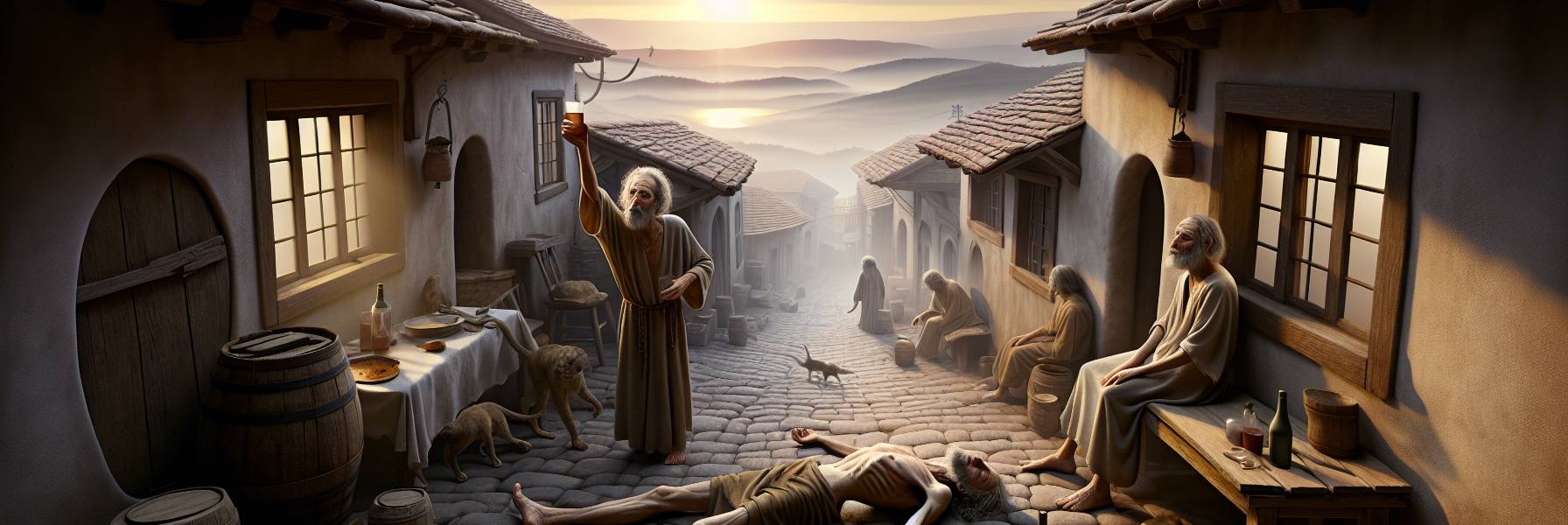

The dawn that broke over the clay-tiled roofs of the village was a slow, reluctant thing. A pale, grey light seeped into the alleyways, chasing the stubborn shadows from the corners where stray cats still huddled. In a small room above the baker’s shop, old Matthias stirred. His bones, like dry leather, complained as he sat up. The verse came to him not as a recited text, but as the echo of his father’s voice, rough as a grindstone: *Wine is a mocker, strong drink a brawler, and whoever is led astray by it is not wise.*
He hadn’t touched the stuff in thirty years, not since the night it had turned his friend Ezra’s laughter into a snarling, clumsy rage over a misplaced dice. The memory was a cold stone in his gut. Downstairs, the ovens were already breathing out the warm, yeasty scent of the day’s first loaves. *“Bread gained by deceit is sweet to a man, but afterward his mouth will be full of gravel.”* Another fragment, surfacing like a familiar ache. Old Nathan, the baker before Levi, had been caught watering his flour. The sweetness of his extra profit had indeed turned to gravel—the gravel of shattered reputation, of a shop that stood empty for a year until Levi, a man whose word was as solid as his hearth-bricks, took it over.
Matthias’s day was one of small, deliberate motions. He was a scribe of sorts, though he owned little parchment. He kept records for men who couldn’t read—harvest shares, debts, marriage contracts. His tools were a wax tablet and a stylus, his office a bench under the great terebinth tree in the square.
The first to find him was Jorah, a young farmer with dust already coating his sandals. His eyes were bright, too bright, with a scheme. “Matthias,” he said, lowering his voice. “I need a deed for the field next to mine, the one old Simeon owns. His mark, you know it. He’s half-blind now. Who’s to say he didn’t sell me the western strip? A small strip. He won’t miss it.”
The air under the tree seemed to grow still. Matthias looked at Jorah’s eager face and saw the ghost of Nathan the baker. *“Differing weights and differing measures—the Lord detests them both.”* It wasn’t just about shekels in a scale pan. It was about the weight of a word, the measure of a man’s integrity.
“No,” Matthias said, the word simple and final as a stone dropped in a well.
“But the silver–” Jorah began.
“Would be a fire in your purse, boy,” Matthias interrupted, not unkindly. “It would burn a hole straight through to your soul. Go. Tend your own field. The yield of honest soil is sleep enough for any man.”
Jorah flushed, muttered, and stalked away. Matthias watched him go, feeling the tiredness of years. *“The purpose in a man’s heart is like deep water, but a man of understanding will draw it out.”* He hadn’t needed to draw much; Jorah’s water was murky and shallow.
Later, it was a dispute between two merchants over a shipment of linen. Each man’s story was a polished artifact, smooth and convincing. They shouted, they gestured, they called on the witnesses of heaven. Matthias listened, his eyes moving from one heated face to the other. *“Who can say, ‘I have made my heart pure; I am clean from my sin’?”* The truth, he knew, was rarely a pure stream. It was usually a muddy river where both men had dropped their own filth.
He sighed. “Abijah,” he said to the older merchant. “You say the bolts were counted at Gaza. Elihu, you say the count was made here. The camels are tired, the linen is sold. The missing five bolts… is their value worth the breath you are spending, which smells of last night’s onions and deceit? Split the difference and go. Or keep shouting. The sparrows are enjoying the spectacle.”
There was a long silence. Then, unexpectedly, Abijah chuckled, a dry, rasping sound. Elihu scowled, but then his shoulders slumped. A bargain was struck, less than each wanted, more than either deserved. It was the justice of a fallen world, imperfect but functional. *“It is a snare for a man to say rashly, ‘It is holy,’ and to reflect only after making his vows.”*
As the sun climbed high, the square grew busy and loud. A group of soldiers from the garrison lounged by the well, their laughter booming and coarse. Watching them, Matthias thought of his own two sons, grown and gone. One to the sea, one to the capital. He remembered the exhausting, glorious chaos of their childhood, the sleepless nights, the constant friction and joy. *“The glory of young men is their strength, but the splendor of old men is their gray hair.”* His own hair, what was left of it, was indeed a mantle of white. His strength was gone, replaced by a different force—the heavy, patient weight of experience, which could not be lifted in a single hand but could steady a whole town.
The day’s last light was a soft, honeyed gold when the widow Tirzah approached. She held a small clay lamp, unlit. Her voice was a whisper. “They say my son is in the tavern again. He has pawned his father’s cloak. The one who holds it… his scales are false. I know it.”
Matthias rose, his joints protesting. He took his staff. “Show me.”
The tavern was a smoky cave of noise. In the corner, a man with quick, rodent-like eyes was weighing out silver pieces for a young, shame-faced man—Tirzah’s boy. Matthias did not speak. He simply stood in the doorway, his presence a silent, grey rock in the stream of revelry. He caught the pawnbroker’s eye and held it. He said nothing about the scales. He didn’t need to. The man’s glance flickered to the widow in the street, to the boy’s slumped shoulders, back to Matthias’s impassive face. *“Food gained by fraud tastes sweet, but one ends up with a mouth full of sand.”*
With a grunt, the pawnbroker shoved the cloak across the table, swept the silver back into his own purse, and jerked his head toward the door. The boy snatched the cloak and fled. Matthias turned and left, the widow’s soft sob of thanks following him out.
Walking home in the deep blue twilight, the stars beginning their cold vigil, Matthias felt the full weariness of the day. It was not a weariness of despair, but of completion. The proverbs were not mere words on a scroll; they were the very grain of the wood, the hidden currents under the soil of their lives. They spoke of the seduction of quick gains and the slow, sure reward of the straight path. They acknowledged the deep, hidden waters in every heart and the simple, brutal fact that no one stood clean before heaven on their own merit.
He entered his quiet room. From his window, he could see a lantern in Levi’s bakery, the good baker preparing for tomorrow. The mocker, wine, was still singing its loud song in the tavern. The just and the unjust alike slept under the same moon. Matthias lay down, the echoes of the day settling in his mind. *“The spirit of man is the lamp of the Lord, searching all his innermost parts.”* His own lamp felt dim, flickering, but it still burned. It had cast just enough light for today. And tomorrow, God willing, there would be dawn again, and bread, and the slow, patient work of weighing things that were not always seen on scales.