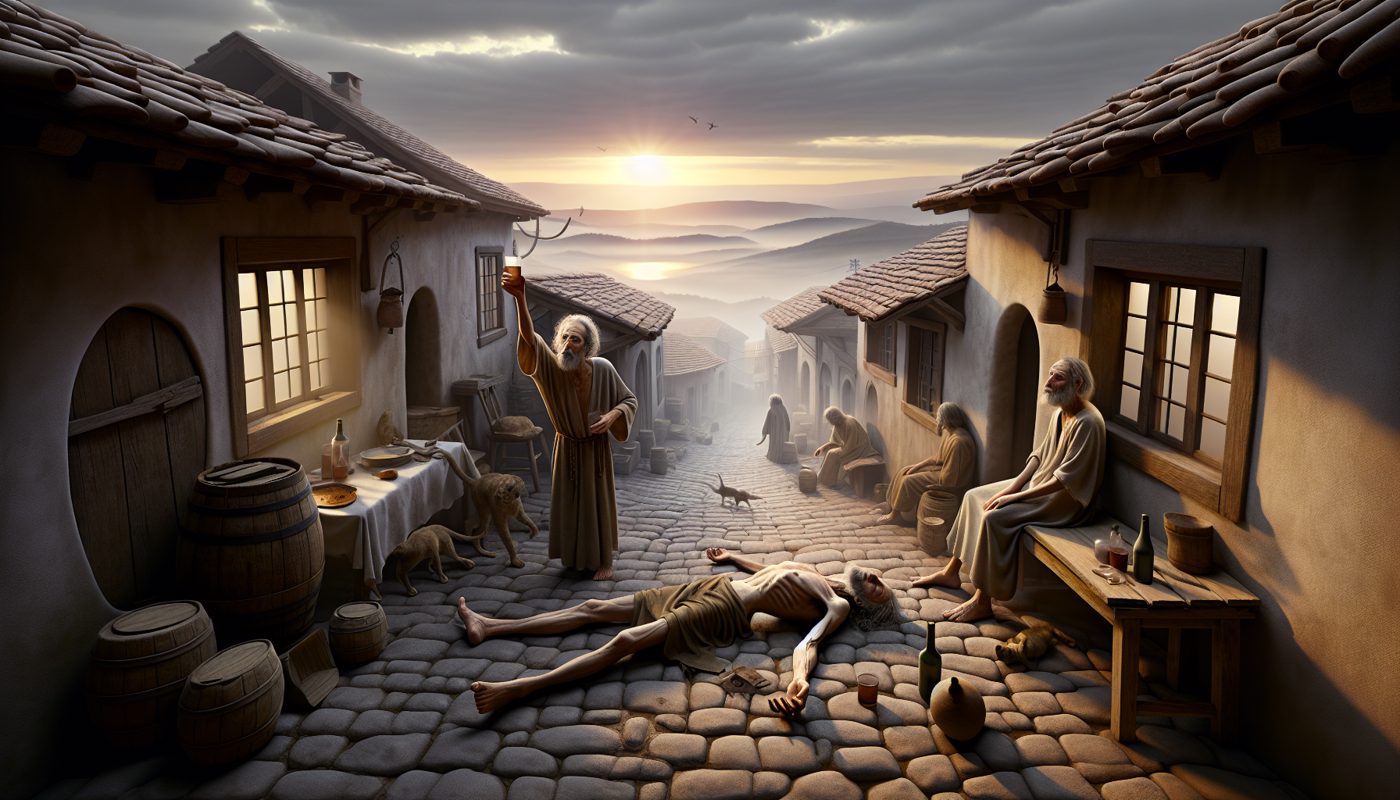
Proverbs 20 opens with a blunt warning: wine is a mocker, strong drink a brawler, and whoever is led astray by it is not wise. The chapter does not pause to explain or soften this. It simply states the danger and moves on. The same directness runs through every verse, as if the text itself refuses to waste words on anything that does not build or test character.
The king appears early, his terror compared to the roaring of a lion. To provoke him is to sin against one's own life. This is not flattery of rulers but a cold recognition of power and consequence. The chapter does not imagine an ideal king; it describes what a king does—scatter evil with his eyes, winnow the wicked, bring the threshing wheel over them. The throne is upheld by kindness and truth, not by force alone.
Then the lens shifts to ordinary transactions. Diverse weights and diverse measures are an abomination to the Lord. The phrase appears twice, as if the writer knows how easily a merchant can justify a thumb on the scale. A false balance is not good. There is no room for nuance here. The buyer who calls a thing bad only to boast about it later is exposed as a deceiver. The bread of falsehood tastes sweet at first, but afterward the mouth is filled with gravel.
Sluggards and fools are sketched in quick strokes. The sluggard will not plow because of the winter, so he will beg at harvest and have nothing. The fool jumps into every quarrel. The one who loves sleep will come to poverty. These are not abstract sins; they are visible failures that produce visible results. A child is known by his doings, whether his work is pure and right. The hearing ear and the seeing eye are both made by the Lord, which means that perception itself is a gift, not a right.
Counsel in the heart of a man is like deep water, but a man of understanding will draw it out. This is the work of patience and skill, not of impulse. The chapter warns against rash vows: it is a snare to say something is holy and then make inquiry afterward. Better to think before speaking. Better to wait on the Lord than to recompense evil. The one who curses father or mother will have his lamp put out in blackness of darkness.
The faithful man is rare. Most people proclaim their own kindness, but who can find someone truly faithful? The righteous man who walks in integrity leaves a blessing for his children. The glory of young men is their strength, and the beauty of old men is the gray head. Both are honored, but neither is automatic. Strength without wisdom becomes violence; age without integrity becomes bitterness.
The spirit of man is the lamp of the Lord, searching all his innermost parts. This is not a comforting image. It means that nothing hidden remains hidden. Stripes that wound cleanse away evil, and strokes reach the innermost parts. The chapter does not flinch from the cost of correction. It does not pretend that wisdom comes gently or that character is formed without pain.
Inheritance gained hastily at the beginning will not be blessed in the end. A man's goings are of the Lord; how then can he understand his own way? This is not fatalism but humility. The chapter does not promise that the righteous will always understand their path, only that the path itself is under a higher hand. The wise king, the honest merchant, the faithful man, the child who shows his character early—all of them live within this tension between human action and divine sovereignty.
The chapter ends where it began: with the weight of choices. Diverse weights are an abomination. A false balance is not good. The Lord sees the scales, the vows, the quarrels, the sleep, the boast, the hidden counsel. Nothing escapes the lamp that searches the innermost parts. The only question left is whether the reader will set down the false weight and pick up the true one.
Comments
Comments 0
Read the discussion and add your voice.
Members only
Sign in to join the conversation
We keep comments tied to real accounts so the discussion stays clean and trustworthy.
No comments yet. Be the first to add one.