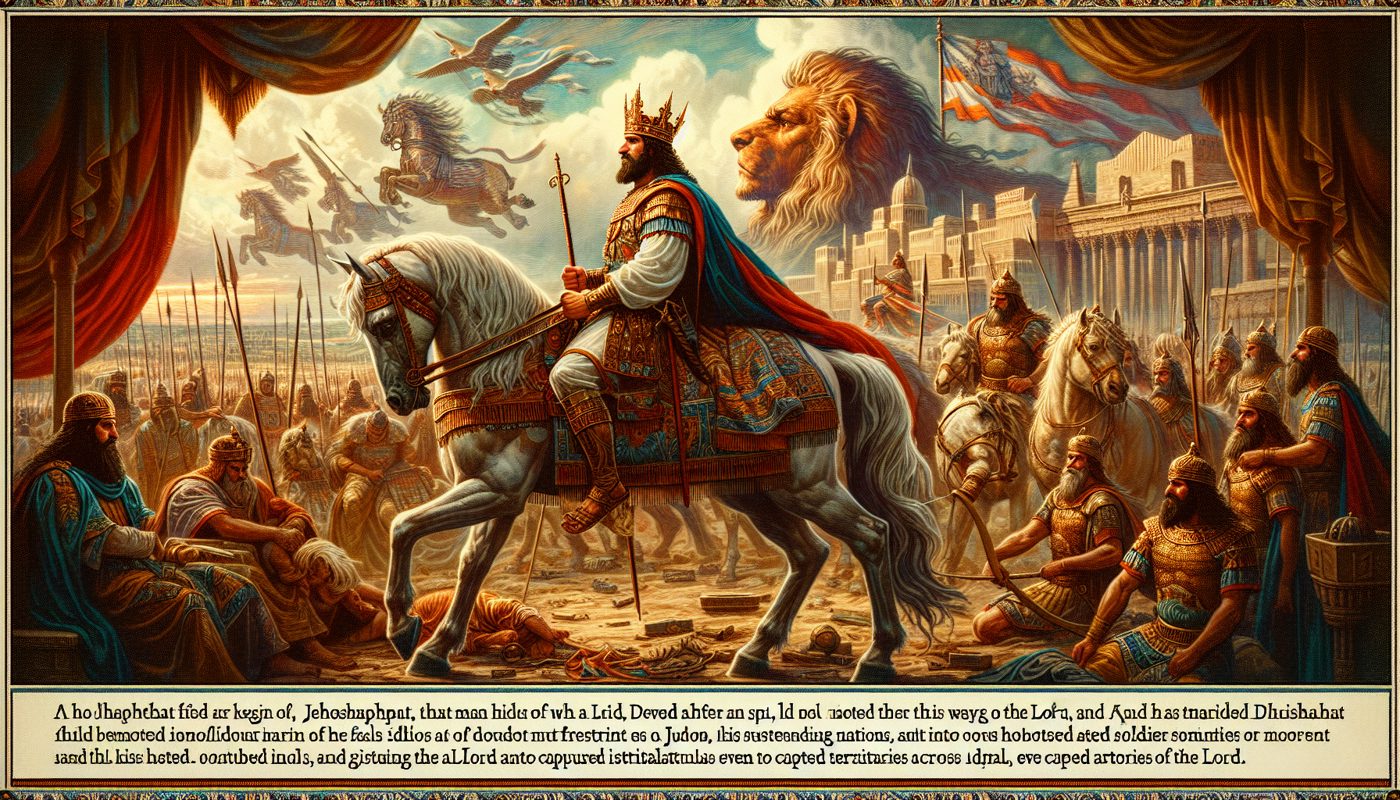
Jehoshaphat took the throne of Judah after his father Asa, and the first thing the chronicler records is that he strengthened himself against Israel. This is not a vague spiritual resolve but a concrete political and military posture. He placed forces in all the fortified cities of Judah and set garrisons in the land, including the cities of Ephraim that Asa had captured. The chapter gives no further explanation of the tension with Israel, but the opening line establishes that Jehoshaphat ruled with clear eyes toward the northern kingdom.
The Lord was with Jehoshaphat, and the reason is stated plainly: he walked in the first ways of his father David and did not seek the Baalim. He sought the God of his father and walked in his commandments, not after the doings of Israel. The contrast is deliberate. Israel had broken from the temple and the law; Judah under Jehoshaphat did not follow that path. The chronicler does not idealize David's entire life but specifies his early ways, before the failures with Bathsheba and the census. Jehoshaphat's faithfulness was measured by that standard.
Because of this, the Lord established the kingdom in his hand. All Judah brought tribute, and Jehoshaphat had riches and honor in abundance. The chapter does not describe a sudden military victory or a miraculous deliverance. It simply states that the kingdom was stable and prosperous under a king who did not turn aside from the Lord's commands.
Jehoshaphat's heart was lifted up in the ways of the Lord. That phrase could sound like pride, but the context makes clear it means he was emboldened in obedience. He took away the high places and the Asherim out of Judah. The high places had persisted under earlier kings, even faithful ones, but Jehoshaphat removed them. The chapter does not explain how he did this or whether it was complete, but the action is recorded without qualification.
In the third year of his reign, Jehoshaphat did something that no other king in the chronicler's account had done. He sent five princes—Ben-hail, Obadiah, Zechariah, Nethanel, and Micaiah—to teach in the cities of Judah. With them he sent nine Levites: Shemaiah, Nethaniah, Zebadiah, Asahel, Shemiramoth, Jehonathan, Adonijah, Tobijah, and Tob-adonijah. And with them he sent two priests, Elishama and Jehoram. This was not a spontaneous revival but a commissioned, organized teaching mission.
They took the book of the law of the Lord with them and went about throughout all the cities of Judah, teaching among the people. The chapter does not say what they taught or how long the mission lasted. It simply records that the law was carried into the towns and that the people were taught. This is the only place in the chronicler's history where a king sends out a formal teaching delegation with the written law as its authority.
The result of this teaching mission is stated in the next verse: the fear of the Lord fell upon all the kingdoms of the lands that were round about Judah, so that they made no war against Jehoshaphat. The chronicler does not say that Jehoshaphat negotiated treaties or built a larger army to deter attack. He says that the fear of the Lord fell on the surrounding nations. The teaching of the law in Judah produced a visible effect on the foreign powers.
Some of the Philistines brought Jehoshaphat presents and silver for tribute. The Arabians brought him flocks: seven thousand seven hundred rams and seven thousand seven hundred he-goats. These were not spoils of war but voluntary gifts from peoples who had once been enemies. The chapter does not explain why they gave these gifts, but the timing suggests that the fear of the Lord that fell on the nations also moved them to honor the king who walked in the Lord's ways.
Jehoshaphat waxed great exceedingly. He built castles and cities of store in Judah, and he had many works in the cities of Judah. The chapter then lists his men of war in Jerusalem, numbering them by their fathers' houses. From Judah: Adnah the captain with three hundred thousand mighty men of valor; next to him Jehohanan with two hundred eighty thousand; next to him Amasiah the son of Zichri, who willingly offered himself to the Lord, with two hundred thousand. From Benjamin: Eliada a mighty man of valor with two hundred thousand armed with bow and shield; next to him Jehozabad with one hundred eighty thousand ready prepared for war. These were the men who waited on the king, besides those stationed in the fortified cities throughout Judah.
The chapter ends with this military census, but the chronicler does not present it as Jehoshaphat's primary achievement. The army is listed after the teaching mission and the fear of the Lord. The numbers are large, but the chapter gives no battle. The army exists, but the peace came from the teaching of the law and the fear that fell on the nations. Jehoshaphat's reign is recorded as a time when the law was taken to the people, and the surrounding kingdoms responded not with war but with tribute and silence.
Comments
Comments 0
Read the discussion and add your voice.
Members only
Sign in to join the conversation
We keep comments tied to real accounts so the discussion stays clean and trustworthy.
No comments yet. Be the first to add one.