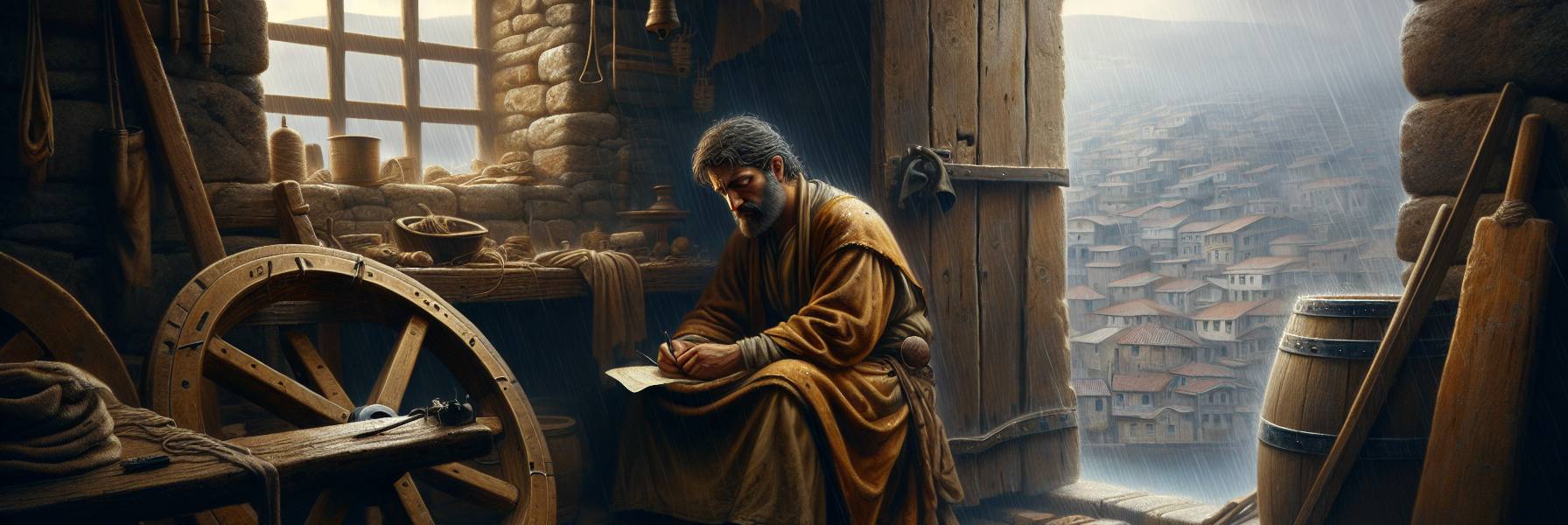

The rain had finally stopped, but the dampness clung to the stones of Thessalonica like a chill memory. Demas wiped his hands on his leather apron, the grit of the day’s work—mending a cracked cartwheel—etched deep into his knuckles. The shop was quiet now, the usual afternoon bustle muted by the lingering drizzle outside. His mind, however, was anything but quiet.
It had been weeks since the letter from Paul arrived. Words on parchment, passed from hand to calloused hand, read aloud in the dim lamplight of Jason’s house until the syllables wore grooves in their hearts. *We ought always to give thanks to God for you, brothers…* Demas leaned against the doorframe, watching the grey light settle over the city. Thanks. It was a hard word to feel some days.
His own brother, Silas, was in the back, his breath still coming in a shallow, painful rhythm from the beating he took near the agora. He’d only been speaking with a wool merchant from Corinth, a man with tired eyes who’d asked about this “new way.” The mob hadn’t cared for distinctions. They saw a Jew speaking with intensity about a crucified Messiah and decided it was a threat to good order, to the peace of Rome and the local gods. The magistrate had looked the other way, as he often did.
Demas felt the old, familiar heat rise in his chest—not the cleansing fire of prophecy, but the slow-burning coal of injustice. He wanted to break something. He wanted to stand in the agora himself and shout until the walls shook. But he was just a wheelwright. And he was tired.
He remembered the rest of Paul’s words, the part that had tangled in his spirit like a knotted rope. *God considers it just to repay with affliction those who afflict you, and to grant relief to you who are afflicted…* When? The question hung in the damp air, unspoken but palpable. Silas’s bruises were a deep, angry purple. Where was the justice in that?
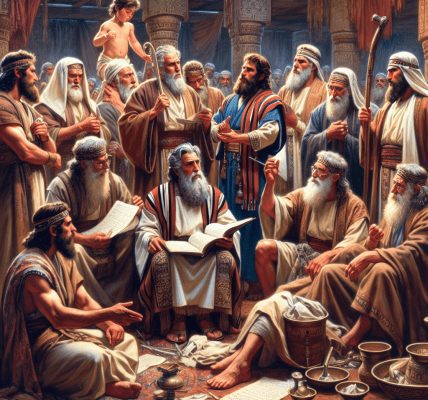
Later that evening, the small group gathered again, not at Jason’s—it was being watched—but in the storage room above Lydia’s dye works. The smell of madder root and wet wool filled the space. The scroll was unrolled once more, this time by old Miriam, her voice thin but steady as a plumb line.
“…*when the Lord Jesus is revealed from heaven with his mighty angels in flaming fire,*” she read, her finger tracing the Greek letters. Demas closed his eyes. He tried to picture it, to push past the daily grind of fear and weariness. Flaming fire. Not the mean, sputtering torch of a night watchman, but a consuming fire that would not, could not, be ignored. A revelation. An unveiling.
Miriam continued, her tone dropping, not with fear, but with a terrible gravity. “*…inflicting vengeance on those who do not know God and on those who do not obey the gospel of our Lord Jesus.*”
A silence fell, broken only by the drip of water from the roof into a clay pot. Demas thought of the men who had beaten Silas. Not as monsters, but as men—the burly fuller who drank too much, the magistrate’s assistant who was proud of his clean toga, the idol-maker whose shop was down the hill. Men who did not know. Their ignorance suddenly seemed to Demas a vast, dark ocean, and the thought of that fiery judgment falling upon it was less a thrill of vindication and more a shudder of awe. It was a dreadful thing. A cosmic righting of scales so absolute it stole his breath.
“What does it mean, ‘do not obey the gospel’?” asked young Phoebe, her face pale. “They have heard it. Some of them have heard us.”
It was Jason who spoke, his hands spread, palms up, as if weighing something. “To hear a song is not to sing it,” he said slowly. “To see a door is not to walk through it. The gospel is a king’s decree. It is news of a coronation. To ignore it, to shrug, to prefer the little kingdoms of our own making… that is the disobedience. It is to choose the shadow when the sun has risen.”
Demas felt the knot in his spirit begin to loosen, not into simplicity, but into a sober, sturdy truth. The fire was not merely punishment; it was the inevitable consequence of a world colliding with its true King. The relief for them—the *rest* Paul wrote of—was not simply the end of persecution. It was the final, definitive arrival of a homeland they had been seeking in their hearts all along.
The letter’s end settled over them: *To this end we always pray for you, that our God may make you worthy of his calling…* Worthy. Not a badge of merit, but a fitness, like a tool worn smooth to its purpose. Demas looked at his own hands, scarred and strong from shaping wood to fit a hub. This was the calling: to endure, to love, to hope, even here, even now, with Silas wounded in the back room and the world’s indifference pressing in. Their steadfastness was not a cause for pride, but evidence of a life being fitted for a different world.
He walked home through the darkened streets, the city sounds familiar and foreign. The ache was still there. Silas would still hurt in the morning. The magistrate would still be corrupt. But the texture of the night felt different. The injustices were real, agonizingly real, but they were not the final word. They were, he realized with a clarity that was both sharp and comforting, evidence that the final word had not yet been spoken. And when it was, it would be spoken in fire, in justice, in a relief so profound it would make the present struggle seem like a single, fading watch in the long, dawning day of the Lord.
He pushed open his door. The lamp was low. He would sit with Silas awhile. They would talk, perhaps, or sit in silence. They would wait. But it was a waiting filled with a terrible and glorious certainty, a waiting that was itself a kind of prayer, shaped on the anvil of a promise that would not—could not—break.