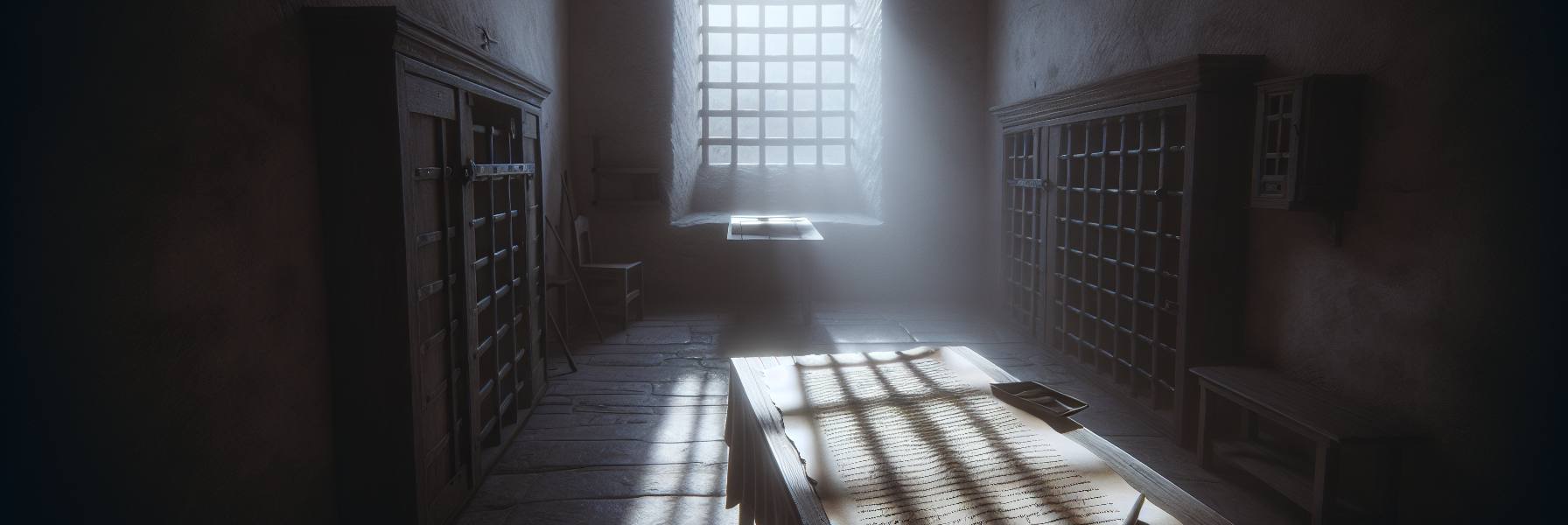

The grey light, thin and cool as water, seeped through the small, high window of my cell. It was the hour before the city of Corinth would truly wake, before the clatter of carts and the cries of hawkers would rise from the street below. On the table before me, a sheet of parchment lay half-filled, the ink still dark. My hand ached, a dull throb in the joints from the night’s labour. But the deeper ache was elsewhere, a familiar, grinding weight in the centre of my being.
I had been writing to them, to the believers in Rome, of grace, of freedom, of life in the Spirit. The words had flowed, borne on a tide of remembered Damascus light. But then… then the shadow had fallen across the page. The argument demanded it. To speak of the sweetness of the gift, one must first describe the bitterness of the bondage. And to do that, I had to go back. Not to Damascus, but further. To the boy I was, before the light.
I pushed back from the table, the stool legs scraping on the stone. The memory was not a picture, but a sensation: the clean, sharp lines of the Law. As a young man, a Pharisee of Pharisees, I had loved those lines. They were like the walls of a well-tended garden, defining the path, marking out the holy from the profane. *You shall not covet.* A simple command. A boundary. I had stood inside that boundary, or so I believed, and looked upon the world outside with a certain pity. The Law was a mirror that showed me a righteous form. I saw the shape of a blameless man, and I took it for my own reflection.
A dry fig from a bowl on the ledge caught my eye. I picked it up, rolling its rough skin between my fingers. The Law was like that once. A good thing. A gift. It told the truth about God’s character. But it could only tell the truth about *my* character if I truly looked. And for years, I did not look. I read the commandment, “You shall not covet,” and I heard only a rule to be obeyed, not a diagnosis to be feared. Coveting? That was for the Gentiles, for the man who lusted after his neighbour’s wife or schemed for his field. My desires were ordered, my ambitions sanctified. Zeal for God’s house consumed me. I did not see the rot within the fruit.
Then came the truer light. Not on the road, but in the quiet afterwards, in the long, stumbling years of learning what it meant to be an apostle of the very grace I had sought to destroy. And in that light, the commandment shifted. It was no longer a distant wall, but a searchlight held to the interior of my soul. “You shall not covet.” And suddenly, I saw covetousness everywhere. Not in gross, actionable sins, but in the very sinews of my will. I desired the approval of the very Jerusalem brothers who mistrusted me. I coveted a smooth passage for my journeys, chafing at the shipwrecks and the bandits. I even, God forgive me, coveted the spiritual victories of others, feeling a pang that was not purely joy when Apollos’s eloquence won converts in Ephesus. The commandment, good in itself, became the occasion for my undoing. It did not cause the sin, but it exposed it, like a bright sun revealing every crack in a jar of cheap clay.
I sat again, the fig still in my hand. The ink on the parchment seemed to pulse. How to explain this? It was not the experience of a man living in rank rebellion. It was the more profound, more terrifying experience of a man who wills one thing with his mind, and finds another power at work in his members. I dipped the reed pen.
*I do not understand my own actions,* I wrote, the letters forming slowly, carefully. *For I do not do what I want, but I do the very thing I hate.* That was the heart of it. The midnight argument with oneself. The resolution made in prayer at dawn, broken by noon in a flash of pride or a simmer of resentment. The self that agreed with the Law, that delighted in it in my inmost being, was at war with a different law—the law of sin that dwelled in me like a squatter in a rented house.
A memory surfaced, unbidden: my nephew, years ago in Jerusalem, trying to walk straight along a narrow wall. He would fix his eyes on the end, his little body tense with determination. But then a bird would flit past, or a sound would startle him, and his feet would betray him, wobbling, splaying, until he tumbled into the dust. He would get up, tears of frustration in his eyes, and cry, “But I *meant* to walk straight!” That was it. That was the wretchedness. The knowing, the willing, the approving… and the falling.
My words grew more desperate on the page, a cascade of confession. *For I know that nothing good dwells in me, that is, in my flesh. For I have the desire to do what is right, but not the ability to carry it out.* It was a shocking admission. A scandal to my old Pharisee self. But it was the necessary, awful truth. The Law was spiritual. It pointed to a life animated by God’s own breath. But I was *of the flesh*, sold under sin. The “I” that wanted the good was real. The “I” that did the evil was also real. They coexisted in a single, fractured person.
I put the pen down, my fingers stained. The room was lighter now. From the street came the first sounds of life: a door creaking, a bucket clanging against a well-stone. The world was going about its business, oblivious to the civil war being described in this small room. A weary smile touched my lips. This was the human condition under the Law. A beautiful, holy standard, held up before a captive will. It was like showing a detailed map of a lush, free country to a prisoner in chains. The map was true, but it only deepened the misery of the cell.
I reached the final cry. It was not a rhetorical flourish. It was the dry, cracked whisper of my own spirit, drawn from a thousand private defeats. *Wretched man that I am! Who will deliver me from this body of death?*
I let the question hang in the quiet air, a raw and unfinished thing. For a long moment, I simply sat in the wretchedness. There was no shortcut. To know the deliverance, one must first feel the depth of the captivity. The narrative had to pause here, in the valley, with the chains felt and the self pronounced bankrupt.
Then, and only then, I took up the pen a final time. The answer was not a theory. It was a person. It was the one who had met me on the road, who had taken the sentence of the Law I could not fulfil upon himself, and who had broken the power of the squatter within. The story of Romans 7 was the long, dark preface. The next words would be the first line of a new chapter.
But for now, the parchment before me held only the honest, aching testimony of the struggle. It was a story written not in the ink of academic theology, but with the tears of lived experience. I left it there, the confession complete, waiting for the dawn to fully break and for the next sentence—the sentence of grace—to begin. Outside, a sparrow landed on the windowsill, tilting its head, then flew away into the widening light.