**The Story of Joseph and His Brothers**
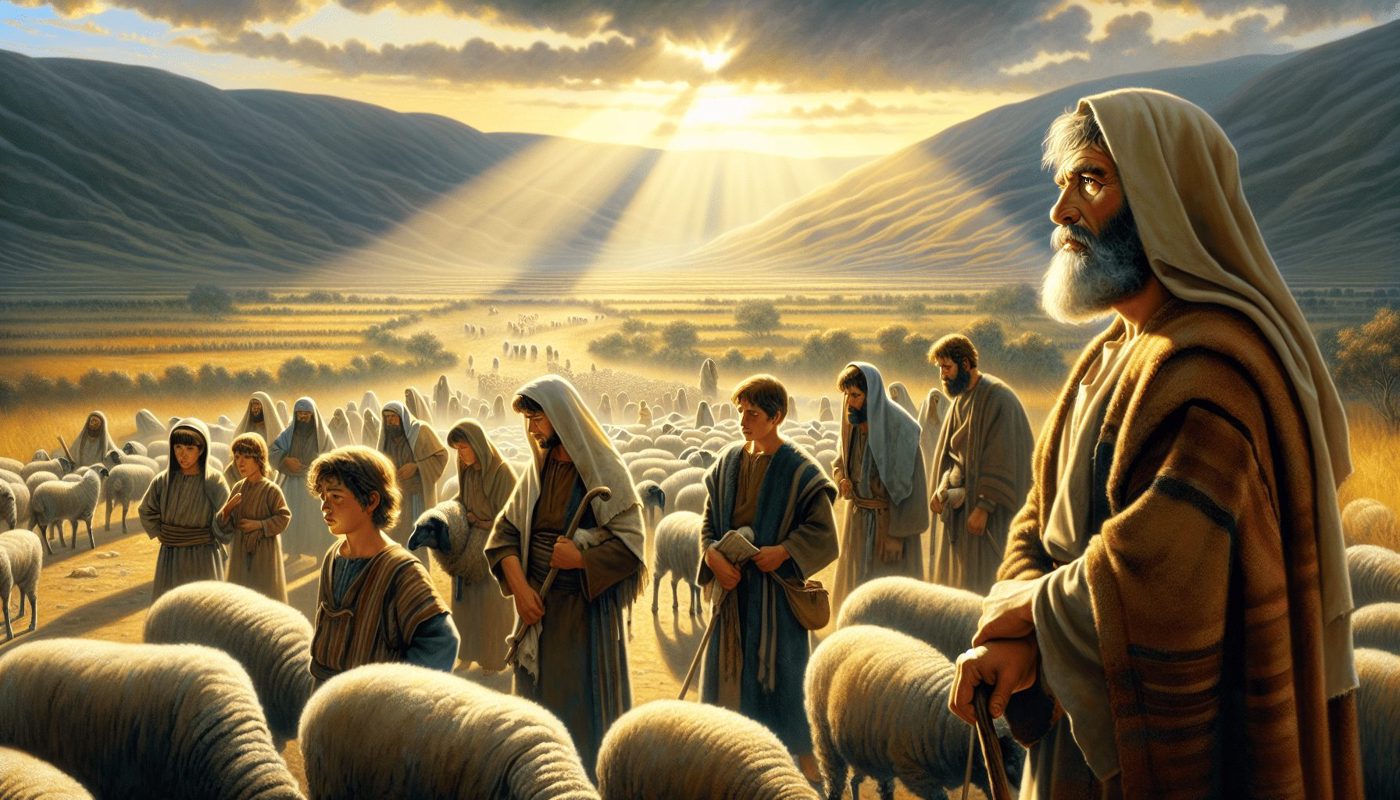
In the land of Canaan, where the sun rose over rolling hills and the earth bore the promise of God’s covenant, there lived a man named Jacob. He was a man of great faith, the son of Isaac and grandson of Abraham, and he dwelt in the land where his father and grandfather had sojourned. Jacob had twelve sons, but among them, one was especially dear to his heart—Joseph, the firstborn of his beloved wife Rachel. Joseph was seventeen years old, and he tended the flocks with his brothers, the sons of Bilhah and Zilpah, his father’s other wives. But Joseph was different. He carried a light within him, a spark of destiny that set him apart.
One day, as the sun dipped low on the horizon, casting long shadows across the fields, Joseph returned from the pastures. His father, Jacob, called him aside and presented him with a gift—a robe of many colors, woven with intricate patterns and dyed in vibrant hues. It was a garment fit for a prince, a symbol of Jacob’s deep affection for his son. When Joseph put it on, the fabric shimmered in the sunlight, and his brothers could not help but notice. Their eyes narrowed, and their hearts burned with jealousy. "Why does he receive such honor?" they muttered among themselves. "Are we not also our father’s sons?"
But the robe was only the beginning. Joseph began to have dreams, vivid and mysterious, that he could not keep to himself. One night, as the stars glittered like diamonds in the heavens, Joseph dreamed that he and his brothers were binding sheaves of grain in the field. Suddenly, his sheaf rose and stood upright, while his brothers’ sheaves gathered around it and bowed low. When Joseph awoke, he felt compelled to share the dream. "Listen to this dream I had," he said to his brothers the next morning. Their faces darkened as he spoke, and their resentment grew. "Do you mean to reign over us? Will you indeed rule over us?" they sneered. Yet Joseph, young and earnest, did not understand the depth of their bitterness.
Not long after, Joseph had another dream. This time, the sun, moon, and eleven stars bowed down to him. Even his father, Jacob, was taken aback when Joseph recounted the dream. "What is this dream you have had?" Jacob asked, his voice tinged with both wonder and concern. "Will your mother and I and your brothers actually come and bow down to the ground before you?" Though Jacob pondered the meaning of the dream, Joseph’s brothers could not contain their envy. They whispered among themselves, their hearts hardening against him.
One day, Jacob called Joseph to him. "Your brothers are tending the flocks near Shechem," he said. "Go and see if all is well with them and the flocks, and bring word back to me." Joseph, ever obedient, set out on the journey. He wore his colorful robe, a beacon of his father’s love, as he traveled through the valleys and hills. When he arrived at Shechem, he learned that his brothers had moved on to Dothan. Undeterred, Joseph continued his search.
From a distance, his brothers saw him approaching. The sight of his robe, fluttering in the breeze, ignited their anger. "Here comes the dreamer!" they said with scorn. "Come now, let’s kill him and throw him into one of these cisterns. We can say that a ferocious animal devoured him. Then we’ll see what becomes of his dreams." But Reuben, the eldest, intervened. "Let’s not take his life," he urged. "Throw him into this cistern here in the wilderness, but don’t lay a hand on him." Reuben’s intention was to rescue Joseph later and return him to their father.
When Joseph reached them, his brothers seized him and stripped him of his robe. They threw him into the empty cistern, its walls cold and unyielding. Joseph cried out, but his pleas fell on deaf ears. As he sat in the darkness, his brothers sat down to eat, their hearts hardened against him. Suddenly, they saw a caravan of Ishmaelites approaching, their camels laden with spices, balm, and myrrh, on their way to Egypt. Judah, another of Joseph’s brothers, saw an opportunity. "What will we gain if we kill our brother and cover up his blood?" he asked. "Come, let’s sell him to the Ishmaelites. After all, he is our brother, our own flesh and blood." The others agreed, and they pulled Joseph from the cistern.
They sold him for twenty shekels of silver, and the Ishmaelites took him away, bound and bewildered, toward the land of Egypt. Reuben, who had been absent during the transaction, returned to the cistern and found it empty. He tore his clothes in anguish. "The boy is gone!" he cried. "What shall I do now?" Desperate, the brothers took Joseph’s robe, dipped it in the blood of a goat, and brought it to their father. "We found this," they said. "See if it is your son’s robe."
Jacob recognized it immediately. His heart shattered as he cried out, "It is my son’s robe! A ferocious animal has devoured him. Joseph has surely been torn to pieces!" He tore his clothes, put on sackcloth, and mourned for many days. His children tried to comfort him, but he refused to be consoled. "I will go down to the grave mourning for my son," he said.
Meanwhile, Joseph was carried to Egypt, where he was sold to Potiphar, an officer of Pharaoh and captain of the guard. Though his circumstances had changed dramatically, Joseph’s faith in God remained steadfast. Little did he know that this was only the beginning of a journey that would fulfill the dreams he had so boldly shared. For God was with Joseph, and His plans were far greater than anyone could imagine.
Thus, the story of Joseph began—a tale of betrayal, resilience, and divine providence, woven into the fabric of God’s redemptive story for His people.
Comments
Comments 0
Read the discussion and add your voice.
Members only
Sign in to join the conversation
We keep comments tied to real accounts so the discussion stays clean and trustworthy.
No comments yet. Be the first to add one.