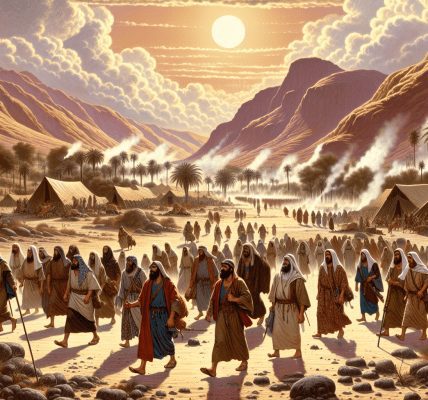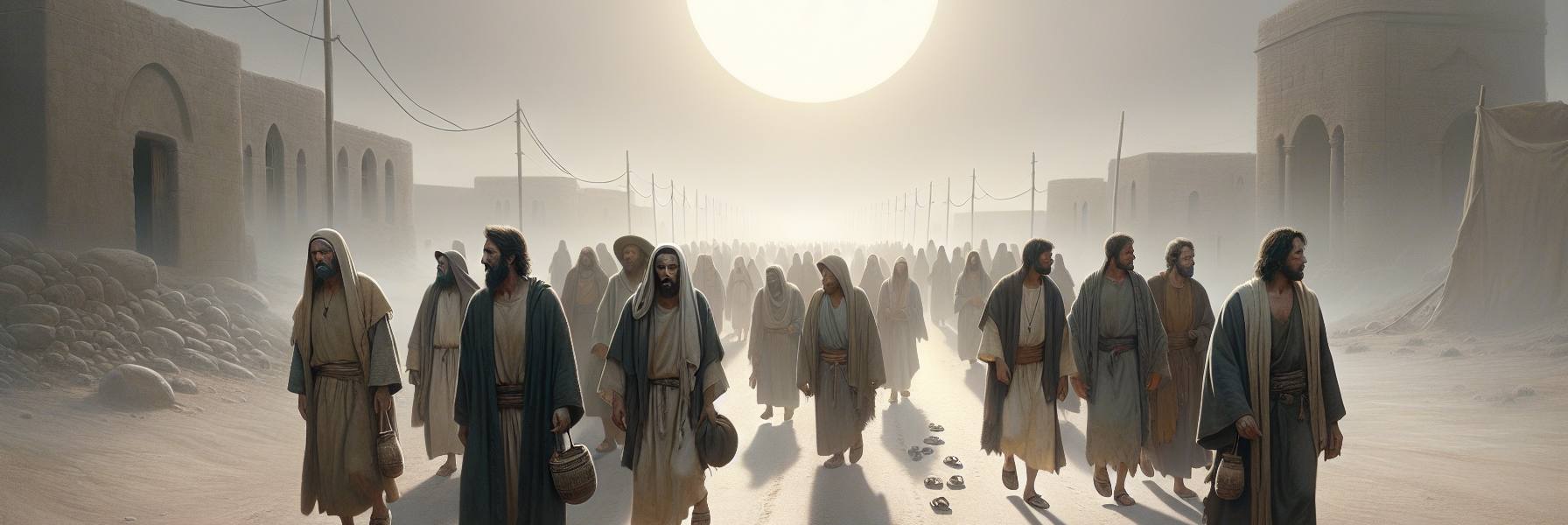

The sun hung heavy over the road to Jericho, a white coin burning in a bleached sky. Dust, fine as ground meal, coated the sandals of the men walking with Jesus. It was the kind of heat that made thought slow and patience short. Among the disciples, a restlessness had been growing, a whispered anxiety about provisions, about the common purse Judas carried. It was into this thick air that Jesus began to speak, not with a prophet’s thunder, but with the casual ease of a man recalling a local scandal.
“There was a rich man,” he said, his voice cutting through the drone of cicadas, “who employed a manager. And word came to him, a murmur through the grapevines of the marketplace, that this manager was squandering his estate.”
He paused, letting them picture it: a great estate, olive groves and grain stores, the manager a man of trusted position now grown careless, or perhaps cunning. The rich man summoned him. ‘What is this I hear about you? Prepare a full accounting of your management. You cannot be my manager any longer.’
Jesus described the manager walking away, the weight of dismissal on his shoulders. He wouldn’t last as a laborer, his soft hands unfit for digging. Begging would be a shame he couldn’t bear. Then, a light sparked in his eyes—a shrewd, desperate light.
“So the manager said to himself, ‘What shall I do? I know. I will ensure that when I am removed from management, people will welcome me into their homes.’”
He called in his master’s debtors, one by one. To the first, a man who owed a hundred *baths* of olive oil, he said, ‘Take your bill, sit down quickly, and write fifty.’ To another, who owed a hundred *kors* of wheat, ‘Take your bill and write eighty.’
Jesus let the figures hang in the air. A staggering reduction. A blatant fraud, yet performed with such audacious speed. The disciples exchanged glances. This was not a hero from the psalms.
“And the master,” Jesus continued, a wry, almost reluctant admiration in his tone, “commended the dishonest manager for his shrewdness. For the sons of this age are more shrewd in dealing with their own generation than the sons of light.”
He leaned forward then, the dust swirling around his feet. “And I tell you, make friends for yourselves by means of unrighteous wealth, so that when it fails, they may welcome you into the eternal dwellings.”
The lesson was jarring, like a sudden cold spring in the desert heat. He wasn’t praising the fraud, but the relentless, focused intelligence of it. A child of the world, facing a crisis, used every resource at his disposal to secure his future. Do the children of light, facing an eternal horizon, act with even half such urgency?
“One who is faithful in very little,” Jesus said, his gaze resting on each of them, “is faithful also in much. And one who is dishonest in very little is dishonest also in much. If you have not been faithful with the unrighteous wealth, who will entrust to you the true riches? And if you have not been faithful with what belongs to another, who will give you what is your own?”
He spoke of divided loyalties, a stark, impossible choice. “No servant can serve two masters. He will either hate the one and love the other, or be devoted to one and despise the other. You cannot serve God and wealth.”
The Pharisees, who had been listening with a veneer of detached interest, snorted at this. They were lovers of money, Luke tells us. They ridiculed him. Jesus turned to them, and his voice, which had been teaching, now took on the edge of a scalpel.
“You are those who justify yourselves before men,” he said, “but God knows your hearts. For what is exalted among men is an abomination in the sight of God.”
He reminded them of the Law and the Prophets, of a covenant that still stood. But then he spoke of a change, a pressing in of a new reality. “The gospel of the kingdom of God is preached, and everyone is forcing his way into it.”
It was as if the conversation had reached a precipice. The talk of money, faithfulness, and the law coalesced into something darker, more final. And perhaps seeing the smug, immutable contempt on the faces of the Pharisees, he told them another story. This one had no wry manager, no lesson on shrewdness. It was a story of two deaths.
“There was a rich man,” he began again, but the tone was now funereal, “who was clothed in purple and fine linen and who feasted sumptuously every day.”
The image was vivid, oppressive in its luxury: the purple dye worth a fortune, the linen cool against the skin, the daily banquet not an occasion but a routine.
“And at his gate was laid a poor man named Lazarus, covered with sores, who desired to be fed with what fell from the rich man’s table. Moreover, even the dogs came and licked his sores.”
The contrast was absolute. Gate separated opulence from agony. Lazarus didn’t beg; he merely desired the crumbs, the scraps brushed from the rich man’s table. His only attendants were stray dogs, showing a pity the rich man withheld.
Jesus then described their deaths with brutal economy. “The poor man died and was carried by the angels to Abraham’s side.” No burial was mentioned for Lazarus; his body was likely tossed into the potter’s field. But his soul was escorted by heavenly beings to the place of highest honor, reclining next to the father of the faith.
“The rich man also died and was buried.” His funeral would have been a spectacle, a procession of mourners. But his soul? “In Hades, being in torment, he lifted up his eyes and saw Abraham far off and Lazarus at his side.”
The great chasm of life had become a literal, fixed chasm in death. The rich man, in anguish, called out. ‘Father Abraham, have mercy on me, and send Lazarus to dip the tip of his finger in water and cool my tongue, for I am in anguish in this flame.’
The detail was harrowing. A single drop of water. The man who ignored a starving body at his gate now begs for the slightest relief for his own tongue. Abraham’s reply was gentle but unyielding. ‘Child, remember that you in your lifetime received your good things, and Lazarus in like manner bad things. But now he is comforted here, and you are in anguish. Besides all this, between us and you a great chasm has been fixed, so that those who might want to pass from here to you cannot, nor may anyone cross from there to us.’
The rich man’s thoughts, even in torment, turned not to repentance, but to his own living brothers. ‘Then I beg you, father, to send him to my father’s house—for I have five brothers—so that he may warn them, lest they also come into this place of torment.’
It was a plea for a sign, for a miraculous messenger from the dead to scare them straight. Abraham’s final words hung in the silent, heat-stricken air. ‘They have Moses and the Prophets; let them hear them.’
But the rich man persisted, a last echo of his earthly arrogance. ‘No, father Abraham, but if someone goes to them from the dead, they will repent.’
Abraham’s conclusion was the last word, and Jesus let it fall like a stone. ‘If they do not hear Moses and the Prophets, neither will they be convinced if someone should rise from the dead.’
The story ended. The road stretched on, dusty and quiet. The disciples walked, the images seared into their minds: the shrewd, desperate manager rewriting ledgers in the fading light, and the rich man in purple, forever separated from a drop of water by the choices of a lifetime. Two tales about money, about seeing what is truly before you, about the terrifying finality of the path we walk while we still have light to walk by. The lessons were not neat. They were unsettling, urgent, and as layered as the human heart itself. They simply walked on, the weight of the words settling deep, with no easy moral to wrap them in.