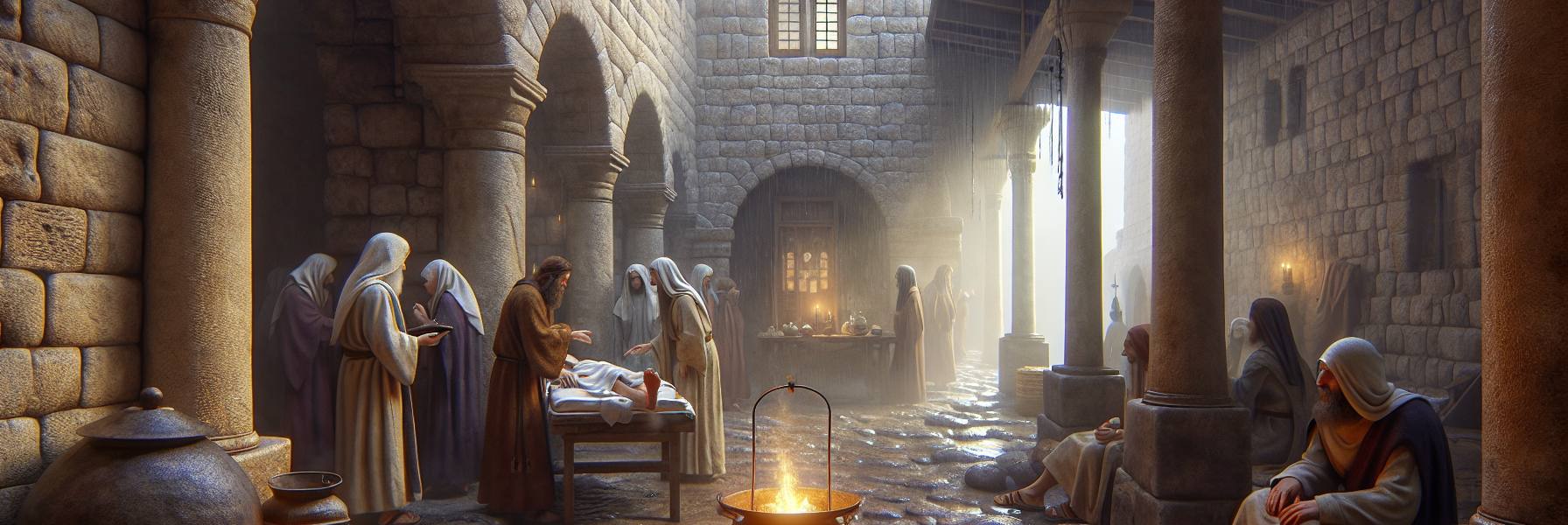

The rain had finally stopped, but the damp clung to everything in Jerusalem. It seeped into the stones of my house, a chill that no brazier could fully dispel. My illness was a quiet, persistent thing—a fever that came and went, a weakness in my limbs that made the simplest journey from bed to chair a monumental effort. The physician had shaken his head, muttered about humors and bile, and left a bitter tincture that did little but sour my stomach.
I was, as the saying goes, brought low.
In the first days, they came. Friends, or men I called friends. Their sandals slapped the courtyard stones, their voices boomed with false heartiness before they remembered to lower them to a respectful hush at my chamber door. They brought words, mostly. “The Lord sustain you,” Eliab from the olive press would say, his eyes already wandering to the window, to the business of the day waiting for him. “He will deliver you,” intoned Simeon the Levite, but his delivery was rote, a line from a scroll. Their visits were short, their condolences like thin broth—sustaining for a moment, then gone, leaving a deeper hunger.
I began to hear the whispers, not in my room, but carried on the damp air from the courtyard, or reported by my young servant, Reuven, whose face would flush with anger.
“They say it is a judgment,” Reuven spat one evening, arranging my blankets with rough, tender hands. “They say your suffering is proof of some hidden fault, some secret sin the Lord is punishing.”
I closed my eyes. The words found the cracks in my spirit, the very doubts that fever breeds. *Was* it? In the long, aching watches of the night, when my breath was shallow and the shadows grew tall, I turned my life over like a potter examining a cracked vessel. Had I failed the poor? Had my heart been proud? The psalm of confession rose to my lips, a mumbled, dry-throated prayer. “Have mercy on me, Lord; heal me, for I have sinned against you.”
But it was the third kind of visitor that carved the deepest wound. Ahithophel. My counselor. The man whose wisdom had been a cool spring in the desert of kingship, whose advice I had trusted as my own thought. He came less often now. And when he did, he did not speak of my healing. He spoke of contingency. Of the stability of the kingdom. Of prudent plans should my strength not return. His words were polished, reasonable, and colder than the Jerusalem stone. He would sit, his posture perfect, and analyze my ruin as if it were a tactical problem. The concern in his eyes was for the throne, not for the man upon it.
Then came the day Reuven did not return from the market with the barley cakes. He came in empty-handed, his tunic torn, a bruise flowering on his cheek. His eyes held a tears of pure fury.
“He was there,” Reuven whispered, his voice trembling. “In the lower market, by the gate. Ahithophel. He was speaking with a group of men… men from the north, with hard faces. He saw me. He didn’t look away. He just… smiled that thin smile of his and went on talking. One of his men shoved me into the gutter when I tried to listen.”
The betrayal was no longer a cold shadow in my sickroom; it had flesh and a smile. The very man who ate my bread, who had broken olives from my dish, was now lifting his heel against me. The image was visceral, brutal: the careful, crushing weight of a heel poised to grind down. My spirit, already frail, crumpled under this new weight. This was more than political maneuvering. This was a personal desecration.
That night was the darkest. The fever spiked, and in its delirium, the whispers became shouts. *Judgment. Failure. The end.* I felt like a discarded wineskin, trampled in the dust of the city street. My prayer was no longer for healing, but simply for an end to the shame, for the earth to swallow me before I had to see the triumph in Ahithophel’s eyes.
But just before dawn, as the blackness outside my window began to soften to charcoal, a different memory surfaced. Not of my own righteousness, but of a moment long past. A year of famine. A family from Bethlehem, hollow-eyed and desperate, at the city gates. I had not just given them alms from a distance. I had brought them to my own table. I saw the mother’s face again, the shock of simple kindness, the way her hands shook as she held the bread. I had made her a promise, a small one, to speak to the overseer of the granaries about her kinsmen. I had kept it. It was a small thing, a single stitch in the vast tapestry of need. I had not done it for remembrance, but because, in that moment, it was the only human thing to do.
And a verse from the Law, learned at my mother’s knee, floated up through the misery: “Blessed is he who considers the poor.”
It did not feel like a boast. It felt like a lifeline. A thread of truth in the tangled lie of my despair. The Lord had seen that moment. Not as a transaction, but as evidence of a heart He knew, a heart that, however flawed, had once bent toward kindness. My enemies—the careless friends, the whispering crowd, the betrayer—they saw only my present ruin and judged the whole of my life by it. But the Lord… the Lord considered. He weighed. He remembered the bread shared as well as the pride harbored.
A profound shift occurred, not in my body, which was still wracked with pain, but in the fortress of my self. The shame lost its power. The betrayal, though no less bitter, could no longer define me. My plea changed. “Lord, be gracious to me,” I murmured into the grey light. “Raise me up. Not for my vengeance, but so I may stand again. So I may look them in the eye, not with their triumph, but with the knowledge that You uphold me. That You set me in your presence, forever.”
I did not get well instantly. But the next morning, when Reuven brought a broth, I found I could hold the cup myself. My hand did not shake. A week later, I walked to the courtyard, leaning on his arm, and felt the sun, true and warm, on my face for the first time in months.
When I finally stood before the court again, thin and aged but upright, the silence was absolute. Ahithophel’s face was a study in frozen calculation. The smile was gone. I said nothing to him of his betrayal. There was no need. The mercy I had received was a wall between us, a fortress he could not scale. I had been shown my own small goodness, not as a trophy, but as a sign of a greater, sustaining Goodness. I had been low, lower than I thought possible. But I had not been abandoned.
Blessed is the one who considers the poor, I thought, looking out at the sea of faces. For in the day of trouble, the Lord considers him. He does not always deliver him *from* the trouble. But He delivers him *in* it. He turns the bed of sickness into a place of meeting. And the heel raised to crush is met, finally, not with the weakness of the crushed, but with the terrible, gentle strength of the upheld.